 JevCode
함수 호출
자연어 거래 요청을 함수 이름과 폐쇄 집합 인수를 신뢰도 인식 TypeSafe 질문으로 매핑하여 일반 입력형 함수 호출로 변환합니다.
이 문서는 en에서 기계 번역되었으며 교정되지 않았습니다. 빠른 참고용으로만 사용하세요.

“라지 아이드 오트 라테, 무가당”을 주문할 때 바리스타는 당신의 문장을 그대로 적지 않습니다. 컵 위에 네 가지 옵션에 체크를 합니다. 이 요리책은 거래 API에 대해 동일한 방식을 적용합니다: 문장이 들어가면, 함수 이름과 그 인자(평가된 열거형으로)가 신뢰도 각도로 함께 출력됩니다.
"plot rolling correlation between nvda and spy for the past month"
    rolling_correlation(symbol='NVDA', benchmark='SPY', window='1mo')   confidence 0.91

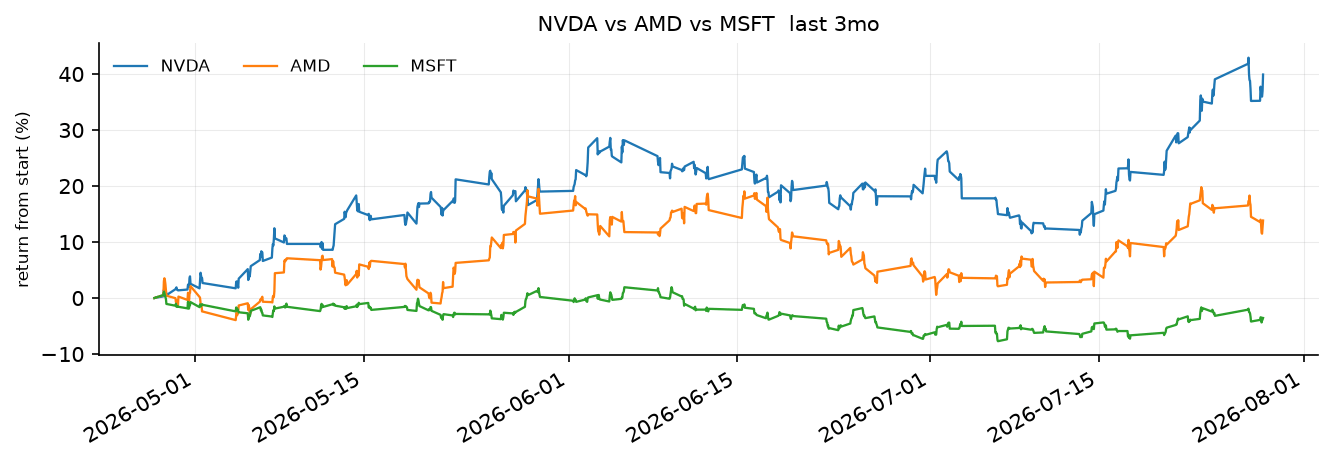
"compare nvda amd and msft over the past three months"
    compare_returns(symbols=['NVDA', 'AMD', 'MSFT'], window='3mo')      confidence 0.94

"show me apple daily with volume"
    plot_price(symbol='AAPL', resolution='1d', include_volume=True)     confidence 0.75

"what tickers do you have"
    list_symbols()                                                     confidence 1.00
그 호출들은 트레이딩 어시스턴트의 열 가지 일반 함수로 전달된다. 그들의 인수는 고정된 목록에서 값을 가져오므로, 이들은 이미 Literal이다:
def plot_price(
    symbol: Literal["SPY", "NVDA", "AMD", "AAPL", "MSFT", "TSLA"],
    style: Literal["line", "candles"] = "line",
    resolution: Literal["1m", "5m", "15m", "1h", "1d"] = "15m",
    window: Literal["1d", "1w", "1mo", "3mo"] = "1w",
    include_volume: bool = False,
    moving_average: Literal["9", "20", "50"] | None = None,
    log_scale: bool = False,
): ...
고정된 목록에서 값을 가져오는 인수는 닫힌 집합이다. 해당 목록에서 하나의 값을 선택하면, 정확히 그 값들에 대해 Choice 질문이 발생하므로 함수에 도달하는 값은 함수가 허용하는 값이다. 함수는 그대로 둔다. 당신이 추가하는 것은 각 인수가 무엇을 의미하는지를 평이한 언어로 명시하는 스펙이다. 최종적으로 당신은 자신의 함수를 가리킬 수 있는 Dispatcher을 갖게 된다.
설정
pip install ipython polars matplotlib numpy "typesafe-sdk>=0.5.7" cooksafe --extra-index-url https://pypi.typesafe.ai/Set TYPESAFE_API_KEY. 두 모듈이 이 파일 옆에 있습니다. trader.py에는 10개의 함수와 캐시에서 답변을 읽는 TypeSafe 클라이언트가 포함되어 있어, 다시 렌더링하면 API를 호출하지 않고도 아래 숫자를 재생합니다. dispatch.py에는 서명과 사양을 읽고 호출을 수행하는 코드가 포함되어 있습니다.
import json
from pathlib import Path

from cooksafe import make_playground_link
from dispatch import ROUTE, Dispatcher, closed_sets
from IPython.display import Markdown, display
from trader import TOOLS, client, load

TYPESAFE_MODEL = "jev-1.12"
print(f"{len(TOOLS)} functions over {load().height:,} one-minute bars")
10 functions over 156,780 one-minute bars시그니처에서 닫힌 집합을 찾으세요
타입 힌트는 이미 어떤 인수가 고정된 목록에서 오는지, 그리고 각 목록에 무엇이 있는지 명시하고 있습니다. closed_sets은 시그니처를 읽고 해당 인수를 세 가지 형태로 분류합니다: choice(목록 중 하나의 값, 즉 Literal), set(그 중 아무 수나, 즉 list[Literal[...]]), 또는 flag(켜짐 또는 꺼짐, 즉 bool). 모든 열 가지 함수는 trader.py에 정의되어 있습니다.
for name, fn in TOOLS.items():
    shapes = closed_sets(fn)
    print(
        f"  {name:<20}{len(shapes)}  "
        + ", ".join(f"{a}:{s}" for a, (s, _) in shapes.items())
    )
print(
    f"\n{sum(len(closed_sets(fn)) for fn in TOOLS.values())} fillable arguments in total"
)
list_symbols 0
market_summary 1 window:choice
plot_price 7 symbol:choice, style:choice, resolution:choice, window:choice, include_volume:flag, moving_average:choice, log_scale:flag
intraday_pattern 3 symbol:choice, window:choice, metric:choice
compare_returns 3 symbols:set, window:choice, normalize:flag
rolling_correlation 4 symbol:choice, benchmark:choice, window:choice, resolution:choice
summary_stats 2 symbol:choice, window:choice
volatility 3 symbol:choice, window:choice, annualized:flag
top_movers 2 window:choice, direction:choice
drawdown 3 symbol:choice, window:choice, plot:flag
28 fillable arguments in totaltop_movers은 제외되는 내용을 보여줍니다. 세 가지 인자 중 두 개는 닫힌 집합입니다. 세 번째 인자 limit는 int이므로 질문을 받지 않으며, 기본값인 3을 유지합니다. 자유 텍스트, 숫자 및 날짜도 동일한 방식으로 동작합니다: 질문이 없으며, 함수의 기본값이 적용됩니다.
스펙 작성
Literal는 "1mo"과 "3mo"라는 문자열을 제공합니다. 사용자가 “이번 분기”라고 입력하는 것이 두 번째 것을 의미한다는 말은 하지 않습니다. 그 부분은 명세에서 규정합니다. 이는 각 인수당 하나의 질문, 각 옵션당 한 줄, 각 함수당 하나의 설명, 그리고 함수 간 선택을 담당하는 하나의 추가 질문을 포함합니다. 이는 spec.json에 위치하며, LLM은 시그니처를 바탕으로 이를 작성해 줄 수 있습니다.
SPEC = json.loads(Path("spec.json").read_text())
for argument in ("style", "moving_average"):
    print(
        json.dumps(
            {argument: SPEC["functions"]["plot_price"]["arguments"][argument]}, indent=2
        )
    )
{
"style": {
"question": "Does the user want a plain line or candles?",
"stated": "Does the user say how the chart should be drawn, such as a line, candles, or OHLC bars?",
"options": {
"line": "a simple line through the closing prices",
"candles": "a candlestick or OHLC chart, showing each bar's open, high, low and close"
}
}
}
{
"moving_average": {
"question": "How many bars should the moving average cover - nine, twenty, or fifty?",
"stated": "Does the user ask for a moving average or a smoothed line over the candles?",
"options": {
"9": "a nine-bar moving average, a fast one",
"20": "a twenty-bar moving average",
"50": "a fifty-bar moving average, a slow one"
}
}
}옵션 키는 함수가 받는 문자열이므로, 나중에 레이블을 인수로 다시 매핑할 필요는 없습니다. stated는 인수를 선택적으로 만듭니다. 이는 해당 인수에 대해 명령이 전혀 언급하는지 여부를 묻는 두 번째 예/아니요 질문입니다. 답변이 아니오인 경우, 호출은 해당 인수를 생략하고 함수 자체의 기본값이 적용됩니다.
집합 인수는 각 구성원당 한 번씩 질문을 받으며, {}는 구성원 이름을 대신합니다. "Does the user want {} in the comparison?"는 각 티커당 하나의 질문이 됩니다.
아이디어에 대해 질문을 작성하세요. 사용자가 선택할 수 있는 단어 자체가 아니라, 의미에 기반한 매칭이 이루어지기 때문입니다. “is amd tracking nvidia lately”는 rolling_correlation에 도달하지만, tracking이나 lately는 spec.json 어디에도 나타나지 않습니다. 질문의 이름을 파라미터로 지정하지 마세요. "Which resolution?"는 명령어에 매칭할 대상이 없습니다.
명세를 질문으로 바꾸기
Dispatcher는 명세에서 질문을 한 번에 생성합니다. 각 명령어는 함수 선택과 모든 함수의 인수를 담은 하나의 요청이며, 디스패처는 선택된 함수의 답변만 읽습니다.
assistant = Dispatcher(SPEC, TOOLS, client)
print(f"{len(assistant.questions)} questions per command, among them:")
for qid in (
    "__tool__",
    "plot_price.style",
    "plot_price.style?",
    "compare_returns.symbols.NVDA",
):
    question = assistant.questions[qid]
    print(f"  {qid:<30}{question['type']:<8}{str(question['instructions'])[:64]}")
54 questions per command, among them:
__tool__ choice What is the user asking the trading assistant to do?
plot_price.style choice Does the user want a plain line or candles?
plot_price.style? noul Does the user say how the chart should be drawn, such as a line,
compare_returns.symbols.NVDA noul Does the user want NVDA in the comparison?14개 명령 실행
요청 한 줄에 하나의 요청이 할당되며, 그 confidence는 해당 호출 뒤에 있는 가장 불확실한 판단입니다.
COMMANDS = [
    "show nvda 1h",
    "plot rolling correlation between nvda and spy for the past month",
    "when during the day does nvda trade the most",
    "what moved today",
    "what tickers do you have",
    "how did the market do this week",
    "candles for tesla with a 20 period moving average",
    "compare nvda amd and msft over the past three months",
    "how volatile is tsla",
    "biggest losers today",
    "worst drawdown for nvda this quarter, and chart it please",
    "spy stats for the last month",
    "show me apple daily with volume",
    "is amd tracking nvidia lately",
]

CALLS = {command: assistant(command) for command in COMMANDS}
for command, call in CALLS.items():
    print(f'  "{command}"')
    print(
        f"      {str(call):<66}confidence {call.confidence:.2f}"
        f"   tool {call.tool.probability:.2f}"
    )
"show nvda 1h"
plot_price(symbol='NVDA', resolution='1h') confidence 0.78 tool 1.00
"plot rolling correlation between nvda and spy for the past month"
rolling_correlation(symbol='NVDA', benchmark='SPY', window='1mo') confidence 0.91 tool 1.00
"when during the day does nvda trade the most"
intraday_pattern(symbol='NVDA') confidence 0.53 tool 1.00
"what moved today"
top_movers(window='1d', direction='gainers') confidence 0.90 tool 0.90
"what tickers do you have"
list_symbols() confidence 1.00 tool 1.00
"how did the market do this week"
market_summary(window='1w') confidence 0.96 tool 0.99
"candles for tesla with a 20 period moving average"
plot_price(symbol='TSLA', style='candles', moving_average='20') confidence 0.69 tool 0.97
"compare nvda amd and msft over the past three months"
compare_returns(symbols=['NVDA', 'AMD', 'MSFT'], window='3mo') confidence 0.94 tool 1.00
"how volatile is tsla"
volatility(symbol='TSLA') confidence 0.96 tool 1.00
"biggest losers today"
top_movers(window='1d', direction='losers') confidence 0.98 tool 0.98
"worst drawdown for nvda this quarter, and chart it please"
drawdown(symbol='NVDA', window='3mo', plot=True) confidence 0.84 tool 0.84
"spy stats for the last month"
summary_stats(symbol='SPY', window='1mo') confidence 0.88 tool 0.88
"show me apple daily with volume"
plot_price(symbol='AAPL', resolution='1d', include_volume=True) confidence 0.75 tool 0.85
"is amd tracking nvidia lately"
rolling_correlation(symbol='AMD', benchmark='NVDA') confidence 0.82 tool 0.82요청한 대로 긴 명령어 두 개가 모두 출력되었다. “plot rolling correlation between nvda and spy for the past month”은 한 문장에서 네 개의 인수를 채웠다. 이 중 symbol와 benchmark는 동일한 여섯 개의 티커에서 추출되며, 각 티커는 질문이 역할을 명시하고 있기 때문에 올바른 인수에 할당되었다. 첫 번째로 언급된 측정 대상과 두 번째로 언급된 기준치가 그것이다. “compare nvda amd and msft over the past three months”은 세 개의 티커를 세트에 포함시켰고 나머지 세 개는 제외했다.
그 중 세 개를 실행하는 중:
for command in (
    "plot rolling correlation between nvda and spy for the past month",
    "compare nvda amd and msft over the past three months",
    "when during the day does nvda trade the most",
):
    print(f'"{command}"  ->  {CALLS[command]}')
    display(CALLS[command].run())
"plot rolling correlation between nvda and spy for the past month" -> rolling_correlation(symbol='NVDA', benchmark='SPY', window='1mo')
"compare nvda amd and msft over the past three months" -> compare_returns(symbols=['NVDA', 'AMD', 'MSFT'], window='3mo')
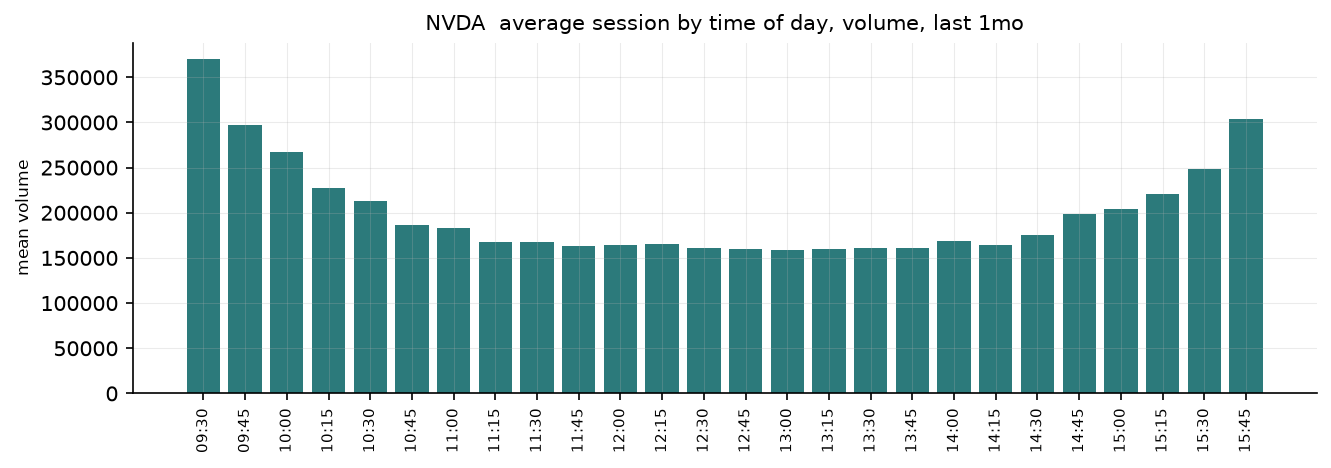
"when during the day does nvda trade the most" -> intraday_pattern(symbol='NVDA')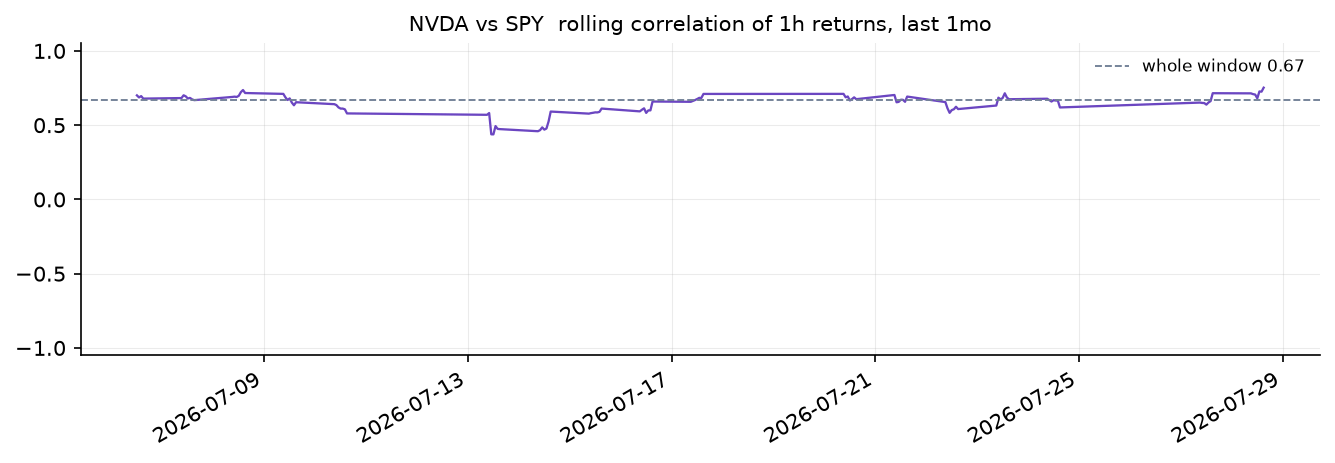
그리고 텍스트로 응답하는 것들:
for command in ("how did the market do this week", "biggest losers today"):
    print(f'"{command}"  ->  {CALLS[command]}')
    print(CALLS[command].run(), "\n")
"how did the market do this week" -> market_summary(window='1w')
the board over 1w
NVDA 254.12 9.62% 389,465,563
AMD 184.20 1.51% 182,740,497
AAPL 258.71 0.97% 223,818,998
SPY 664.86 0.40% 138,617,365
MSFT 451.35 0.26% 113,427,173
TSLA 320.22 -0.97% 266,317,023
"biggest losers today" -> top_movers(window='1d', direction='losers')
top 3 losers over 1d
AMD -0.57% -> 184.20
MSFT 0.67% -> 451.35
AAPL 1.40% -> 258.71 신뢰도를 읽으세요
confidence는 모든 판단의 곱이 아니라, 호출에서 가장 불확실한 판단을 보고합니다. 이는 하나의 잘못된 인자만으로도 결과가 망가질 수 있기 때문입니다. 곱은 다른 질문(“모든 부분이 정확한가”)에 답하며, 함수가 더 많은 인자를 받으면 한 판단이 흔들리든 흔들리지 않든 상관없이 그 값은 떨어집니다.
그 숫자가 어디에서 유래했는지, 인자별로 살펴보자:
call = CALLS["is amd tracking nvidia lately"]
print(f'"is amd tracking nvidia lately"  ->  {call}   confidence {call.confidence:.2f}')
for name, argument in call.arguments.items():
    top = sorted(argument.distribution.items(), key=lambda kv: -kv[1])[:3]
    shown = "omitted, default stands" if argument.omitted else repr(argument.value)
    print(
        f"  {name:<12}{shown:<26}p {argument.probability:.2f}   "
        + "  ".join(f"{k} {v:.2f}" for k, v in top)
    )
print(f"  weakest argument: {call.weakest().name}")
"is amd tracking nvidia lately" -> rolling_correlation(symbol='AMD', benchmark='NVDA') confidence 0.82
symbol 'AMD' p 0.87 AMD 0.87 NVDA 0.13 AAPL 0.00
benchmark 'NVDA' p 0.78 NVDA 0.92 AMD 0.08 AAPL 0.00
window omitted, default stands p 0.96
resolution omitted, default stands p 0.99
weakest argument: benchmarkwindow와 resolution는 둘 다 여기서 생략됩니다. ’최근’이라는 표현이 얼마나 과거를 가리키는지, 또는 어떤 막대 차트에서인지 명시하지 않기 때문입니다. 따라서 rolling_correlation는 한 달과 시간 단위 막대 차트라는 기본값으로 실행됩니다. 이것이 stated 질문의 존재 이유입니다. 이것이 없다면, 선택지는 특정 기간을 명시해야 했을 것이며, 자신 있게 그 기간을 지정했을 것입니다.
플레이그라운드에서 열기
아래 링크에는 선택된 함수에 대한 하나의 명령과 질문이 담겨 있습니다: 열 가지 함수 설명 중 선택과 rolling_correlation의 네 가지 인자입니다. 그곳의 명령을 편집하면 인자도 함께 변경됩니다.
COMMAND = "plot rolling correlation between nvda and spy for the past month"
picked = CALLS[COMMAND]
playground_link = make_playground_link(
    COMMAND,
    {ROUTE: assistant.questions[ROUTE]}
    | {q: v for q, v in assistant.questions.items() if q.startswith(f"{picked.name}.")},
    models=[TYPESAFE_MODEL],
)
display(
    Markdown(
        f"🔗 [Open the command and its questions in the TypeSafe playground]({playground_link})"
    )
)