JevCode
계층적 분류
TypeSafe Choice 확률에 대한 병렬 빔 검색을 통해 심층 특허, 소매 제품, 생물의학 및 소스 코드 계층 구조를 사용하여 문서를 분류합니다.
이 문서는 en에서 기계 번역되었으며 교정되지 않았습니다. 빠른 참고용으로만 사용하세요.

많은 데이터는 분류체계, 파일시스템 계층, 웹사이트 구조, 코드베이스, 조직도, 생물학적 오토로직, LLM 스킬, 모더레이션 정책 등과 같은 구조화된 계층 형태로 존재합니다. 계층적 분류(Hierarchical Classification)의 목표는 올바른 리프 노드까지 계층을 탐색하여 최종 분류를 결정하는 것입니다. 이는 TypeSafe의 Choice 원리에 완벽하게 부합합니다. 우리는 루트에서 시작하여 각 노드에서 문서를 분류함으로써 가장 확률이 높은 리프를 찾아내고, 리프에 도달할 때까지 가장 확률이 높은 다음 노드로 반복적으로 이동합니다(Greedy Search).
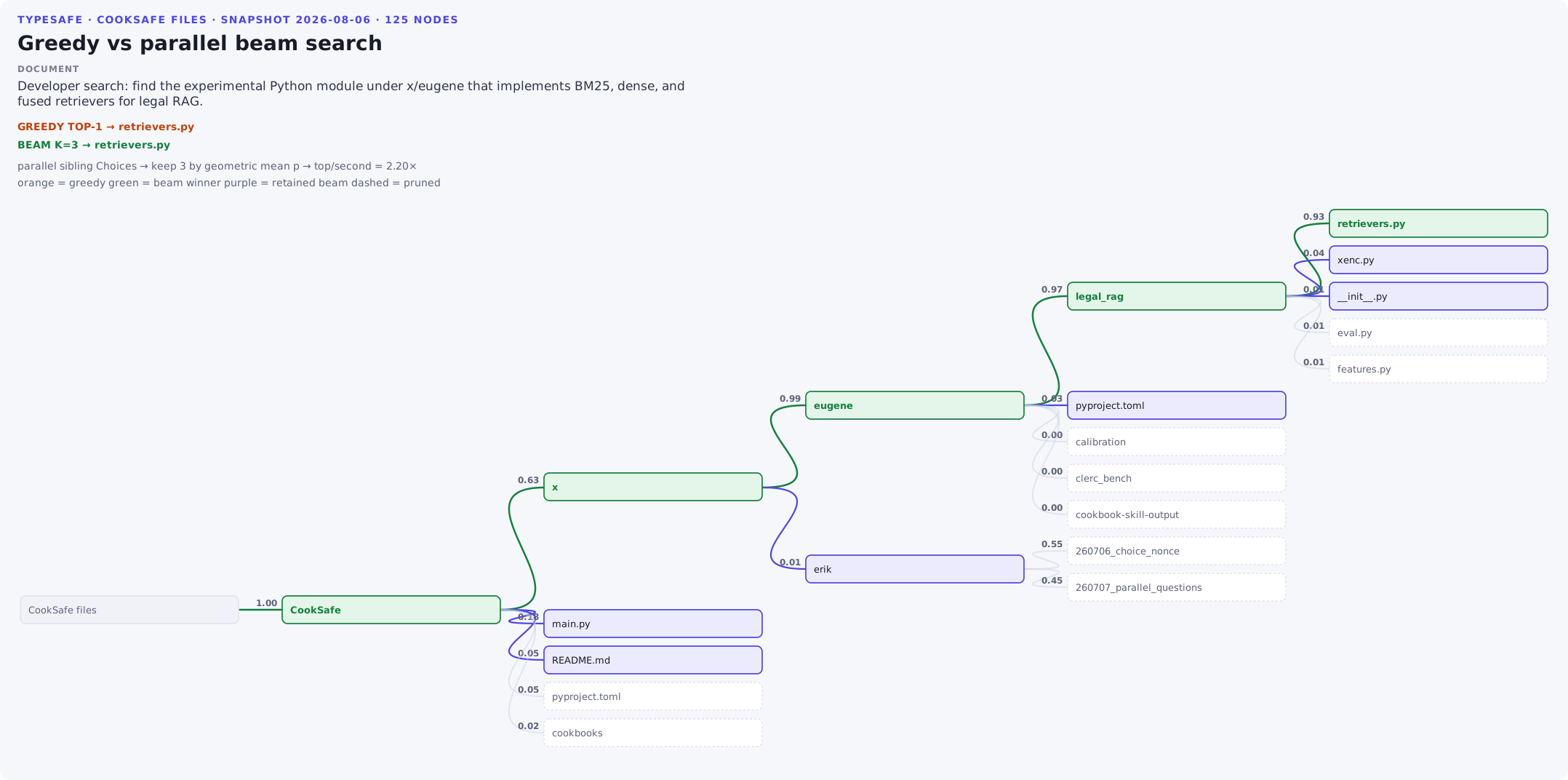
API의 병렬 특성은 **빔 서치(Beam Search)**를 사용하여 여러 경로를 병렬 질문으로 탐색함으로써 성능을 향상시킬 수 있게 합니다. 이 쿡북의 TypeSafe API 호출은 계층의 K 경로를 동시에 평가합니다. 빔 서치는 기하평균 에지 확률 product(edge_probabilities) ** (1 / decisions)에 따라 가장 좋은 K 경로를 유지하고 나머지는 가지치기합니다. 이 확률은 길이가 정규화되어 있으므로, 얕은 리프와 깊은 리프를 공정하게 비교할 수 있습니다.
이러한 계층 구조로 문제를 분해하는 것에도 자체적인 이점이 있습니다:
- 관찰 가능성
- 오분류가 가장 많이 발생하는 노드를 식별
- 각 노드와 엣지가 횡수되는 횟수를 측정
- 테스트 가능성
- 계층 구조 업데이트가 분류 성능에 미치는 영향을 단위 테스트하고 측정
-

이 쿡북에서 사용되는 계층 구조
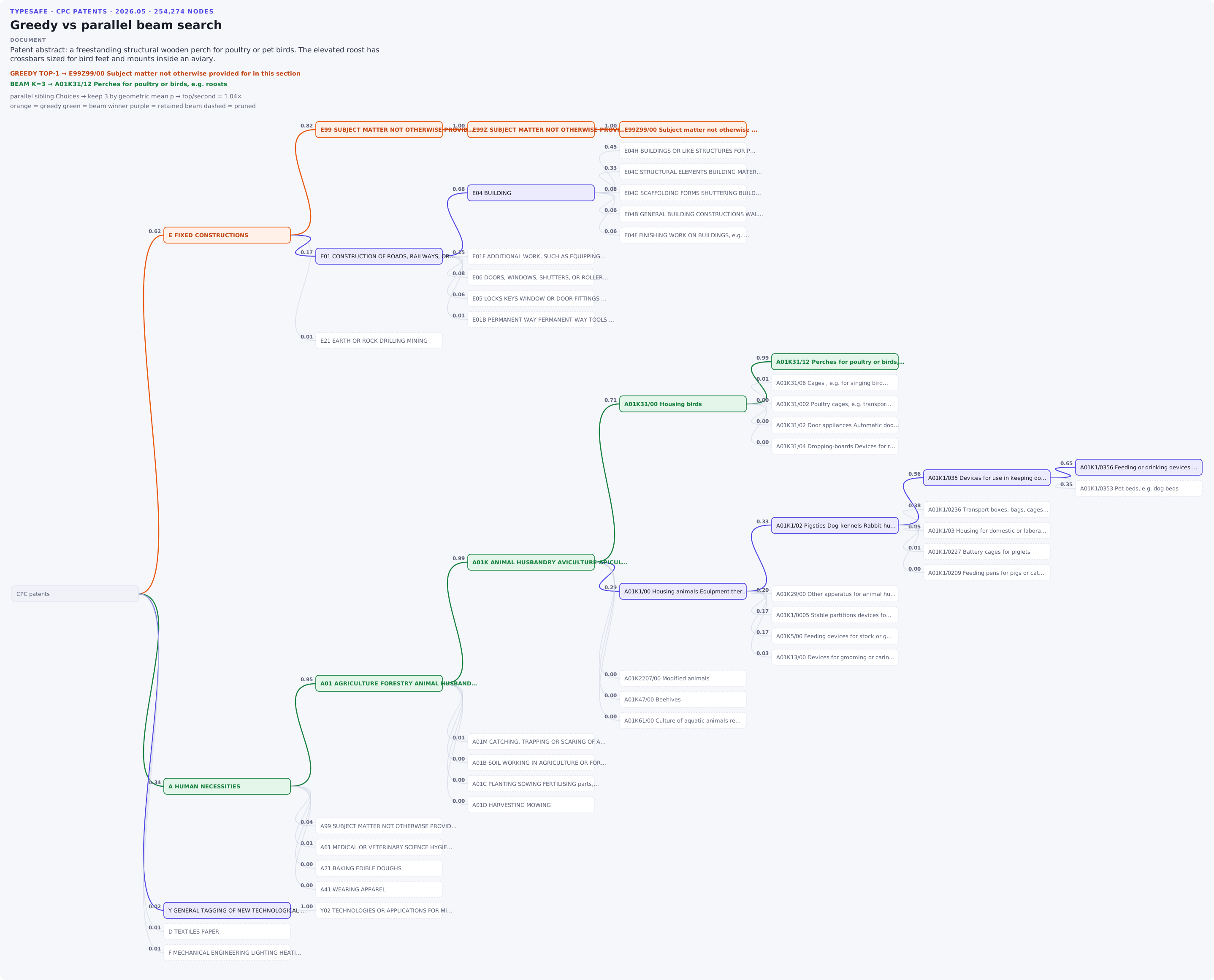
- CPC 2026.05: 특허 대상, 광범위한 기술 섹션부터 구체적인 발명까지.
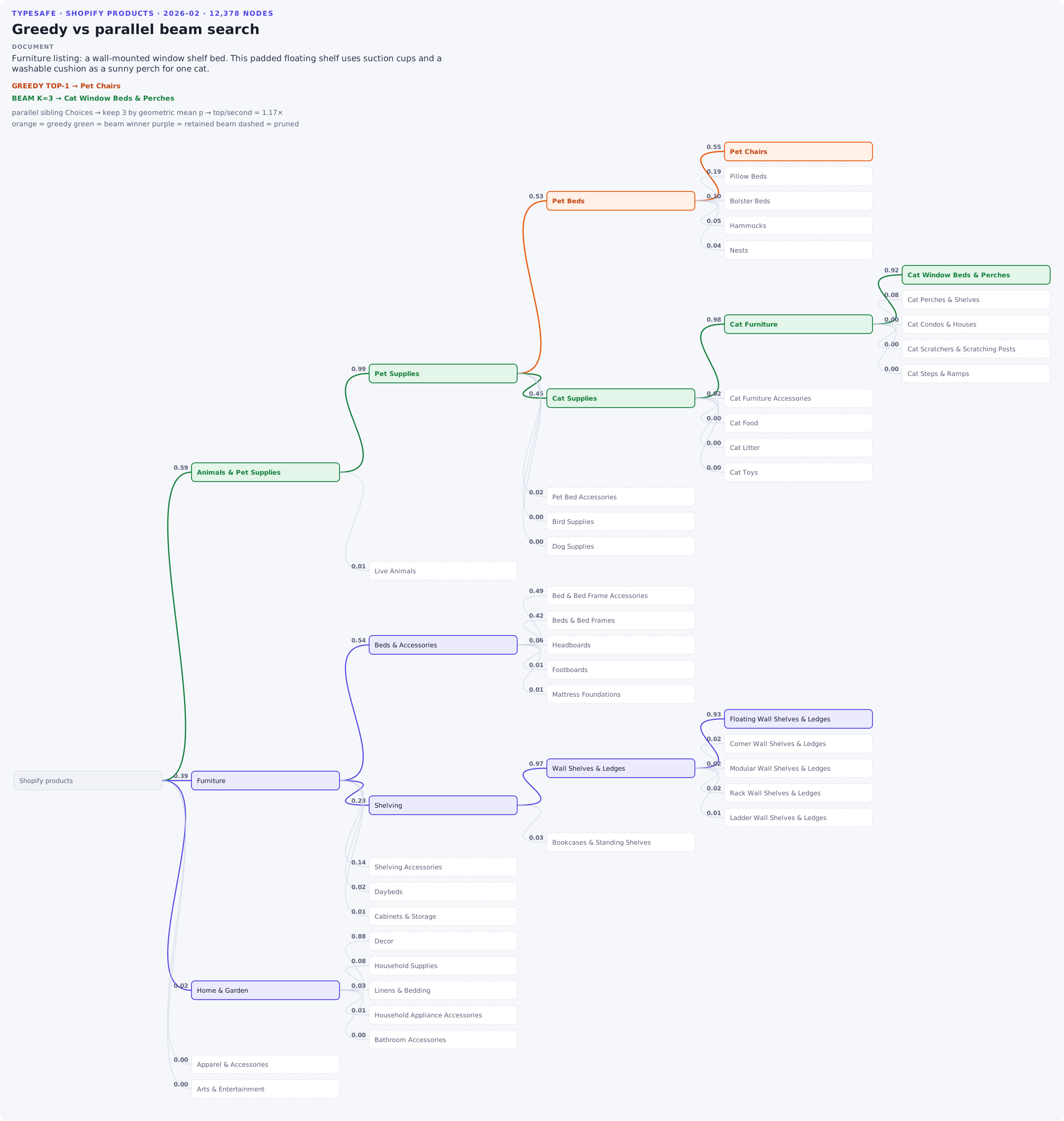
- Shopify 2026-02: 소매 제품 카테고리, 매장 부서부터 특정 제품 유형까지.
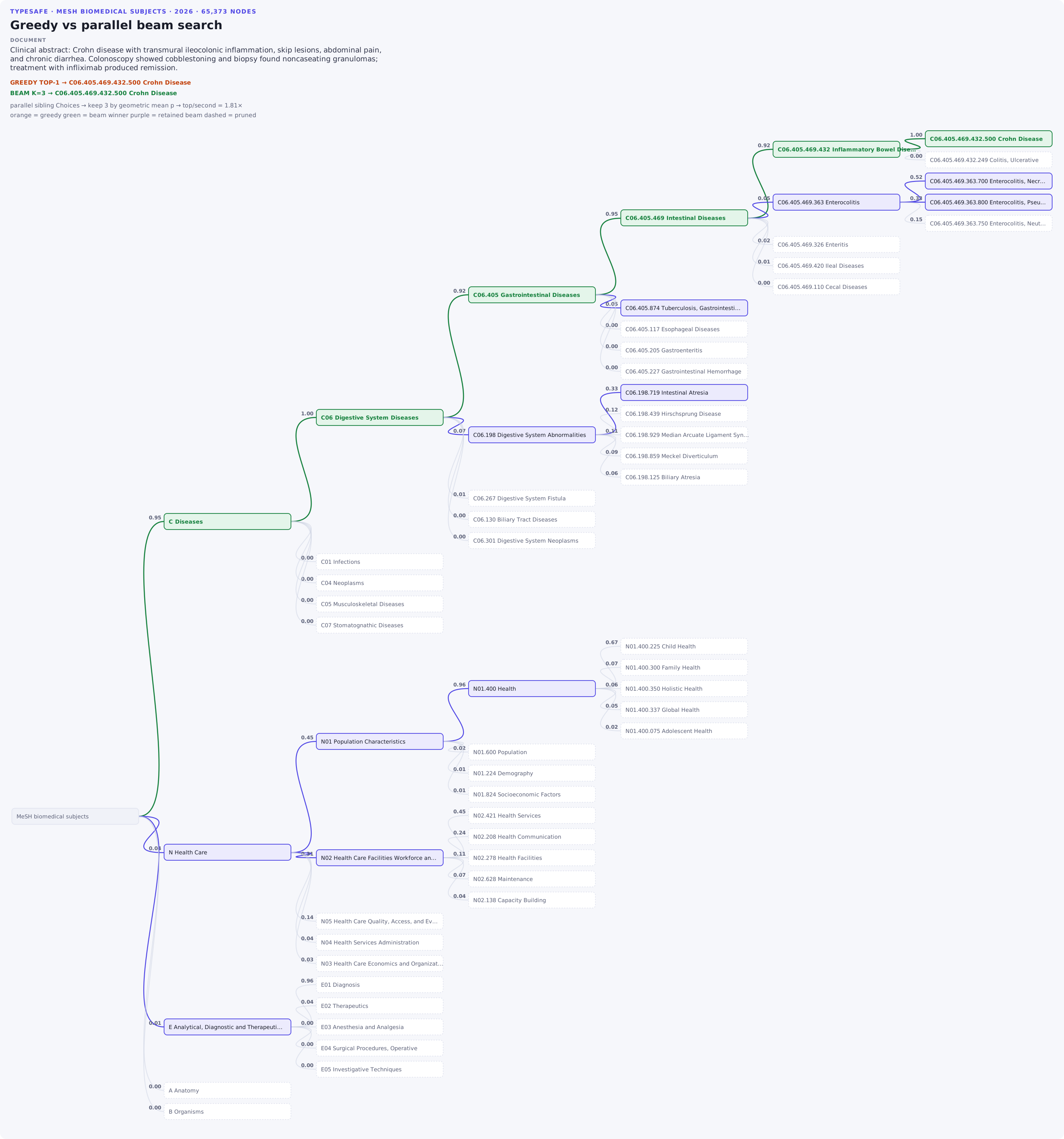
- MeSH 2026: 광범위한 도메인부터 특정 질환까지의 생물의학 주제. MeSH는 DAG이므로 하나의 설명자가 여러 부모 아래에 나타날 수 있습니다. 이 데모는 공식 트리 번호 경로를 확장합니다.
- CookSafe 파일: TypeSafe의 요리책 저장소 계층 구조, 폴더부터 소스 파일까지 검색됨.
메서드
- 탐욕적 검색: 가장 확률이 높은 자손을 선택하고 모든 대안을 폐기합니다. 초기의 실한 번은 복구할 수 없습니다.
- 빔 검색:
K개의 타당한 경로를 유지하고 프론티어(경계)의 모든 항목을 병렬로 분류합니다. 더 깊은 증거는 모호한 초기 결정을 수정할 수 있습니다. 기하평균 확률이 가장 높은 경로의 리프가 최종 분류가 됩니다. - TypeSafe Choice: 모든 노드는
Choice질문이며, 그 전체 확률 분포가 간선입니다. 빔의 각 경로는 병렬 질문으로 실행되므로, 추가 탐색은 실제 실행 시간(latency)에 거의 영향을 미치지 않습니다. - 공식:
path_score = product(edge_probabilities) ** (1 / decisions)- 경로 가지치기 및 경로 비교에 사용됨
separation = top_path_score / second_path_score- 유용한 지표이지만 가지치기에는 사용되지 않음
- 이 비율은 상위 경로의 기하평균을 가장 가까운 경쟁자와 비교합니다.
1×근처는 모호함- 큰 비율은 명확한 분리를 의미합니다.
- 지표에 대한 참고 사항:
- 각 노드에서 매우 명확한 결정을 내리는 경로를 최적화하도록 설계된
min(top_prob/second_top_prob)와 같은 다른 지표 - 매우 깊은 계층(예: >10층)의 정밀도 오류를 피하기 위해
product(edge_probabilities) ** (1 / decisions)대신exp(mean(log(probs)))사용
예제 계층 구조 로드 및 시각화
이 헬퍼들은 고정된 분류원소를 다운로드하고, 이를 직계 자식 트리로 파싱하며, 각 검색 트래버설을 정적 SVG로 렌더링합니다.
import html
import os
import shutil
import textwrap
import urllib.request
from collections import defaultdict
from concurrent.futures import ThreadPoolExecutor
from pathlib import Path
from typing import NamedTuple, TypeAlias
from xml.etree import ElementTree
from zipfile import ZipFile

from cooksafe import JsonCache
from IPython.display import Markdown, display
from typesafe_sdk import Choice, RetryPolicy, TypeSafeClient

Tree: TypeAlias = dict[str, "Tree"]


class Hierarchy(NamedTuple):
    """One query and a complete hierarchy.

    :param slug: filename-safe taxonomy name.
    :param name: display name.
    :param version: pinned dataset version.
    :param source_url: hierarchy source.
    :param node_count: number of loaded hierarchy nodes.
    :param document: unstructured text classified by TypeSafe.
    :param expected_leaf: expected final classification.
    :param tree: nested direct-child menus.
    """

    slug: str
    name: str
    version: str
    source_url: str
    node_count: int
    document: str
    expected_leaf: str
    tree: Tree


CPC_URL = (
    "https://www.cooperativepatentclassification.org/sites/default/files/"
    "cpc/bulk/CPCSchemeXML202605.zip"
)
SHOPIFY_URL = (
    "https://raw.githubusercontent.com/Shopify/product-taxonomy/"
    "v2026-02/dist/en/categories.txt"
)
MESH_URL = "https://nlmpubs.nlm.nih.gov/projects/mesh/MESH_FILES/xmlmesh/desc2026.zip"
MESH_CATEGORIES = {
    "A": "Anatomy",
    "B": "Organisms",
    "C": "Diseases",
    "D": "Chemicals and Drugs",
    "E": "Analytical, Diagnostic and Therapeutic Techniques, and Equipment",
    "F": "Psychiatry and Psychology",
    "G": "Phenomena and Processes",
    "H": "Disciplines and Occupations",
    "I": "Anthropology, Education, Sociology, and Social Phenomena",
    "J": "Technology, Industry, and Agriculture",
    "K": "Humanities",
    "L": "Information Science",
    "M": "Named Groups",
    "N": "Health Care",
    "V": "Publication Characteristics",
    "Z": "Geographicals",
}


def _download(url: str, path: Path) -> Path:
    """Download a pinned dataset once.

    :param url: official dataset URL.
    :param path: local cache path.
    :returns: local dataset path.
    """

    if path.exists():
        return path
    path.parent.mkdir(parents=True, exist_ok=True)
    temporary_path: Path = path.with_suffix(path.suffix + ".tmp")
    request = urllib.request.Request(
        url, headers={"User-Agent": "typesafe-taxonomy/1.0"}
    )
    with urllib.request.urlopen(request, timeout=120) as response:
        with temporary_path.open("wb") as file:
            shutil.copyfileobj(response, file)
    temporary_path.replace(path)
    return path


def _insert(tree: Tree, path: tuple[str, ...]) -> None:
    subtree_value: Tree = tree
    for label in path:
        subtree_value = subtree_value.setdefault(label, {})


def _cpc_title(item: ElementTree.Element) -> str:
    class_title: ElementTree.Element | None = item.find("class-title")
    if class_title is None:
        return ""
    return " ".join(" ".join(class_title.itertext()).split())


def _load_cpc(path: Path) -> tuple[Tree, int]:
    titles: dict[str, str] = {}
    levels: dict[str, int] = {}
    parent_by_symbol: dict[str, str] = {}
    children_by_symbol: defaultdict[str, list[str]] = defaultdict(list)

    def visit(item: ElementTree.Element, parent_symbol: str | None) -> None:
        symbol: str | None = item.findtext("classification-symbol")
        next_parent: str | None = parent_symbol
        if symbol:
            title: str = _cpc_title(item)
            if title:
                titles[symbol] = title
            levels[symbol] = min(levels.get(symbol, 99), int(item.attrib["level"]))
            if (
                parent_symbol
                and parent_symbol != symbol
                and symbol not in parent_by_symbol
            ):
                parent_by_symbol[symbol] = parent_symbol
                children_by_symbol[parent_symbol].append(symbol)
            next_parent = symbol
        for child in item.findall("classification-item"):
            visit(child, next_parent)

    with ZipFile(path) as zip_file:
        names = sorted(
            name
            for name in zip_file.namelist()
            if name.startswith("cpc-scheme-") and name.endswith(".xml")
        )
        for name in names:
            root = ElementTree.fromstring(zip_file.read(name))
            for item in root.findall("classification-item"):
                visit(item, None)

    labels: dict[str, str] = {
        symbol: f"{symbol} {titles.get(symbol, '')}".strip() for symbol in levels
    }

    def build(symbol: str) -> Tree:
        return {
            labels[child]: build(child) for child in children_by_symbol.get(symbol, [])
        }

    root_symbols: list[str] = sorted(
        symbol for symbol, level in levels.items() if level == 2
    )
    tree: Tree = {labels[symbol]: build(symbol) for symbol in root_symbols}
    return tree, len(labels)


def _load_shopify(path: Path) -> tuple[Tree, int]:
    tree: Tree = {}
    category_count: int = 0
    for line in path.read_text().splitlines():
        if not line or line.startswith("#"):
            continue
        _, path_text = line.split(" : ", maxsplit=1)
        category_path: tuple[str, ...] = tuple(path_text.strip().split(" > "))
        _insert(tree, category_path)
        category_count += 1
    return tree, category_count


def _load_mesh(path: Path) -> tuple[Tree, int]:
    """Load every official MeSH tree-number path.

    A descriptor may have multiple tree numbers because MeSH is a DAG. Expanding
    those positions into paths makes it usable by the tree-oriented beam search.

    :param path: MeSH descriptor XML ZIP.
    :returns: expanded tree and position count.
    """

    with ZipFile(path) as zip_file:
        root: ElementTree.Element = ElementTree.fromstring(
            zip_file.read("desc2026.xml")
        )
    names_by_tree_number: dict[str, str] = {
        tree_number.text: descriptor_record.findtext("DescriptorName/String", "")
        for descriptor_record in root.findall("DescriptorRecord")
        for tree_number in descriptor_record.findall("TreeNumberList/TreeNumber")
        if tree_number.text
    }
    tree: Tree = {}
    for tree_number in sorted(names_by_tree_number):
        parts: list[str] = tree_number.split(".")
        prefixes: list[str] = [
            ".".join(parts[:index]) for index in range(1, len(parts) + 1)
        ]
        category_code: str = tree_number[0]
        category_path: tuple[str, ...] = (
            f"{category_code} {MESH_CATEGORIES[category_code]}",
            *(f"{prefix} {names_by_tree_number[prefix]}" for prefix in prefixes),
        )
        _insert(tree, category_path)
    position_count: int = len(names_by_tree_number) + len(tree)
    return tree, position_count


CODEBASE_SNAPSHOT = Path("codebase_files.txt")


def _load_codebase(path: Path) -> tuple[Tree, int]:
    """Load the frozen CookSafe source-file hierarchy.

    The listing is a snapshot of the repository's source files in the order a walk found them,
    taken when this cookbook was rendered, rather than a walk of whatever tree the cookbook
    happens to sit in. A live walk makes the taxonomy -- and every number derived from it --
    depend on the reader's checkout, including untracked scratch files, so the shipped cache
    stops describing the same tree. Line order is significant: sibling options are asked in the
    order they appear here, so it is part of the question, not presentation.

    :param path: file holding one repository-relative source path per line.
    :returns: nested file tree and node count.
    """

    tree: Tree = {}
    node_paths: set[tuple[str, ...]] = set()
    for line in path.read_text(encoding="utf-8").splitlines():
        if not line.strip():
            continue
        hierarchy_path: tuple[str, ...] = ("CookSafe", *line.split("/"))
        _insert(tree, hierarchy_path)
        node_paths.update(
            hierarchy_path[:index] for index in range(1, len(hierarchy_path) + 1)
        )
    return tree, len(node_paths)


def load_hierarchies(data_directory: Path = Path("datasets")) -> tuple[Hierarchy, ...]:
    """Load three public taxonomies and one frozen code hierarchy.

    :param data_directory: cache directory for official raw files.
    :returns: CPC, Shopify, MeSH, and CookSafe examples.
    """

    cpc_tree, cpc_nodes = _load_cpc(
        _download(CPC_URL, data_directory / "CPCSchemeXML202605.zip")
    )
    shopify_tree, shopify_nodes = _load_shopify(
        _download(SHOPIFY_URL, data_directory / "shopify_categories_2026-02.txt")
    )
    mesh_tree, mesh_nodes = _load_mesh(
        _download(MESH_URL, data_directory / "mesh_descriptors_2026.zip")
    )
    codebase_tree, codebase_nodes = _load_codebase(CODEBASE_SNAPSHOT)
    return (
        Hierarchy(
            slug="cpc",
            name="CPC patents",
            version="2026.05",
            source_url=CPC_URL,
            node_count=cpc_nodes,
            document=(
                "Patent abstract: a freestanding structural wooden perch for poultry or "
                "pet birds. The elevated roost has crossbars sized for bird feet and mounts "
                "inside an aviary."
            ),
            expected_leaf="A01K31/12 Perches for poultry or birds, e.g. roosts",
            tree=cpc_tree,
        ),
        Hierarchy(
            slug="shopify",
            name="Shopify products",
            version="2026-02",
            source_url=SHOPIFY_URL,
            node_count=shopify_nodes,
            document=(
                "Furniture listing: a wall-mounted window shelf bed. This padded floating shelf "
                "uses suction cups and a washable cushion as a sunny perch for one cat."
            ),
            expected_leaf="Cat Window Beds & Perches",
            tree=shopify_tree,
        ),
        Hierarchy(
            slug="mesh",
            name="MeSH biomedical subjects",
            version="2026",
            source_url=MESH_URL,
            node_count=mesh_nodes,
            document=(
                "Clinical abstract: Crohn disease with transmural ileocolonic inflammation, "
                "skip lesions, abdominal pain, and chronic diarrhea. Colonoscopy showed "
                "cobblestoning and biopsy found noncaseating granulomas; treatment with "
                "infliximab produced remission."
            ),
            expected_leaf="C06.405.469.432.500 Crohn Disease",
            tree=mesh_tree,
        ),
        Hierarchy(
            slug="codebase",
            name="CookSafe files",
            version="snapshot 2026-08-06",
            source_url=str(CODEBASE_SNAPSHOT),
            node_count=codebase_nodes,
            document=(
                "Developer search: find the experimental Python module under x/eugene that "
                "implements BM25, dense, and fused retrievers for legal RAG."
            ),
            expected_leaf="retrievers.py",
            tree=codebase_tree,
        ),
    )


NODE_W, NODE_H = 300, 38
COL_W, ROW_H = 360, 50
PAD_X = 28
EDGE_TOP_K = 5


def subtree(tree: Tree, path: tuple[str, ...]) -> Tree:
    """Return the direct-child menu below ``path``.

    :param tree: taxonomy root.
    :param path: path from the taxonomy root.
    :returns: child mapping at the path.
    """

    subtree_value: Tree = tree
    for label in path:
        subtree_value = subtree_value[label]
    return subtree_value


def _escape(value: object) -> str:
    return html.escape(str(value), quote=True)


def _truncate(value: str, length: int = 33) -> str:
    return value if len(value) <= length else value[: length - 1] + "…"


def _build_nodes(hierarchy: Hierarchy, result: dict) -> dict:
    records: dict[tuple[str, ...], dict] = {
        tuple(record["parent"]): record for record in result["records"]
    }
    best_path: tuple[str, ...] = tuple(result["beam"][0]["path"])
    greedy_path: tuple[str, ...] = tuple(result["greedy"]["path"])
    retained: set[tuple[str, ...]] = {tuple(path) for path in result["retained_paths"]}

    def grow(path: tuple[str, ...]) -> list[dict]:
        record: dict | None = records.get(path)
        if record is None:
            return []
        children: list[dict] = []
        probabilities: dict[str, float] = record["probabilities"]
        ranked: list[tuple[str, float]] = sorted(
            probabilities.items(), key=lambda item: item[1], reverse=True
        )
        shown_labels: set[str] = {label for label, _ in ranked[:EDGE_TOP_K]}
        shown_labels.update(
            label
            for label, _ in ranked
            if path + (label,) in retained
            or path + (label,) == best_path[: len(path) + 1]
            or path + (label,) == greedy_path[: len(path) + 1]
        )
        for label, probability in ranked:
            if label not in shown_labels:
                continue
            child_path: tuple[str, ...] = path + (label,)
            on_best_path: bool = child_path == best_path[: len(child_path)]
            on_greedy_path: bool = child_path == greedy_path[: len(child_path)]
            kind: str = (
                "winner"
                if on_best_path
                else "greedy"
                if on_greedy_path
                else "beam"
                if child_path in retained
                else "alt"
            )
            children.append(
                {
                    "label": label,
                    "probability": probability,
                    "kind": kind,
                    "children": grow(child_path),
                }
            )
        return children

    return {
        "label": hierarchy.name,
        "probability": None,
        "kind": "root",
        "children": grow(()),
    }


def _layout(root: dict) -> tuple[int, int]:
    rows: list[int] = [0]
    maximum_depth: list[int] = [0]

    def walk(node: dict, depth: int) -> None:
        node["depth"] = depth
        maximum_depth[0] = max(maximum_depth[0], depth)
        if node["children"]:
            for child in node["children"]:
                walk(child, depth + 1)
            node["row"] = (node["children"][0]["row"] + node["children"][-1]["row"]) / 2
        else:
            node["row"] = rows[0]
            rows[0] += 1

    walk(root, 0)
    return maximum_depth[0], rows[0]


def render_svg(hierarchy: Hierarchy, result: dict, path: Path) -> None:
    """Write a standalone traversal SVG matching the Customer_ProdX visual language.

    :param hierarchy: taxonomy demonstration.
    :param result: beam-search result from the notebook.
    :param path: output SVG path.
    """

    root: dict = _build_nodes(hierarchy, result)
    maximum_depth, row_count = _layout(root)
    document_lines: list[str] = textwrap.wrap(
        hierarchy.document,
        width=105,
        break_long_words=False,
        break_on_hyphens=False,
    ) or [""]
    document_y: int = 124
    greedy_y: int = document_y + (len(document_lines) - 1) * 21 + 34
    beam_y: int = greedy_y + 25
    method_y: int = beam_y + 29
    legend_y: int = method_y + 23
    header_height: int = legend_y + 32
    width: int = PAD_X * 2 + maximum_depth * COL_W + NODE_W
    height: int = header_height + max(row_count, 1) * ROW_H + 34
    edges: list[str] = []
    nodes: list[str] = []

    def node_x(node: dict) -> float:
        return PAD_X + node["depth"] * COL_W

    def node_y(node: dict) -> float:
        return header_height + node["row"] * ROW_H

    def walk(node: dict) -> None:
        x_value, y_value = node_x(node), node_y(node)
        for child in node["children"]:
            child_x, child_y = node_x(child), node_y(child)
            x1, y1 = x_value + NODE_W, y_value + NODE_H / 2
            x2, y2 = child_x, child_y + NODE_H / 2
            bend: float = COL_W * 0.38
            edges.append(
                f'<path class="edge {child["kind"]}" '
                f'd="M{x1:.0f},{y1:.0f} C{x1 + bend:.0f},{y1:.0f} '
                f'{x2 - bend:.0f},{y2:.0f} {x2:.0f},{y2:.0f}"/>'
            )
            edges.append(
                f'<text class="prob" x="{x2 - 7:.0f}" y="{y2 - 5:.0f}" '
                f'text-anchor="end">{child["probability"]:.2f}</text>'
            )
            walk(child)

        kind: str = node["kind"]
        label: str = _truncate(node["label"], 40)
        nodes.append(
            f'<g class="node {kind}"><title>{_escape(node["label"])}</title>'
            f'<rect x="{x_value:.0f}" y="{y_value:.0f}" width="{NODE_W}" '
            f'height="{NODE_H}" rx="7"/>'
            f'<text x="{x_value + 11:.0f}" y="{y_value + 24:.0f}">'
            f"{_escape(label)}</text></g>"
        )

    walk(root)
    best: dict = result["beam"][0]
    best_path: tuple[str, ...] = tuple(best["path"])
    greedy_path: tuple[str, ...] = tuple(result["greedy"]["path"])
    beam_leaf: str = best_path[-1] if best_path else "no leaf"
    greedy_leaf: str = greedy_path[-1] if greedy_path else "no leaf"
    beam_width: int = result["beam_width"]
    separation_ratio: float = result["separation_ratio"]
    document_text: str = "".join(
        f'<text class="document" x="24" y="{document_y + index * 21}">'
        f"{_escape(line)}</text>"
        for index, line in enumerate(document_lines)
    )
    separation_text: str = (
        ">999×" if separation_ratio > 999 else f"{separation_ratio:.2f}×"
    )

    svg: str = f'''<svg xmlns="http://www.w3.org/2000/svg" viewBox="0 0 {width} {height}"
  width="{width}" height="{height}" role="img" aria-label="{_escape(hierarchy.name)} taxonomy beam search">
<style>
  .bg {{ fill:#f6f7fb }}
  text {{ font-family:ui-monospace,"SF Mono",Menlo,Consolas,monospace }}
  .eyebrow {{ font-size:14px; font-weight:700; letter-spacing:1.2px; fill:#4f46e5 }}
  .title {{ font:700 28px system-ui,-apple-system,"Segoe UI",sans-serif; fill:#181b28 }}
  .document-label {{ font:700 12px system-ui,-apple-system,"Segoe UI",sans-serif; letter-spacing:1px; fill:#777c91 }}
  .document {{ font:500 17px system-ui,-apple-system,"Segoe UI",sans-serif; fill:#303449 }}
  .copy {{ font-size:14px; fill:#5c6178 }}
  .result {{ font-size:14px; font-weight:700 }}
  .greedy-result {{ fill:#c2410c }}
  .beam-result {{ fill:#15803d }}
  .edge {{ fill:none; stroke:#c9cee0; stroke-width:2 }}
  .edge.winner {{ stroke:#15803d; stroke-width:2.5 }}
  .edge.greedy {{ stroke:#ea580c; stroke-width:2.5 }}
  .edge.beam {{ stroke:#4f46e5; stroke-width:2.2 }}
  .edge.alt {{ opacity:.48 }}
  .prob {{ font-size:12px; font-weight:600; fill:#5c6178 }}
  .node rect {{ stroke-width:1.7 }}
  .node text {{ font-size:13px }}
  .node.root rect {{ fill:#f0f2f8; stroke:#e2e5f0 }}
  .node.root text {{ fill:#5c6178 }}
  .node.winner rect {{ fill:#e4f5ea; stroke:#15803d }}
  .node.winner text {{ fill:#15803d; font-weight:700 }}
  .node.greedy rect {{ fill:#fff0e8; stroke:#ea580c }}
  .node.greedy text {{ fill:#c2410c; font-weight:700 }}
  .node.beam rect {{ fill:#ecebfd; stroke:#4f46e5 }}
  .node.beam text {{ fill:#181b28 }}
  .node.alt rect {{ fill:#fff; stroke:#e2e5f0; stroke-dasharray:3 3 }}
  .node.alt text {{ fill:#5c6178 }}
</style>
<rect class="bg" width="{width}" height="{height}" rx="14"/>
<text class="eyebrow" x="24" y="32">TYPESAFE · {hierarchy.name.upper()} · {hierarchy.version.upper()} · {hierarchy.node_count:,} NODES</text>
<text class="title" x="24" y="69">Greedy vs parallel beam search</text>
<text class="document-label" x="24" y="99">DOCUMENT</text>
{document_text}
<text class="result greedy-result" x="24" y="{greedy_y}">GREEDY TOP-1 → {_escape(_truncate(greedy_leaf, 105))}</text>
<text class="result beam-result" x="24" y="{beam_y}">BEAM K={beam_width} → {_escape(_truncate(beam_leaf, 105))}</text>
<text class="copy" x="24" y="{method_y}">parallel sibling Choices → keep {beam_width} by geometric mean p → top/second = {separation_text}</text>
<text class="copy" x="24" y="{legend_y}">orange = greedy   green = beam winner   purple = retained beam   dashed = pruned</text>
{"".join(edges)}{"".join(nodes)}
</svg>'''
    path.write_text(svg)
탐욕 및 빔 탐색 구현
각 형제 집합은 다음 섹션에서 하나의 Choice 질문이 되며, 여기서는 또한 두 가지 탐색 전략을 구현하고 정적 다이어그램이 필요한 확률을 고정합니다.
HIERARCHIES = load_hierarchies()
MODEL, BEAM_WIDTH, MAX_DEPTH, EPSILON = "jev-1.12", 3, 12, 1e-9
client = TypeSafeClient(
    api_key=os.environ["TYPESAFE_API_KEY"],
    retry=RetryPolicy(max_retries=5, backoff_initial=1.0, backoff_max=20.0),
)
json_cache = JsonCache(Path("json_cache.json"))


@json_cache
def choose(state: str, labels: tuple[str, ...]) -> dict[str, float]:
    """Ask one atomic direct-child question and return its distribution."""
    if len(labels) == 1:
        return {labels[0]: 1.0}
    question, keys = child_question(labels)
    response = client.system_one(
        state=state, questions={"child": question}, model=MODEL
    )
    probabilities = response.answers["child"].probabilities
    return {label: probabilities[key] for key, label in keys.items()}


def child_question(labels: tuple[str, ...]) -> tuple[Choice, dict[str, str]]:
    """Build the direct-child Choice and its reversible option mapping."""
    keys = {f"c{i}": label for i, label in enumerate(labels)}
    question = Choice(
        instructions="Which direct child category best matches this document?",
        criteria=keys,
    )
    return question, keys


def extend_candidate(
    candidate: dict, label: str, probabilities: dict[str, float]
) -> dict:
    """Append one edge and recompute its geometric-mean path score."""
    is_decision: bool = len(probabilities) > 1
    # Use log space for very deep trees to avoid floating-point precision loss.
    probability_product: float = candidate["probability_product"] * (
        max(probabilities[label], EPSILON) if is_decision else 1.0
    )
    decision_count: int = candidate["decision_count"] + is_decision
    return {
        "path": candidate["path"] + (label,),
        "probability_product": probability_product,
        "decision_count": decision_count,
        "score": probability_product ** (1 / decision_count) if decision_count else 1.0,
    }


def choice_record(path: tuple[str, ...], probabilities: dict[str, float]) -> dict:
    """Package one sibling decision for the traversal diagram."""
    return {"parent": path, "probabilities": probabilities}


def beam_search(hierarchy: Hierarchy) -> dict:
    """Parallel width-three beam search using geometric-mean probability."""
    beam = [{"path": (), "probability_product": 1.0, "decision_count": 0, "score": 1.0}]
    records, retained_paths = [], {()}

    for _ in range(MAX_DEPTH):
        expandable = [
            candidate
            for candidate in beam
            if subtree(hierarchy.tree, candidate["path"])
        ]
        finished = [
            candidate
            for candidate in beam
            if not subtree(hierarchy.tree, candidate["path"])
        ]
        if not expandable:
            break
        with ThreadPoolExecutor(max_workers=BEAM_WIDTH) as executor:
            distributions = list(
                executor.map(
                    lambda candidate: choose(
                        hierarchy.document,
                        tuple(subtree(hierarchy.tree, candidate["path"])),
                    ),
                    expandable,
                )
            )

        expanded = []
        round_records = []
        for candidate, probabilities in zip(expandable, distributions, strict=True):
            round_records.append(choice_record(candidate["path"], probabilities))
            candidate_expanded = []
            for label in probabilities:
                candidate_expanded.append(
                    extend_candidate(candidate, label, probabilities)
                )
            expanded.extend(candidate_expanded)
        beam = sorted(
            finished + expanded,
            key=lambda candidate: candidate["score"],
            reverse=True,
        )[:BEAM_WIDTH]
        retained_paths.update(candidate["path"] for candidate in beam)
        records.extend(round_records)

    beam = sorted(beam, key=lambda candidate: candidate["score"], reverse=True)
    return {
        "beam": beam,
        "records": records,
        "retained_paths": sorted(retained_paths, key=lambda path: (len(path), path)),
    }


def greedy_search(hierarchy: Hierarchy) -> dict:
    """Follow only the locally highest-probability child."""
    path, probability_product, decision_count, records = (), 1.0, 0, []
    for _ in range(MAX_DEPTH):
        labels = tuple(subtree(hierarchy.tree, path))
        if not labels:
            break
        probabilities = choose(hierarchy.document, labels)
        records.append(choice_record(path, probabilities))
        label = max(probabilities, key=probabilities.get)
        if len(probabilities) > 1:
            probability_product *= max(probabilities[label], EPSILON)
            decision_count += 1
        path += (label,)
    score: float = (
        probability_product ** (1 / decision_count) if decision_count else 1.0
    )
    return {"path": path, "score": score, "records": records}


def compare_searches(hierarchy: Hierarchy) -> dict:
    """Run beam and greedy, then merge their queried nodes for rendering."""
    result = beam_search(hierarchy)
    greedy = greedy_search(hierarchy)
    recorded_paths = {tuple(record["parent"]) for record in result["records"]}
    result["records"].extend(
        record
        for record in greedy["records"]
        if tuple(record["parent"]) not in recorded_paths
    )
    result["greedy"] = greedy
    result["beam_width"] = BEAM_WIDTH
    top_score: float = result["beam"][0]["score"]
    second_score: float = result["beam"][1]["score"]
    result["separation_ratio"] = top_score / max(second_score, EPSILON)
    return result
메서드 비교
두 가지 전략을 네 개의 레이블이 지정된 예시에 대해 실행하고, 그 리프 노드를 예상되는 분류와 비교하며 탐색한 경로를 시각화하세요.
with ThreadPoolExecutor(max_workers=len(HIERARCHIES)) as executor:
results = list(executor.map(compare_searches, HIERARCHIES))
rows: list[dict[str, str | int | bool]] = []
for hierarchy, result in zip(HIERARCHIES, results, strict=True):
svg_path: Path = Path(f"{hierarchy.slug}_tree.svg")
render_svg(hierarchy, result, svg_path)
beam_path: tuple[str, ...] = tuple(result["beam"][0]["path"])
greedy_path: tuple[str, ...] = tuple(result["greedy"]["path"])
beam_leaf: str = beam_path[-1]
greedy_leaf: str = greedy_path[-1]
rows.append(
{
"hierarchy": hierarchy.name,
"nodes": hierarchy.node_count,
"expected leaf": hierarchy.expected_leaf,
"greedy leaf": greedy_leaf,
"beam K=3 leaf": beam_leaf,
"greedy correct": greedy_leaf == hierarchy.expected_leaf,
"beam correct": beam_leaf == hierarchy.expected_leaf,
"mean p": f"{result['beam'][0]['score']:.2f}",
"top/second": f"{result['separation_ratio']:.2f}×",
}
)
greedy_correct_count: int = sum(bool(row["greedy correct"]) for row in rows)
beam_correct_count: int = sum(bool(row["beam correct"]) for row in rows)
recovered_names: str = ", ".join(
str(row["hierarchy"])
for row in rows
if not row["greedy correct"] and row["beam correct"]
)
table_lines: list[str] = [
"| Hierarchy | Expected leaf | Greedy leaf | Beam K=3 leaf | Greedy correct | Beam correct |",
"| --- | --- | --- | --- | --- | --- |",
]
table_lines.extend(
"| "
+ " | ".join(
(
str(row["hierarchy"]),
str(row["expected leaf"]),
str(row["greedy leaf"]),
str(row["beam K=3 leaf"]),
"yes" if row["greedy correct"] else "no",
"yes" if row["beam correct"] else "no",
)
)
+ " |"
for row in rows
)
display(
Markdown(
"## Results\n\n"
"Each example has a known expected leaf. "
f"Beam search matched {beam_correct_count} of {len(rows)} expected leaves; "
f"greedy search matched {greedy_correct_count} of {len(rows)}. "
f"Keeping three paths recovered the expected classification for {recovered_names}.\n\n"
+ "\n".join(table_lines)
+ "\n\nThe diagrams show why the methods differ. Orange marks the greedy route, "
"green marks the winning beam route, purple marks other retained paths, and "
"dashed edges were pruned.\n\n"
+ "\n\n".join(
f"### {hierarchy.name}\n\n"
for hierarchy in HIERARCHIES
)
)
)결과
각 예시에는 알려진 최종 리프가 있습니다. 빔 검색은 4개의 예상 리프 중 4개를 일치시켰으며, 탐욕 검색은 4개 중 2개를 일치시켰습니다. 세 개의 경로를 유지함으로써 CPC 특허와 Shopify 제품의 예상 분류를 복원했습니다.
| 계층 구조 | 예상 리프 | 탐욕 리프 | 빔 K=3 리프 | 탐욕 정확 | 빔 정확 |
|---|---|---|---|---|---|
| CPC 특허 | A01K31/12 가금류 또는 조류용 지주, 예: 횃대 | E99Z99/00 이 섹션에서 다른 곳으로 제공되지 않은 주제 | A01K31/12 가금류 또는 조류용 지주, 예: 횃대 | 아니요 | 예 |
| Shopify 제품 | 고양이 창문 침대 & 지주 | 애완동물 의자 | 고양이 창문 침대 & 지주 | 아니요 | 예 |
| MeSH 생물 의학 주제 | C06.405.469.432.500 크론병 | C06.405.469.432.500 크론병 | C06.405.469.432.500 크론병 | 예 | 예 |
| CookSafe 파일 | retrievers.py | retrievers.py | retrievers.py | 예 | 예 |
다이어그램은 방법들이 어떻게 다른지를 보여줍니다. 주황색은 탐욕 경로를, 초록색은 승리한 빔 경로를, 보라색은 다른 유지된 경로를 표시하며, 점선 간선은 가지치기되었습니다.
CPC 특허
Shopify 제품
MeSH 생물의학적 주제
CookSafe 파일