 JevCode
기술 제안
182개의 Nous Research Hermes 카탈로그 기술 중 하나를 선택합니다. TypeSafe 요청은 모든 기술을 순위별로 정렬하고 턴에 기술이 필요한지 여부를 묻고, 두 번째 요청은 상위 세 가지를 정확히 읽어서 모두 거부할 수 있습니다. 승자의 이름은 에이전트의 sy
이 문서는 en에서 기계 번역되었으며 교정되지 않았습니다. 빠른 참고용으로만 사용하세요.

에이전트는 스킬을 잘라내어 시스템 메시지에 모두 로드함으로써 스킬을 선택하는데, 이는 비용을 증가시키고 스킬 선택 성능을 저하시키며 세션의 나머지 부분에 대해 컨텍스트 부패를 유발합니다. 우리는 턴마다 두 번의 TypeSafe 요청(스킬 순위 매기기용 하나와 선택 검증용 하나)을 사용하여 이를 해결하며, 잘못된 스킬 로드 횟수를 절반 이상 줄입니다.
대용량의 기술 목록을 가진 에이전트는 거의 정보가 없는 상태에서 선택을 내린다. 이 목록은 인덱스 형태로 전달되며, 각 기술마다 한 줄씩 할당되고 설명은 잘려서 전체 텍스트가 대화를 가리지 않도록 한다. 여기서 사용되는 에이전트 허들인 Hermes는 기본적으로 60자로 제한한다. 예를 들어, 그 너비에서 .pptx 파일을 편집하는 기술은 그 파일을 작성하는 기술과 거의 동일하게 읽힌다. 피치 데크를 요청하면 에이전트가 잘못된 것을 로드할 수 있다. 전혀 적합한 기술이 없는 턴에서도, 이름의 목록이 추측을 유도하기 때문에 에이전트는 여전히 하나를 로드할 수 있다.
이 쿡북은 설명 부분을 그대로 두고 점진적 공개를 사용하며, 182개 스킬을 저렴하게 모두 읽은 후 세 가지를 자세히 읽습니다. 어떤 스킬을 로드할지(또는 로드하지 않을지) 결정하기 전에 두 개의 TypeSafe 요청이 들어갑니다. 첫 번째는 로스터의 모든 스킬을 사용자의 턴과 비교하여 랭킹을 매기고, 턴에 스킬이 필요한지 여부를 답변합니다. 두 번째는 이제 각 스킬의 전체 설명과 지시사항의 시작 부분을 포함하여 상위 세 개만 다시 읽으며, 모든 스킬을 거부할 수도 있습니다.
승자의 이름은 해당 턴의 에이전트 시스템 프롬프트의 한 줄 추가에 입력됩니다:
<skill_relevance>
Relevant to the current request: pptx-author. Ignore this if it does not fit what the user
actually asked for.
</skill_relevance>
에이전트는 전체 인덱스와 자체 판단을 유지하며, 해당 한 줄은 첫 번째로 확인할 항목을 가리키는 역할만 합니다. 명단 자체는 절대 변경되지 않으므로, 해당 명단에 대한 모든 접두어 캐싱은 여전히 유효합니다. claude-haiku-4-5-20251001에 대해 488건의 요청을 수행한 결과, Hermes 명단의 스킬을 사용했습니다:
| 잘못된 스킬 로드 | 적합한 것이 없을 때 하나 로드 | |
|---|---|---|
| 로스터만 있는 단독 에이전트 | 16.8% | 9.8% |
| TypeSafe 제안이 있는 에이전트 | 7.3% | 4.0% |
| 정답을 전달받은 에이전트 | 2.5% | 1.2% |
세 번째 행은 실수를 위한 바닥이 0이 아님을 보여줍니다. 올바른 기술을 부여받은 에이전트라도 그것을 항상 로드하지는 않으며, 아무리 좋은 선택 방법이라도 그 한계를 넘지 못하기 때문입니다.
최대 하나의 스킬 이름만 반환하는 suggest() 함수, 시스템 프롬프트를 위해 이를 감싸는 suggestion_block(), 그리고 위의 표를 생성한 하니스가 완성됩니다. 이제 이를 자신의 로스터를 가리키도록 준비할 수 있습니다.
흐름 방향: LR
| 노드 | 설명 | 그룹 |
|---|---|---|
C1 |
콜 1 - 182개 스킬 모두 스킴 | 콜 1 - 182개 스킬 모두 스킴 |
Q1 |
Choice: 어떤 스킬이 적합할까? / 182개 모두, 각 줄마다 한 줄씩 | 콜 1 - 182개 스킬 모두 스킴 |
N1 |
Nouls: 스킬이 정말 필요한가? / · 그들의 작업에 개입할 것인가? / · 서면 지침을 따를 것인가? / · 아니면 그냥 대화만 할 것인가? | 콜 1 - 182개 스킬 모두 스킴 |
C2 |
콜 2 - 해당 3개를 제대로 읽기 | 콜 2 - 해당 3개를 제대로 읽기 |
Q2 |
Choice: 이 3개 중 어떤 것을? / 이제 실제 세부 사항과 함께 | 콜 2 - 해당 3개를 제대로 읽기 |
N2 |
Nouls: 각각이 / 정말 그것을 수행하는가? | 콜 2 - 해당 3개를 제대로 읽기 |
| From | Condition | To |
|---|---|---|
Q1 |
— | N1 |
Q2 |
— | N2 |
C1 |
상위 3개 | C2 |
C1 |
해당 없음 / 적용 | STOP |
C2 |
해당 없음 | STOP |
C2 |
우승자 | OUT |
설정
- TypeSafe 클라이언트, Anthropic 클라이언트, 그리고 공유 쿡북 도우미를 설치합니다.
- TypeSafe API 키와 측정할 에이전트의 Anthropic 키를 설정합니다.
pip install anthropic matplotlib ipython "typesafe-sdk>=0.5.7" cooksafe --extra-index-url https://pypi.typesafe.ai/
export TYPESAFE_API_KEY=your-key-here
export ANTHROPIC_API_KEY=your-key-here
참고: 아래 코드 블록은 순서대로 하나의 스크립트입니다. 따라하려면 표시된 순서대로 단일 파일에 넣으세요.
캐싱 결과
JsonCache은 각 호출의 결과를 입력을 키로 하여 저장하므로, 아래 숫자를 다시 실행하면 API를 호출하는 대신 재실행됩니다. json_cache.json을 삭제하면 라이브로 실행됩니다. 공개된 실행은 jev-1.12과 claude-haiku-4-5-20251001을 사용했으며, 2026-07-31에 렌더링되었습니다.
import json
import os
from collections import defaultdict
from concurrent.futures import ThreadPoolExecutor
from pathlib import Path
from time import perf_counter

import anthropic
import matplotlib
import matplotlib.pyplot as plt
from matplotlib.ticker import PercentFormatter
from cooksafe import JsonCache, make_playground_link
from IPython.display import Markdown, display
from typesafe_sdk import Choice, Noul, TypeSafeClient

matplotlib.use("Agg")  # headless render

TYPESAFE_MODEL = "jev-1.12"
AGENT_MODEL = (
    "claude-haiku-4-5-20251001"  # the agent under test, pinned so scores are stable
)

SHORTLIST = 3  # candidates carried from the first request into the second
EXCERPT_CHARS = (
    700  # SKILL.md characters each candidate brings; the roster file stores 1600
)
GATE_THRESHOLD = (
    0.30  # mean of the three request nouls, below which nothing is suggested
)
FITS_THRESHOLD = (
    0.30  # a shortlist whose best "does this fit" noul is under this is dropped
)
WORKERS = 8  # small pool: enough to keep a live run to minutes, gentle on rate limits

assert EXCERPT_CHARS <= 1600, (
    "the shipped roster file stores 1600 body characters per skill"
)

client = TypeSafeClient(
    api_key=os.environ.get(
        "TYPESAFE_API_KEY", "cache-only"
    ),  # keyless kernels replay the cache
    base_url=os.environ.get("TYPESAFE_ENDPOINT"),
    timeout=120.0,
)
agent = anthropic.Anthropic(api_key=os.environ.get("ANTHROPIC_API_KEY", "cache-only"))
json_cache = JsonCache(Path("json_cache.json"))
1단계: 명단 로드
hermes_roster.json는 NousResearch/hermes-agent(MIT)의 고정된 커밋 하나에 있는 182개 스킬을 담고 있습니다. 각 레코드에는 스킬의 이름과 카테고리, 인덱스가 보여주는 설명, 전체 설명, 그리고 SKILL.md의 시작 부분이 포함됩니다.
아래의 색인 및 프롬프트 내 그 위의 지침은 Hermes에서 복사한 것입니다.
ROSTER = json.loads(Path("hermes_roster.json").read_text(encoding="utf-8"))
BY_NAME = {skill["name"]: skill for skill in ROSTER}

# Verbatim from hermes-agent agent/prompt_builder.py:build_skills_system_prompt.
PREAMBLE = (
    "## Skills (mandatory)\n"
    "Before replying, scan the skills below. If a skill matches or is even partially relevant "
    "to your task, you MUST load it with skill_view(name) and follow its instructions. "
    "Err on the side of loading — it is always better to have context you don't need "
    "than to miss critical steps, pitfalls, or established workflows. "
    "Skills contain specialized knowledge — API endpoints, tool-specific commands, "
    "and proven workflows that outperform general-purpose approaches. Load the skill "
    "even if you think you could handle the task with basic tools like web_search or terminal. "
    "Skills also encode the user's preferred approach, conventions, and quality standards "
    "for tasks like code review, planning, and testing — load them even for tasks you "
    "already know how to do, because the skill defines how it should be done here.\n"
    "Whenever the user asks you to configure, set up, install, enable, disable, modify, "
    "or troubleshoot Hermes Agent itself — its CLI, config, models, providers, tools, "
    "skills, voice, gateway, plugins, or any feature — load the `hermes-agent` skill "
    "first. It has the actual commands (e.g. `hermes config set …`, `hermes tools`, "
    "`hermes setup`) so you don't have to guess or invent workarounds.\n"
    "If a skill has issues, fix it with skill_manage(action='patch').\n"
    "After difficult/iterative tasks, offer to save as a skill. "
    "If a skill you loaded was missing steps, had wrong commands, or needed "
    "pitfalls you discovered, update it before finishing.\n"
    "\n"
)
FOOTER = "\n\nOnly proceed without loading a skill if genuinely none are relevant to the task."
IDENTITY = (
    "You are Hermes, a capable AI assistant with access to tools and a library "
    "of skills. You help the user with coding, research, and everyday tasks.\n\n"
)


def render_index() -> str:
    """The body of <available_skills>: skills grouped by category, both sorted by name."""
    by_category = defaultdict(list)
    for skill in ROSTER:
        by_category[skill["category"]].append(skill)
    lines = []
    for category in sorted(by_category):
        lines.append(f"  {category}:")
        for skill in sorted(by_category[category], key=lambda s: s["name"]):
            lines.append(f"    - {skill['name']}: {skill['description']}")
    return "\n".join(lines)


CATALOG_PROMPT = (
    IDENTITY
    + PREAMBLE
    + "<available_skills>\n"
    + render_index()
    + "\n</available_skills>"
    + FOOTER
)

widths = [len(skill["description"]) for skill in ROSTER]
print(f"{len(ROSTER)} skills in {len({s['category'] for s in ROSTER})} categories")
print(f"roster prompt: {len(CATALOG_PROMPT):,} characters")
print(
    f"index description: {sum(widths) / len(widths):.0f} characters on average, "
    f"{max(widths)} at most"
)
print("\none category, as the agent reads it:")
index_lines = render_index().splitlines()
start = index_lines.index("  apple:")
end = next(
    i
    for i in range(start + 1, len(index_lines))
    if not index_lines[i].startswith("    ")
)
print("\n".join(index_lines[start:end]))
182 skills in 33 categories
roster prompt: 16,089 characters
index description: 54 characters on average, 60 at most
one category, as the agent reads it:
apple:
- apple-notes: Manage Apple Notes via memo CLI: create, search, edit.
- apple-reminders: Apple Reminders via remindctl: add, list, complete.
- findmy: Track Apple devices/AirTags via FindMy.app on macOS.
- imessage: Send and receive iMessages/SMS via the imsg CLI on macOS.단계 2: 에이전트를 자체적으로 평가하기
requests.json는 488건의 단일 턴 요청을 보유하며, 이 중 315건은 정확히 하나의 스킬로 처리되고 나머지 173건은 어떤 스킬로도 처리되지 않습니다.
Claude Sonnet 5가 각 스킬의 고유한 SKILL.md에서 작성한 요청이므로, 라벨은 신뢰할 수 있고 요청은 사용자가 보내는 것보다 더 쉽습니다.
발견된 173개는 모두 추측을 처벌하기 위해 작성되었다: 85개의 일상적인 요청, 42개의 어떤 기술도 처리하지 못하는 기술적 질문 (모나드가 무엇인지 설명해 줘), 그리고 46개의 로스터가 X와 그 외에는 아무것도 다루지 않는 등 로스터가 처리할 수 없는 구체적인 기능을 요구하는 것들 (Mastodon에 게시해 줘).
점수는 에이전트의 첫 번째 응답만 평가합니다. 두 숫자는 모두 오류율이므로, 각각의 값이 낮을수록 더 좋습니다:
- 잘못된 로드: 커버된 요청 중 첫 번째
skill_view호출이 커버 스킬이 아니었던 비율. 아무것도 로드하지 않은 턴은 누락으로 간주됩니다. - 불필요한 로드: 커버되지 않은 요청 중 에이전트가
skill_view를 호출한 비율.
REQUESTS = json.loads(Path("requests.json").read_text(encoding="utf-8"))
POSITIVES = [p for p in REQUESTS if p["gold"]]
NEGATIVES = [p for p in REQUESTS if not p["gold"]]

print(
    f"{len(REQUESTS)} requests: {len(POSITIVES)} covered by a skill "
    f"({len({p['gold'] for p in POSITIVES})} distinct skills), {len(NEGATIVES)} covered by none"
)
print(f"\ncovered   [{POSITIVES[0]['gold']}]  {POSITIVES[0]['text']}")
print(f"uncovered  {NEGATIVES[0]['text']}")
488 requests: 315 covered by a skill (171 distinct skills), 173 covered by none
covered [1password] I've got a config.yaml with `{{ op://app-prod/db/password }}` placeholders in it — can you set up my project to pull the real values in at runtime instead of hardcoding them?
uncovered Add these three cards to our Trello backlog.제안은 로스터 내부가 아닌, 로스터 이후의 시스템 프롬프트 내 별도의 블록에 포함되므로, 로스터 텍스트는 모든 턴에서 동일하게 유지되어 프리픽스 캐싱이 가능합니다.
에이전트는 skill_view를 포함해 최소한의 도구 세트를 갖추고 있으며, skill_view는 자유 텍스트 이름으로 스킬을 로드합니다. 정확한 로드를 위해 이름은 스킬명과 정확히 일치해야 합니다.
# Verbatim from hermes-agent tools/skills_tool.py:SKILL_VIEW_SCHEMA.
SKILL_VIEW_DESCRIPTION = (
    "Skills allow for loading information about specific tasks and workflows, as "
    "well as scripts and templates. Load a skill's full content or access its "
    "linked files (references, templates, scripts). First call returns SKILL.md "
    "content plus a 'linked_files' dict showing available references/templates/"
    "scripts. To access those, call again with file_path parameter."
)
TOOLS = [
    {
        "name": "skill_view",
        "description": SKILL_VIEW_DESCRIPTION,
        "input_schema": {
            "type": "object",
            "properties": {
                "name": {"type": "string", "description": "The skill name."}
            },
            "required": ["name"],
        },
    },
    {
        "name": "terminal",
        "description": "Run a shell command on the user's machine and return its output.",
        "input_schema": {
            "type": "object",
            "properties": {"command": {"type": "string"}},
            "required": ["command"],
        },
    },
    {
        "name": "read_file",
        "description": "Read a file from the user's filesystem.",
        "input_schema": {
            "type": "object",
            "properties": {"path": {"type": "string"}},
            "required": ["path"],
        },
    },
    {
        "name": "web_search",
        "description": "Search the web and return result snippets.",
        "input_schema": {
            "type": "object",
            "properties": {"query": {"type": "string"}},
            "required": ["query"],
        },
    },
]


@json_cache
def run_turn(model: str, arm: str, request: str, suggestion: str) -> dict:
    """One measured turn. ``arm`` is in the key so each arm samples independently."""
    system = [
        {"type": "text", "text": CATALOG_PROMPT, "cache_control": {"type": "ephemeral"}}
    ]
    if suggestion:
        system.append({"type": "text", "text": suggestion})  # after the breakpoint
    response = agent.messages.create(
        model=model,
        max_tokens=1024,
        system=system,
        tools=TOOLS,
        messages=[{"role": "user", "content": request}],
    )
    usage = response.usage
    return {
        "loaded": [
            str(block.input.get("name", ""))
            for block in response.content
            if block.type == "tool_use" and block.name == "skill_view"
        ],
        "input_tokens": usage.input_tokens or 0,
        "output_tokens": usage.output_tokens or 0,
    }


def summarise(turns: dict[str, dict]) -> dict[str, float]:
    """Two failure rates: wrong loads on covered requests, needless ones on uncovered."""
    hits = [turns[p["text"]]["loaded"][:1] == [p["gold"]] for p in POSITIVES]
    over = [bool(turns[p["text"]]["loaded"]) for p in NEGATIVES]
    return {
        # both metrics are errors, so the two columns read the same direction
        "wrong_load": 1 - sum(hits) / len(hits),
        "needless_load": sum(over) / len(over),
    }


def run_arm(arm: str, suggestions: dict[str, str]) -> dict[str, dict]:
    """One measured turn per request, in a small pool. 488 calls."""
    texts = [request["text"] for request in REQUESTS]
    with ThreadPoolExecutor(max_workers=WORKERS) as pool:
        turns = pool.map(
            lambda t: run_turn(AGENT_MODEL, arm, t, suggestions.get(t, "")), texts
        )
        return dict(zip(texts, turns))
에이전트는 현재 방식대로 로스터만으로 먼저 실행됩니다. 그 두 가지 오류율은 나머지 쿡북이 측정하는 기준선이 됩니다.
baseline = run_arm("baseline", {})
base_scores = summarise(baseline)
print(
    f"wrong loads    {base_scores['wrong_load']:.1%}   ({len(POSITIVES)} covered requests)"
)
print(
    f"needless loads {base_scores['needless_load']:.1%}   ({len(NEGATIVES)} uncovered requests)"
)

# where the wrong loads land: a neighbour of the right skill, or somewhere unrelated?
misses = [
    (p["gold"], baseline[p["text"]]["loaded"][0])
    for p in POSITIVES
    if baseline[p["text"]]["loaded"] and baseline[p["text"]]["loaded"][0] != p["gold"]
]
same_category = sum(
    1
    for gold, got in misses
    if got in BY_NAME and BY_NAME[got]["category"] == BY_NAME[gold]["category"]
)
print(
    f"\nof {len(misses)} wrong first picks, {same_category} came from the right skill's own "
    f"category"
)
wrong loads 16.8% (315 covered requests)
needless loads 9.8% (173 uncovered requests)
of 36 wrong first picks, 10 came from the right skill's own category잘못된 부하가 우연이 기대하는 것보다 훨씬 더 자주 해당 기술의 고유 카테고리에 할당되므로, 어려운 부분은 몇몇 유사한 항목들을 구분해 내는 것입니다. 에이전트는 이미 대략 올바른 위치를 살펴보고 있습니다.
단계 3: 전체 로스터 순위 매기기
하나의 요청에는 두 가지 유형의 질문이 담겨 있습니다:
- **
which**는 182개 스킬 이름 전체에 대한Choice질문이며, 각 선택지의 기준은 인덱스 설명과 동일합니다(에이전트가 직접 받는 텍스트와 같음). 그 확률이 순위를 결정합니다. - 요청에 대한 세 가지
Noul질문이 아래에 표시되며, 각각 설명이 아닌 조치 취하기를 원하는지 다른 방식으로 묻습니다.prose_suffices는 반대 방향으로 계산합니다. 이들의 평균이 아예 무엇을 제안할지 여부를 결정하며, 0.30 미만일 때는 아무것도 제안하지 않습니다.
둘 다 한 번의 요청으로 전송되므로, 랭킹 및 확인 비용은 왕복 한 번에 해당합니다.
이 세 가지를 작성하여 액션이 필요한지 여부를 확인하세요. 주제에 대한 질문은 모나드가 무엇인지 설명해 주세요와 기술이 필요한 요청을 분리하지 않습니다. 둘 다 소프트웨어이므로
한 Choice개의 질문은 이 정도의 명단을 자연스럽게 감당합니다. 몇 배 더 커지면 청크로 나누어 각각을 랭킹한 뒤, 이 동일한 짧은 후보군 단계에서 우승자들을 다시 처리합니다.
CHOICE_INSTRUCTIONS = (
    "Which of these skills, if any, is the right one to load to help with the "
    "user's latest request?"
)
GATE_QUESTIONS = {
    "acts_on_user_system": (
        "Is the assistant being asked to act on the user's files, accounts, devices, "
        "or online services, rather than only to explain or advise?"
    ),
    "would_follow_documented_procedure": (
        "Would a careful expert answering this consult a specific documented procedure "
        "or set of commands, rather than answering from general understanding?"
    ),
    "prose_suffices": (
        "Could a knowledgeable generalist fully satisfy this request in prose, with "
        "no tools, no documentation, and no access to the user's files or accounts?"
    ),
}
INVERTED = {"prose_suffices"}  # a yes here points away from needing a skill


def build_state(request: str) -> dict:
    return {"request": request, "recent_context": ""}


@json_cache
def rank_wide(request: str) -> dict:
    """Request 1: rank all 182 skills, and score the request for whether a skill applies."""
    questions = {
        "which": Choice(
            instructions=CHOICE_INSTRUCTIONS,
            criteria={skill["name"]: skill["description"] for skill in ROSTER},
        )
    }
    for key, text in GATE_QUESTIONS.items():
        questions[f"gate::{key}"] = Noul(instructions=text)
    started = perf_counter()
    response = client.system_one(
        state=build_state(request), questions=questions, model=TYPESAFE_MODEL
    )
    ranked = sorted(
        response.answers["which"].probabilities.items(), key=lambda kv: -kv[1]
    )
    values = {
        key.removeprefix("gate::"): answer.noul
        for key, answer in response.answers.items()
        if key.startswith("gate::")
    }
    oriented = [(1.0 - v) if k in INVERTED else v for k, v in values.items()]
    return {
        "ranked": ranked[
            :12
        ],  # more than any shortlist needs, and keeps the cache small
        "gate": sum(oriented) / len(oriented),
        "values": values,
        "seconds": round(perf_counter() - started, 2),
        "input_tokens": response.usage.input_tokens or 0,
        "output_tokens": response.usage.output_tokens or 0,
    }


DEMO = [
    "Can you save this recipe as a new note in my 'Recipes' folder in Notes.app so it syncs"
    " to my phone? Just write it up in whatever editor pops up.",
    "Can you put together a pitch deck skeleton (cover, situation overview, comps, precedent"
    " transactions, DCF, LBO) as a .pptx, using our firm-template.pptx for branding and"
    " footnoting each valuation number back to the cell it came from in the model?",
    "Post this announcement to my Mastodon account.",
]
for request in DEMO:
    wide = rank_wide(request)
    verdict = "suggest" if wide["gate"] >= GATE_THRESHOLD else "stay quiet"
    print(f'"{request[:78]}"')
    print(f"  needs a skill {wide['gate']:.2f} -> {verdict}   ({wide['seconds']}s)")
    for name, probability in wide["ranked"][:SHORTLIST]:
        print(f"    {probability:.3f}  {name:<38}{BY_NAME[name]['description']}")
    print()
"Can you save this recipe as a new note in my 'Recipes' folder in Notes.app so "
needs a skill 0.75 -> suggest (0.31s)
0.990 apple-notes Manage Apple Notes via memo CLI: create, search, edit.
0.010 computer-use Drive the user's desktop in the background — clicking, ty...
0.000 concept-diagrams Generate flat, minimal educational SVG visuals as HTML.
"Can you put together a pitch deck skeleton (cover, situation overview, comps, "
needs a skill 0.76 -> suggest (0.16s)
0.700 powerpoint Create, read, edit .pptx decks, slides, notes, templates.
0.300 pptx-author Build PowerPoint decks headless with python-pptx.
0.000 chroma Embedding database for RAG and semantic search.
"Post this announcement to my Mastodon account."
needs a skill 0.78 -> suggest (0.16s)
0.550 xurl X/Twitter via xurl CLI: raw post search, posting, DM, media.
0.140 computer-use Drive the user's desktop in the background — clicking, ty...
0.080 openhands Delegate coding to OpenHands CLI (model-agnostic, LiteLLM).Notes.app 요청은 명확하며, 최상위 옵션이 정답입니다. 랭킹이 무엇을 하든 Mastodon 쪽은 구제할 수 없습니다. 세 가지 질문은 스킬이 필요함을 말해주는데, 계정 게시는 액션이기 때문입니다. X에 게시하는 스킬은 있지만 Mastodon에 대한 스킬이 없다면, 어차피 가장 가까운 스킬이 선택됩니다.
그럼 덱이 남는다. 두 리더는 .pptx 스킬이며, 60명의 캐릭터 기준에서 넓은 Choice 질문은 덱 작성에 관한 요청이므로 편집 스킬이 작성 스킬보다 앞선다.
4단계: 상위 3개 재랭킹
세 가지 옵션은 각 스킬의 고유한 SKILL.md의 시작 부분과 함께 전체 설명을 담을 여지를 남기므로, 두 번째 요청은 더 나은 증거에 동일한 질문을 던집니다:
- **
which**은 쇼트리스트에 대한Choice질문이며, 해당 긴 텍스트가 각 옵션의 기준입니다. - **
fits::{name}**은 각 후보자당 하나의Noul질문입니다: 이 스킬이 요청에서 요구하는 구체적인 작업을 수행하는가? 각각 독립적으로 답변하므로, 모두 낮은 점수를 받을 수 있으며, 최고 점수가 0.30 미만인 쇼트리스트는 완전히 제외됩니다.
RERANK_INSTRUCTIONS = (
    "Exactly one of these skills is the right one to load for the user's latest "
    "request. Which one? Read what each actually does, not just its name."
)


def rerank_criteria(names: tuple[str, ...], excerpt: int) -> dict[str, str]:
    return {
        name: f"{BY_NAME[name]['description_full']} — {BY_NAME[name]['body'][:excerpt]}"
        for name in names
    }


def rerank_questions(names: tuple[str, ...], excerpt: int) -> dict:
    questions = {
        "which": Choice(
            instructions=RERANK_INSTRUCTIONS, criteria=rerank_criteria(names, excerpt)
        )
    }
    for name in names:
        questions[f"fits::{name}"] = Noul(
            instructions=(
                f"Does the skill '{name}' do the specific thing the user's request asks "
                f"for? It is described as: {BY_NAME[name]['description_full']}"
            )
        )
    return questions


@json_cache
def rerank(request: str, names: tuple[str, ...], excerpt: int) -> dict:
    """Request 2: the same Choice over a shortlist, plus one absolute noul per candidate."""
    started = perf_counter()
    response = client.system_one(
        state=build_state(request),
        questions=rerank_questions(names, excerpt),
        model=TYPESAFE_MODEL,
    )
    return {
        "winner": response.answers["which"].choice,
        "fits": {
            key.removeprefix("fits::"): answer.noul
            for key, answer in response.answers.items()
            if key.startswith("fits::")
        },
        "seconds": round(perf_counter() - started, 2),
        "input_tokens": response.usage.input_tokens or 0,
        "output_tokens": response.usage.output_tokens or 0,
    }


for request in DEMO:
    wide = rank_wide(request)
    if wide["gate"] < GATE_THRESHOLD:
        print(f'"{request[:78]}"\n  scored too low, nothing suggested\n')
        continue
    shortlist = tuple(name for name, _ in wide["ranked"][:SHORTLIST])
    result = rerank(request, shortlist, EXCERPT_CHARS)
    best = max(result["fits"].values())
    verdict = result["winner"] if best >= FITS_THRESHOLD else "nothing fits"
    print(f'"{request[:78]}"')
    print(f"  was {shortlist[0]} -> {verdict}   ({result['seconds']}s)")
    for name in shortlist:
        print(f"    fits {result['fits'][name]:.2f}  {name}")
    print()
"Can you save this recipe as a new note in my 'Recipes' folder in Notes.app so "
was apple-notes -> apple-notes (0.12s)
fits 0.60 apple-notes
fits 0.54 computer-use
fits 0.01 concept-diagrams
"Can you put together a pitch deck skeleton (cover, situation overview, comps, "
was powerpoint -> pptx-author (0.09s)
fits 0.73 powerpoint
fits 0.38 pptx-author
fits 0.02 chroma
"Post this announcement to my Mastodon account."
was xurl -> xurl (0.09s)
fits 0.56 xurl
fits 0.38 computer-use
fits 0.05 openhands두 .pptx 스킬은 각각 고유한 텍스트를 가져올 때 한 번씩 분리됩니다: 데크 요청이 작성 스킬로 전환됩니다.
fits Noul과 Choice는 여기서 의견이 갈립니다: Noul은 편집 기술을 더 높은 점수로 평가하는 반면, Choice는 작성 기술을 선택합니다. 그들은 서로 다른 기준을 결정하고 있습니다. Choice는 어떤 기술인지를 결정하고, Noul은 아예 언급할지 여부를 결정합니다.
Mastodon 요청은 두 가지 검사 모두를 통과합니다: 최선의 fits noul 점수가 0.30을 상회하므로, Mastodon 관련 요청에는 X 스킬을 사용하는 것이 좋습니다. 이와 유사한 대부분의 요청은 필터링됩니다. 두 번째 패스는 넓은 랭킹이 제공한 항목 중 거절 가능한 것만 거절할 수 있으며, 여기서는 세 가지 근접 실패 사례가 해당되었습니다.
아래 함수는 전체 레시피입니다: 두 번의 요청과 두 개의 임계값이 있으며, 반환되는 스킬 이름은 최대 하나입니다.
The translation into Korean is as follows:
자신의 로스터를 가리키도록 하려면 hermes_roster.json를 교체하세요. 위의 모든 질문은
name, description, description_full, 그리고 body를 해당 파일에서 읽으며, 그 외에는
Hermes에 대해 아는 것이 없습니다.
def suggest(request: str) -> tuple[str, ...]:
    """At most one skill name for a request, or () for "nothing here applies"."""
    wide = rank_wide(request)
    if wide["gate"] < GATE_THRESHOLD:
        return ()
    shortlist = tuple(name for name, _ in wide["ranked"][:SHORTLIST])
    result = rerank(request, shortlist, EXCERPT_CHARS)
    if max(result["fits"].values()) < FITS_THRESHOLD:
        return ()
    return (result["winner"],)


def suggestion_block(names: tuple[str, ...]) -> str:
    """What gets appended after the roster, in the suggestion.

    This string is a measured input rather than prose: it goes to the agent, so it is part
    of every graded turn's cache key. Editing a word here silently invalidates the shipped
    results and costs a live re-run to restore them.
    """
    body = (
        f"Relevant to the current request: {', '.join(names)}. Ignore this if it does not "
        "fit what the user actually asked for."
        if names
        else "No skill in the roster appears relevant to this request."
    )
    return f"\n\n<skill_relevance>\n{body}\n</skill_relevance>"


print(suggestion_block(suggest(DEMO[1])))
print(suggestion_block(suggest(DEMO[2])))
<skill_relevance>
Relevant to the current request: pptx-author. Ignore this if it does not fit what the user actually asked for.
</skill_relevance>


<skill_relevance>
Relevant to the current request: xurl. Ignore this if it does not fit what the user actually asked for.
</skill_relevance>
5단계: 제안 측정
488개 요청 각각은 에이전트에게 세 번씩 전달되며, 각 전달은 한 번의 측정된 턴으로 구성됩니다. 실행 간 차이는 에이전트에게 알려지는 내용뿐입니다:
| 시스템 프롬프트에 들어갈 내용 | |
|---|---|
| 에이전트 단독 | 없음 |
| 제안이 있는 에이전트 | whatever suggest()에서 반환된 내용 |
| 정답이 주어진 에이전트 | 커버링 스킬의 이름, 또는 해당 사항이 없을 경우 “nothing applies” |
세 번째는 달성 불가능합니다. 이는 다른 두 가지가 측정되는 기준점, 즉 한계입니다.
그 제안의 문구는 두 가지 역할을 한다. 그 제안은 무시할 수 있음을 말하는데, 더 강하게 밀어붙이면 잘못된 제안에도 순응을 얻을 수 있으며, 잘못된 제안은 아무것도 없는 것보다 나쁘기 때문이다. 그리고 제안할 것이 없는 턴에서도 이를 알리는 문장을 보냅니다; 전혀 보내지 않으면 로스터의 자체적인 “불확실할 때 로딩 쪽으로 기울인다”는 지시가 반대 없이 방치된다.
texts = [request["text"] for request in REQUESTS]
with ThreadPoolExecutor(max_workers=WORKERS) as pool:  # up to 488 x 2 TypeSafe requests
    suggested = dict(zip(texts, pool.map(suggest, texts)))
WIDE = {text: rank_wide(text) for text in texts}  # all cache hits now; reused below

arms = {
    "baseline": {},
    "TypeSafe": {
        request["text"]: suggestion_block(suggested[request["text"]])
        for request in REQUESTS
    },
    "oracle": {
        request["text"]: suggestion_block((request["gold"],) if request["gold"] else ())
        for request in REQUESTS
    },
}
scores = {
    arm: summarise(run_arm(arm, suggestions)) for arm, suggestions in arms.items()
}

print(f"{'run':<10}{'wrong loads':>13}{'needless loads':>16}")
for arm, row in scores.items():
    print(f"{arm:<10}{row['wrong_load']:>13.1%}{row['needless_load']:>16.1%}")


def fewer(metric: str) -> str:
    """The plain ratio between the two arms' error rates."""
    return f"{scores['baseline'][metric] / scores['TypeSafe'][metric]:.1f}x fewer"


print(
    f"\nbaseline -> TypeSafe:  {fewer('wrong_load')} wrong loads, "
    f"{fewer('needless_load')} needless ones"
)
run wrong loads needless loads
baseline 16.8% 9.8%
TypeSafe 7.3% 4.0%
oracle 2.5% 1.2%
baseline -> TypeSafe: 2.3x fewer wrong loads, 2.4x fewer needless onesmoved = [
(
baseline[p["text"]]["loaded"][:1] == [p["gold"]],
run_turn(AGENT_MODEL, "TypeSafe", p["text"], arms["TypeSafe"][p["text"]])[
"loaded"
][:1]
== [p["gold"]],
)
for p in POSITIVES
]
print(
f"of {len(POSITIVES)} covered requests: {sum(not b and a for b, a in moved)} the suggestion "
f"fixed, {sum(b and not a for b, a in moved)} it broke"
)of 315 covered requests: 37 the suggestion fixed, 7 it broke제안사항은 많은 요청을 수정하지만, 에이전트가 자체적으로 정확히 처리하던 일부 요청도 잘못 고칩니다. 턴 앞에 하나를 배치하는 대가로, 전혀 없는 제안보다 확신에 찬 잘못된 제안이 더 설득력 있습니다.
SURFACE, INK, INK2, MUTED = "#fcfcfb", "#0b0b0b", "#52514e", "#898781"
GRID, AXIS, BLUE, ORANGE = "#e1e0d9", "#c3c2b7", "#2a78d6", "#eb6834"

ARM_COLOR = {"baseline": BLUE, "TypeSafe": ORANGE, "oracle": MUTED}


def style(ax):
    ax.set_facecolor(SURFACE)
    for side in ("top", "right"):
        ax.spines[side].set_visible(False)
    for side in ("left", "bottom"):
        ax.spines[side].set_color(AXIS)
    ax.tick_params(colors=MUTED, labelcolor=INK2, labelsize=9)
    ax.set_axisbelow(True)


panels = [
    ("wrong_load", f"wrong loads\n{len(POSITIVES)} covered requests"),
    ("needless_load", f"needless loads\n{len(NEGATIVES)} uncovered requests"),
]
names = list(scores)
fig, axes = plt.subplots(1, 2, figsize=(8.4, 3.6), facecolor=SURFACE)
for ax, (metric, title) in zip(axes, panels):
    style(ax)
    ax.grid(axis="y", color=GRID, linewidth=0.8)
    values = [scores[arm][metric] for arm in names]
    bars = ax.bar(
        names,
        values,
        0.58,
        color=[ARM_COLOR[arm] for arm in names],
        # the oracle is a ceiling, not a competitor: gray, and hatched so it never depends
        # on colour alone
        hatch=["", "", "///"],
        edgecolor=SURFACE,
        linewidth=1.2,
    )
    ax.bar_label(
        bars,
        labels=[f"{v:.1%}" for v in values],
        padding=3,
        color=INK2,
        fontsize=9,
    )
    ax.set_title(title, loc="left", color=INK2, fontsize=9.5)
    ax.set_ylim(0, max(values) * 1.28)
    ax.yaxis.set_major_formatter(PercentFormatter(xmax=1, decimals=0))
    ax.set_ylabel("% of those requests - lower is better", color=INK2, fontsize=9)
fig.suptitle(
    f"Hermes' {len(ROSTER)}-skill roster, {len(REQUESTS)} requests, {AGENT_MODEL}",
    x=0.02,
    ha="left",
    color=INK,
    fontsize=11,
)
fig.tight_layout()
display(fig)
plt.close(fig)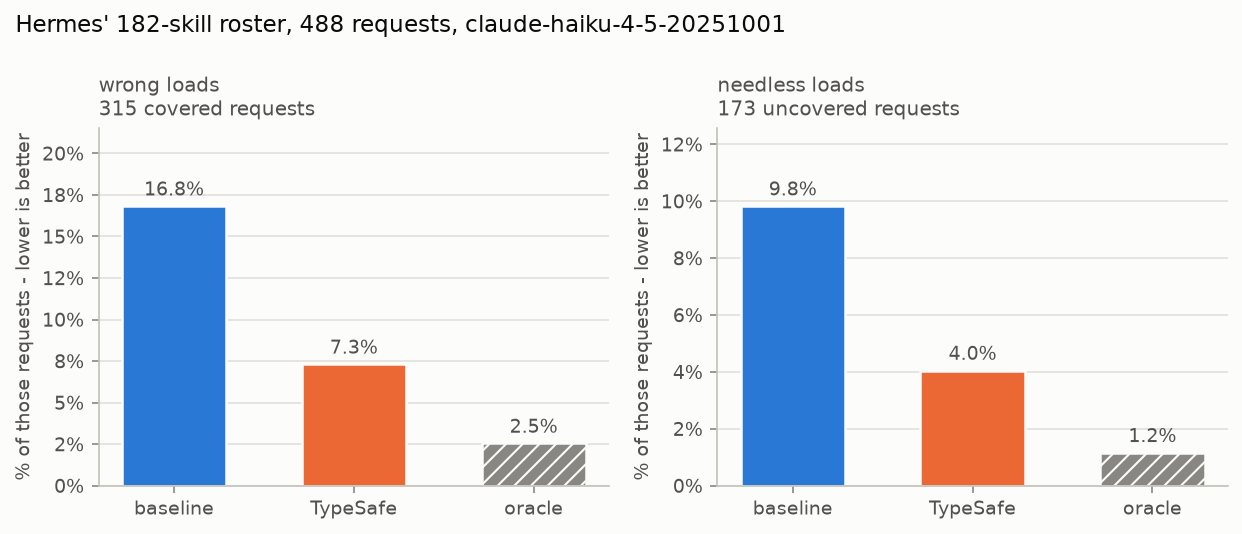
결과가 보여주는 것
- 잘못된 로드는 16.8%에서 7.3%로, 불필요한 로드는 9.8%에서 4.0%로 감소했으며, 이는 잘린 인덱스에서 추측하는 것과 정답을 전달받는 사이의 격차 대부분을 설명합니다.
- 에이전트가 처음부터 올바르게 처리했던 일부 요청은 제안이 첨부되면 잘못 반환됩니다. 해당 건수는 위와 같습니다.
당신의 에이전트가 많은 대상을 관리할 때 이 형태를 복사하세요: 모든 것에 대한 저렴한 랭킹, 그 다음 두세 가지를 밀착해서 살펴보기. 어느 단계에서도 결과가 없을 수 있습니다.
플레이그라운드에서 열기
4단계의 데크 요청에 대한 플레이그라운드 링크를 생성하세요. 각 후보의 전체 설명과 본문 발췌문을 기준으로 사용하세요.
demo_shortlist = tuple(name for name, _ in rank_wide(DEMO[1])["ranked"][:SHORTLIST])
playground_link = make_playground_link(
    build_state(DEMO[1]),
    rerank_questions(demo_shortlist, EXCERPT_CHARS),
    models=[TYPESAFE_MODEL],
)
display(
    Markdown(
        f"🔗 [Open the shortlist + questions in the TypeSafe playground]({playground_link})"
    )
)
TypeSafe 플레이그라운드에서 쇼트리스트와 질문 열기 →
다음 단계
같은 형태가 다른 곳에서도 나타납니다: 의도 라우팅은 스킬이 아닌 핸들러로 라우팅하기 위해, 신뢰도는 두 임계값을 선택하기 위해, 그리고 추측성 팬아웃은 모든 질문을 하나의 요청에 담기 위해 사용됩니다.