 JevCode
SDE 캐스케이드
2단계 구조화된 데이터 추출 캐스케이드(미니 → 검증 → 추론)를 활용하여, 대형 추론 모델의 높은 품질을 훨씬 낮은 비용으로 실현합니다.
이 문서는 en에서 기계 번역되었으며 교정되지 않았습니다. 빠른 참고용으로만 사용하세요.

- 개요
- 대형 추론 모델은 구조화된 데이터를 잘 추출하지만, 속도가 느리고 비용이 비쌉니다.
- 소형 모델은 저렴하지만, 실수를 범합니다.
- 캐스케이드(cascade) 방식은 비용의 일부분으로 대부분의 품질을 확보합니다.
- 우리가 사용하는 모델과 그 가격 ($1M 토큰당, 입력 / 출력; 표준 요금, 2026년 9월 15일 기준 확인):
- 0단 (mini):
gpt-5.4-mini$0.75 / $4.50 - 1단 (reasoning):
gpt-5.5$5.00 / $30.00 (mini의 약 7배) - 검증기: TypeSafe
jev-1.12$0.042 / $0.00 (출력 토큰은 무료; 공개된 Jev 가격표) - 알고리즘
- 저렴하거나/small한 모델로 **추출(Extract)**합니다.
- TypeSafe 프리미티브로 **검증(Verify)**합니다: 필드별 예/아니오 (“Noul 질문”) 질문
- (예: “이 값이 소스에 없습니까?”, “관련 없는 텍스트에서 가져왔습니까?”), 각각 P(무언가 잘못됨)를 반환합니다.
- 검증기 신호가 발생하면 비싼 추론 모델로 **에스컬레이션(Escalate)**합니다; 그렇지 않다면 저렴한 답변을 유지합니다.
- 이 쿡북
- 하나의 실제 예제를 끝까지 따라간 후, 100개 프롬프트에 걸친 트레이드오프를 보여줍니다.
- 참고: 두 추출 단계는 텍스트 모드 OpenAI를 사용합니다.
- 우리는 구조화된 출력, 도구 호출, JSON 모드를 사용하지 않습니다. 그 이유는:
- 스키마 따르기(schema following) 실수는 우리가 LLM이 범길 실수가 아닙니다 (이것을 위해 합성 데이터를 만드는 것은 쉽습니다)
- LLM이 스키마를 따르는 데 실패한다면, 그것은 거의 항상 매우 혼란스러운 상태이므로, 제약 있는 디코딩(constrained decoding)은 근본적인 문제를 해결하지 못합니다
- 하지만 시도해 보시기를 권장합니다!
설정
- 의존성을 설치합니다(TypeSafe 검증자 클라이언트는 TypeSafe의 패키지 인덱스에서 제공됩니다):
pip install openai datasets jsonschema ipython "typesafe-sdk>=0.5.7" cooksafe --extra-index-url https://pypi.typesafe.ai/- 그런 다음 환경에서
OPENAI_API_KEY와TYPESAFE_API_KEY를 설정하세요
import json
import os
from pathlib import Path

import jsonschema
from cooksafe import JsonCache, make_playground_link
from datasets import load_dataset
from IPython.display import Markdown, display
from openai import OpenAI
from typesafe_sdk import Noul, NoulCriteria, TypeSafeClient

MINI = "gpt-5.4-mini"  # rung 0: cheap + fast
REASONING = "gpt-5.5"  # rung 1: strong, run with reasoning_effort="high"
TS_MODEL = "jev-1.12"  # the TypeSafe verifier model
FIRE_T = 0.7  # escalate if any per-field P(wrong) exceeds this; also the "<== FIRES" display marker

oai = OpenAI()

ts = TypeSafeClient(api_key=os.environ["TYPESAFE_API_KEY"], timeout=30.0)
1단계: 데이터
우리는 scrapegraphai라는 huggingface 데이터를 선택합니다
SCRAPEGRAPHAI_REVISION = "4bb9fba1dff9181c5acdb60a5a26fea62fa54fe9"
row = load_dataset(
    "scrapegraphai/scrapegraphai-100k",
    revision=SCRAPEGRAPHAI_REVISION,
    split="train",
)[516]
schema = json.loads(row["schema"])
prompt = row["prompt"]
content = row["content"]

print(
    f"""
PROMPT
===========
{prompt}

SCHEMA
===========
{json.dumps(schema, indent=2)}

CONTENT
===========
{content}
""".strip()
)
PROMPT
===========
Find registration open date fall semester for New York University in New York, NY for the 2024-2025 school year.
SCHEMA
===========
{
"properties": {
"registration_open_date": {
"description": "The date that registration opens for the fall semester. MUST be in the format mm/dd/yyyy. For example, for a college in the 2024-2025 school year, it might be something like 09/05/2024. Return a blank string if you are unsure.",
"title": "Registration Open Date",
"type": "string"
},
"description": {
"description": "A brief description of the registration open date. For example, 'Registration opens for the fall semester'.",
"title": "Description",
"type": "string"
}
},
"required": [
"registration_open_date",
"description"
],
"title": "RegistrationOpen",
"type": "object"
}
CONTENT
===========
Skip to content Skip to current page navigation
[ ](https://www.nyu.edu/)
Search Site
[ ](https://www.nyu.edu/)
* [ Academics](https://www.nyu.edu/academics.html)
* [ Admissions](https://www.nyu.edu/admissions.html)
* [ Research](https://www.nyu.edu/research.html)
* [ University Life](https://www.nyu.edu/life.html)
* [ About](https://www.nyu.edu/about.html)
All NYU
# Mobile Navigation
[ ](https://www.nyu.edu/)
Search Site
* [Academics](https://www.nyu.edu/academics.html)
* [Admissions](https://www.nyu.edu/admissions.html)
* [Research](https://www.nyu.edu/research.html)
* [University Life](https://www.nyu.edu/life.html)
* [About](https://www.nyu.edu/about.html)
All NYU
Info for
* Back to main menu
* Info for
* [Students](https://www.nyu.edu/students.html)
* [Faculty](https://www.nyu.edu/faculty.html)
* [Alumni](https://www.nyu.edu/alumni.html)
* [Employees](https://www.nyu.edu/employees.html)
* [Community](https://www.nyu.edu/community.html)
[Log In](http://home.nyu.edu/)
Info for
* [Students](https://www.nyu.edu/students.html)
* [Faculty](https://www.nyu.edu/faculty.html)
* [Alumni](https://www.nyu.edu/alumni.html)
* [Employees](https://www.nyu.edu/employees.html)
* [Community](https://www.nyu.edu/community.html)
[Log In](https://home.nyu.edu/)
Search Site Search
# Events Calendar
Search Events
Apply Reset
* [About the Events Calendar ](https://www.nyu.edu/employees/resources-and-services/media-and-communications/digital-communications/university-events-calendar.html)
* [Events Calendar Tutorial ](https://www.nyu.edu/employees/resources-and-services/media-and-communications/digital-communications/university-events-calendar/tutorials.html)
* [Report issue or provide feedback ](https://nyu.service-now.com/sp?id=sc_cat_item&sys_id=7698dd2a98bcf4004c8c03063d84e274)
Search Filters Calendar
New York University
Equal Opportunity and Non-Discrimination at NYU - New York University is committed to maintaining an environment that encourages and fosters respect for individual values and appropriate conduct among all persons. In all University spaces--physical and digital--programming, activities, and events are carried out in accordance with applicable law as well as University policy, which includes but is not limited to its Non-Discrimination and Anti-Harassment Policy.
Unless otherwise noted, all content copyright New York University. All rights reserved.
* [Search](https://search.nyu.edu/)
* [Campus Map](https://www.nyu.edu/map.html)
* [Events](https://events.nyu.edu/)
* [Contact Us](https://www.nyu.edu/contact-us.html)
* [Give](https://www.nyu.edu/about/giving.html)
* [Copyright & Fair Use](https://www.nyu.edu/copyright-and-fair-use.html)
* [Privacy](https://www.nyu.edu/privacy.html)
* [Accessibility](https://www.nyu.edu/accessibility.html)
* [Feedback](https://www.nyu.edu/#feedback.html)
* [New York Campus](https://www.nyu.edu/)
* [Abu Dhabi Campus](https://nyuad.nyu.edu/)
* [Shanghai Campus](https://shanghai.nyu.edu/)
* [](https://facebook.com/)
* [](https://linkedin.com/)
* [](https://x.com/)
* [](https://instagram.com/)
* [](https://youtube.com/)- 이 행은 NYU 이벤트 캘린더 페이지(“2024년 가을 학기 등록 마감일”)입니다:
- 스키마는
registration_open_date와description두 가지 필드만 요구합니다 - 프롬프트 스크랩은 캘린더 내비게이션과 표준 텍스트만 캡처했습니다: 등록 날짜나 설명이 없습니다
- 스키마의
description필드는 자체 필드 설명에 예시 값(“가을 학기 등록 시작”)을 포함합니다 - 그러므로 잘 작동하는 추출기는 페이지에 없는 필드를 발명하지 말아야 합니다
- 작은 모델이 올바른 행동을 하는지 확인해 봅시다!
2단계: 미니 모델로 추출 (텍스트 모드)
- 참고:
gpt-5.4-mini는 이 입력에서 매우 확률적(stochastic)입니다 –temperature=0에서도 거의 모든 실행마다 다른description를 생성합니다. 재현 가능한 진행을 위해 이 노트북에서 설명하고 검증기가 P(wrong) > 0.8에서 플래그하는 유일한 표준적 fabrication을 하드코딩합니다(그리고 검증기가 P(wrong) > 0.8에서 플래그함). 실제 파이프라인은extract(MINI, prompt, schema, content, temperature=0)을 직접 취할 것입니다.
EXTRACT_SYSTEM = (
    "You extract structured data from documents. Return only values supported by the text. "
    "Follow any value format specified by the schema or its field descriptions."
)


# LLM and TypeSafe calls are cached to ``json_cache.json``, which ships with the cookbook, so
# re-rendering reproduces the published results with no API spend; delete the file to re-run live.
json_cache = JsonCache(Path("json_cache.json"))


@json_cache
def extract(
    model: str,
    prompt: str,
    schema: dict,
    content: str,
    *,
    reasoning_effort: str | None = None,
    temperature: float | None = None,
) -> dict:
    user = (
        f"{prompt}\n\nReturn ONLY a JSON object matching this JSON Schema:\n"
        f"{json.dumps(schema, indent=2)}\n\nDocument:\n{content}"
    )
    kwargs = {
        "model": model,
        "messages": [
            {"role": "system", "content": EXTRACT_SYSTEM},
            {"role": "user", "content": user},
        ],
    }
    if reasoning_effort:
        kwargs["reasoning_effort"] = reasoning_effort
    if temperature is not None:
        kwargs["temperature"] = temperature
    text = oai.chat.completions.create(**kwargs).choices[0].message.content
    # The prompt asks for ONLY a JSON object, so parse the reply as-is -- no regex fishing a
    # substring out of a malformed reply. If ``json.loads`` fails, treat it as an empty extraction
    # (the record-level analog of NaN): every field reads as absent, which the verifier flags and the
    # gate escalates -- the safe direction. Schema-following errors are rare here (see the overview).
    try:
        return json.loads(text)
    except (ValueError, json.JSONDecodeError):
        return {}


# Hard-coded canonical fabrication (see note above); a real pipeline would use extract(MINI, prompt, schema, content, temperature=0).
mini_record = {
    "registration_open_date": "",
    "description": "Registration opens for the fall semester",
}
print("mini extraction:\n", json.dumps(mini_record, indent=2))

# The record is a perfect fit for the JSON Schema -- and still wrong. Schema validation is necessary
# but not sufficient: it catches structural errors, never semantic ones. That gap is the whole point.
print("\nschema-valid:", jsonschema.Draft202012Validator(schema).is_valid(mini_record))
mini extraction:
{
"registration_open_date": "",
"description": "Registration opens for the fall semester"
}
schema-valid: True- 해당 레코드는 스키마 유효 (위의 줄이
True을 출력함)하지만, 잘못되었습니다: registration_open_date이 비워져 있으며, 이는 페이지와 일치합니다: 날짜가 없음을 명시하고 있음- 그러나
description은 허위입니다: 페이지에 등록 날짜에 대한 설명이 전혀 없으므로, mini가 그럴듯한 날짜를 만들어냈습니다. 스키마의 예시인 “가을 학기 등록 접수”를 그대로 따르거나, “…문서에서 발견되지 않음”과 같은 서술을 할 수 있습니다. - JSON-Schema 검사로는 이를 확인할 수 없습니다. 저가의 모델은 이러한 유형의 확신에 찬, 스키마를 만족시키는 허위 정보를 생성하며, 이를 잡아내는 것은 의미론적 검증기의 역할입니다
3단계: TypeSafe로 검증
- 검증자는 TypeSafe입니다; 각 필드에 대해 우리는
Noul질문을 생성합니다: - 좁은 예/아니오 질문으로,
true= 문제가 있음(에스컬레이션)으로 구성됩니다 - TypeSafe는 각 질문마다 calibrated
noul=P(true)를 system_one 호출 하나로 반환합니다 - 질문 세트:
- 전체적인
__overall__::judge헤드 하나 (“이 레코드를 에스컬레이션해야 하는가?”). 우리는 전체 레코드 판단과 필드별 헤드를 대비하기 위해 이를 계산하고 표시하지만, Step 4의 게이트는 이것을 사용하지 않습니다 – 에스컬레이션은 필드별 배터리에 의해 주도됩니다. - 필드별 배터리
- 비어 있지 않은 필드는 헤드의 전체 세트를 받습니다
- 빈 필드(null / “” / [])는
absence_wrong헤드만 받습니다 - (전체 파이프라인에는 전체 컨테이너용
spurious헤드와 전체difficulty점수도 있습니다; 여기서는 두 가지 게이트 헤드만 다루기 위해 생략합니다) - TypeSafe 방식: 분해
- 모든 것이 프로그래밍적으로 분해되는 방식에 주목하십시오, 이것이 TypeSafe 방식입니다.
- 분해는 모든 프롬프트의 지능을 극대화하고, 알고리즘을 조정 가능하고 해석 가능하게 만듭니다.
-

# metric -> (question, NoulCriteria)
MAIN_QUESTIONS = {
    "name_desc_mismatch": (
        "Does the `extracted_field` fail to match the field at `path` or the `description` in the "
        "`field_spec`? If the `description` is empty, judge against the `path` alone.",
        NoulCriteria(
            true="the `extracted_field` does not match the field name or its `description`",
            false="the `extracted_field` matches the field name and `description`",
        ),
    ),
    "type_mismatch": (
        "Does the `extracted_field` violate the `type` declared in the `field_spec`?",
        NoulCriteria(
            true="the `extracted_field` violates the declared `type`",
            false="the `extracted_field` conforms to the declared `type`",
        ),
    ),
    "unreasonable": (
        "Is the `extracted_field` one that a reasonable person would not have extracted for this "
        "`field_spec`?",
        NoulCriteria(
            true="a reasonable person would not have extracted this value",
            false="the extraction is reasonable",
        ),
    ),
    "hallucinated": (
        "Is the `extracted_field` unsupported by, or absent from, the source text?",
        NoulCriteria(
            true="the `extracted_field` is a hallucination -- not supported by, or absent "
            "from, the source text",
            false="the `extracted_field` is supported by the source text",
        ),
    ),
    "off_target": (
        "Does the source text fail to genuinely report the thing the `field_spec` describes, so the "
        "value was pulled from incidental text?",
        NoulCriteria(
            true="the source does not genuinely provide this field -- the value was pulled "
            "from incidental text",
            false="the source genuinely reports this field",
        ),
    ),
    "incomplete": (
        "Does the `extracted_field` fail to capture a value the source supports (note whether the "
        "`field_spec` is `required`)?",
        NoulCriteria(
            true="the field is wrongly empty, null, or missing a value the source supports",
            false="the field captures the value the source supports",
        ),
    ),
    "format_violation": (
        "Does the `extracted_field` violate the format or constraints implied by the `description`, "
        "the schema `type`, and the extraction instructions (e.g. date format, units, enum membership)?",
        NoulCriteria(
            true="the `extracted_field` violates the implied format or constraints",
            false="the `extracted_field` satisfies the format and constraints",
        ),
    ),
}
ABSENCE_QUESTION = (
    "The `extracted_field` is empty, null, or an empty collection. Does the source text contain the "
    "information the `field_spec` describes, making the empty result wrong?"
)
ABSENCE_CRITERIA = NoulCriteria(
    true="a value was wrongly omitted", false="returning nothing is correct"
)

# The pipeline also asks one holistic, whole-record head: "should this be escalated?"
OVERALL_JUDGE = (
    "Is this extracted record an incorrect extraction -- some value unsupported by the source or "
    "not conforming to the schema, required information missing or wrong, or some field hallucinated -- "
    "so it should be escalated to a smarter model?"
)
OVERALL_JUDGE_CRITERIA = NoulCriteria(
    true="the record is an incorrect extraction",
    false="the record is a correct extraction",
)


def is_empty(v) -> bool:
    return v is None or (isinstance(v, (str, list, dict)) and len(v) == 0)


def field_spec(name: str) -> dict:
    """Minimal spec pulled from the schema (unwrapping anyOf/null for optional fields)."""
    p = schema["properties"][name]
    branches = p.get("anyOf") or []
    typ = p.get("type") or next(
        (b["type"] for b in branches if b.get("type") != "null"), "unknown"
    )
    return {
        "path": name,
        "type": typ,
        "description": p.get("description", ""),
        "required": name in schema.get("required", []),
    }


def build_questions(record: dict) -> dict[str, Noul]:
    """The verify question set: one holistic ``__overall__::judge`` head plus a per-field battery,
    keyed ``field::metric`` (mirrors build_verify_prompts)."""
    questions: dict[str, Noul] = {
        "__overall__::judge": Noul(
            instructions=OVERALL_JUDGE, criteria=OVERALL_JUDGE_CRITERIA
        ),
    }
    for name, value in record.items():
        spec = field_spec(name)
        if is_empty(value):
            questions[f"{name}::absence_wrong"] = Noul(
                instructions={
                    "field_spec": spec,
                    "extracted_field": value,
                    "main_question": ABSENCE_QUESTION,
                },
                criteria=ABSENCE_CRITERIA,
            )
            continue
        for metric, (question, criteria) in MAIN_QUESTIONS.items():
            if metric == "type_mismatch" and spec["type"] == "unknown":
                continue
            questions[f"{name}::{metric}"] = Noul(
                instructions={
                    "field_spec": spec,
                    "extracted_field": value,
                    "main_question": question,
                },
                criteria=criteria,
            )
    return questions


@json_cache
def verify(record: dict) -> dict[str, float | str]:
    """Run the whole Noul battery over a record in one TypeSafe call; return ``{field::metric: P(true)}``."""
    state = {
        "system_message": EXTRACT_SYSTEM,
        "instruction": "Extract the structured record from this document",
        "source_text": row["content"],
        "schema": schema,
        "extraction": record,
    }
    questions = build_questions(record)
    answers = ts.system_one(state=state, questions=questions, model=TS_MODEL).answers
    return {qid: ans.noul for qid, ans in answers.items()} | {
        "playground_link": make_playground_link(state, questions)
    }
미니 추출을 통해 전체 배터리를 실행
checks = verify(mini_record)
playground_link = checks.pop("playground_link")
display(
    Markdown(
        f"🔗 [Open this verification in the TypeSafe playground]({playground_link})"
    )
)

print(f"{'qid':<40}{'P(wrong)':>9}")
print("-" * 50)
for fld, p in sorted(checks.items(), key=lambda c: -c[-1]):
    flag = "  <== FIRES" if p > FIRE_T else ""
    print(f"{fld:<40}{p:>9.2f}{flag}")
qid P(wrong)
--------------------------------------------------
description::hallucinated 0.95 <== FIRES
description::off_target 0.85 <== FIRES
description::unreasonable 0.58
__overall__::judge 0.56
description::incomplete 0.16
registration_open_date::absence_wrong 0.14
description::format_violation 0.10
description::name_desc_mismatch 0.08
description::type_mismatch 0.02TypeSafe 플레이그라운드에서 이 검증을 여세요 →
- TypeSafe는 실제로 잘못된 필드에 신호를 집중합니다.
- 결과 보정이 이루어집니다: 잘못된 필드에서는 높게, 올바른 필드에서는 낮게, 명확히 잘못되지는 않았지만 이상해 보이는 필드에서는 중간 정도로 평가됩니다.
- 이것이 맹목적인 “전체가 괜찮은가?“라는 판단자보다 타입세이프 검증기가 제공하는 이점입니다.
4단계: 에skal레이션 게이트
- 이제 우리는 **
any_flag**에서 게이트를 설정합니다: 어떤 필드 플래그라도FIRE_T(0.7, 위에서 설정됨 및 Step 3의<== FIRES마커와 공유됨)를 초과하면 에스컬레이션합니다 - 이는 평균이 아닌
max-스타일 게이트입니다(어떤 필드라도 발화하면 에스컬레이션), 따라서 하나의 확신 있는 빨간색 플래그가 침묵으로 평균화되는 대신 충분합니다
# any_flag is a per-field gate: the holistic __overall__ head is shown above but not part of it
fired = {
    qid: p
    for qid, p in checks.items()
    if not qid.startswith("__overall__") and p > FIRE_T
}
escalate = bool(fired)

print(
    f"any_flag gate (threshold {FIRE_T}): {'ESCALATE' if escalate else 'ACCEPT cheap result'}"
)
for qid, p in sorted(fired.items(), key=lambda c: -c[1]):
    print(f"  fired: {qid}  (P={p:.2f})")
any_flag gate (threshold 0.7): ESCALATE
fired: description::hallucinated (P=0.95)
fired: description::off_target (P=0.85)5단계: 추론 모델로 에스컬레이션
신호가 발생했으므로, 우리는 강력한 모델(gpt-5.5, reasoning_effort="high")에 대한 비용을 지불합니다.
final_record = (
    extract(REASONING, prompt, schema, content, reasoning_effort="high")
    if escalate
    else mini_record
)

print("mini      :", json.dumps(mini_record))
print("reasoning :", json.dumps(final_record))
print("\nfield-level diff (mini -> final):")
for name in mini_record:
    if mini_record[name] != final_record.get(name):
        print(f"  {name}: {mini_record[name]!r}  ->  {final_record.get(name)!r}")
mini : {"registration_open_date": "", "description": "Registration opens for the fall semester"}
reasoning : {"description": "", "registration_open_date": ""}
field-level diff (mini -> final):
description: 'Registration opens for the fall semester' -> ''- 개선 사항
- 추론 모델은 위조된
description를 제거하고""를 반환함 - 해당 페이지에 등록 날짜가 전혀 기술되어 있지 않음을 인지하고, 이를 발명하지 않음
- 연쇄 작용은 확신에 차고 스키마 유효한 위조를 정직한 빈 필드로 전환함
- 그리고 검증기가 이 항목에 한해 추론을 요청했기 때문에, 이 항목에만 추론 모델 비용을 지출함
6단계: 100개의 프롬프트에서 이것이 어떻게 보이는지
- 이것들은 내부 TypeSafe 결과로, 위의 일반 방법으로 생성됨:
- 동일한
extract → verify → escalate루프,gpt-5.4-mini → gpt-5.5-reasoning,any_flag게이트가 필드별 헤드 위에 적용되며, 100개의 scrapegraphai 프롬프트에 대해 실행됨 - 각 항목의 cheap-rung 추출 결과는 TypeSafe에 의해 점수화됨; 게이트 임계값(“cut”)은 0→1로 스윕되며, 생성된 모든 구성이 (비용, 품질) 공간에 플롯됨
- 차트는 과거의 스냅샷임; 비용은 위에 나열된 현재 Jev 기준으로 다시 계산되지 않음
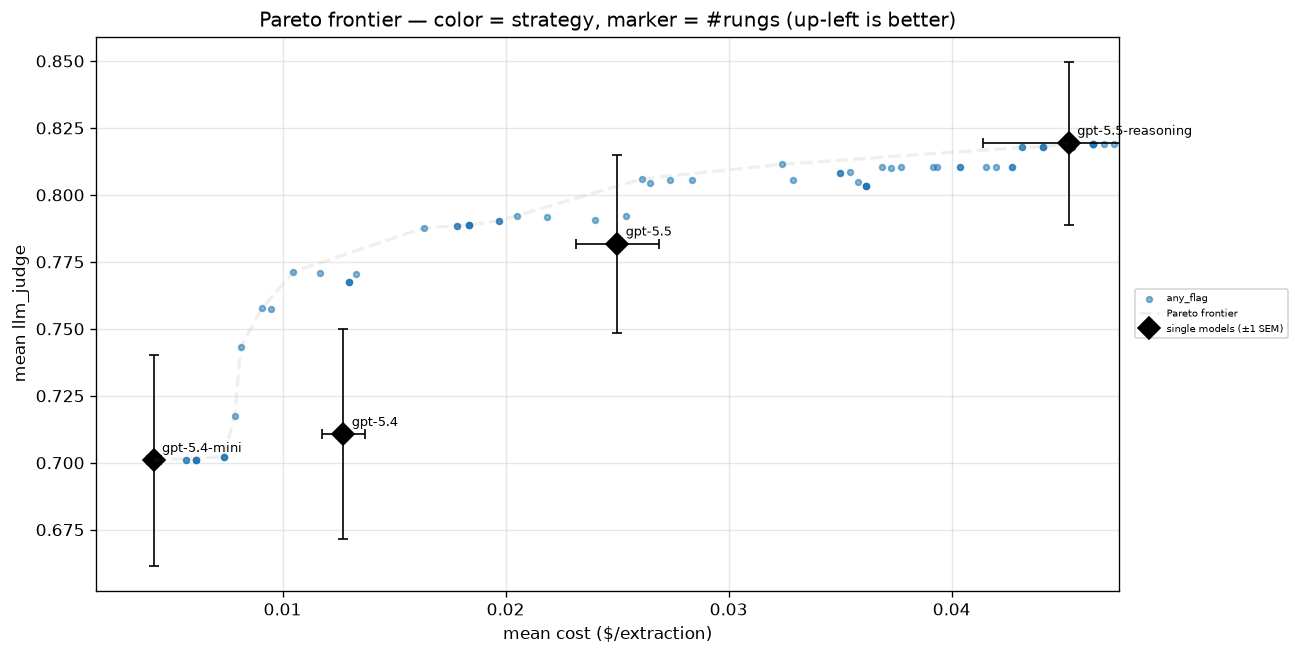
- 읽는 방법:
- 블랙 다이아몬드 = 네 가지 모델이 각각 단독으로 실행된 경우 (역량에 따라 비용이 증가함; 가장 강력한 모델인
gpt-5.5-reasoning는 좌상단에서 ≈0.81의 품질에 ≈$0.10/추출 비용으로 위치함) - 파란 점 = 다양한 게이트 임계값에서의 캐스케이드; 점선 부분은 파레토 프론티어를 나타냄
- 캐스케이드 프론티어는 모든 단일 모델의 좌상단에 위치함: 게이트를 조정하면 최상위 모델의 품질 대부분을 그 비용의 극히 일부로 확보할 수 있음
- 저렴한 단계는 쉬운 항목을 거의 무료에 처리하며, 플래그가 지정된 항목만 추론 모델의 비용을 지불함
부록 A: 양질의 검증자 신호를 만드는 요소
- 캐스케이드는 검증자의 수준만큼만 유효하다; 유용한 신호와 무용한 신호를 가르는 기준은:
- 범위를 좁히고 근거에 기반할 것.
- 소스와 비교해 한 필드에 대해 하나의 검증 가능한 예/아니오 질문 (예: “이 값이 소스에서 결여되어 있는가?”)을 던지고, 모호한 “이 추출물이 좋은가?“라는 질문은 피한다.
- 모호한 질문은 흐릿하고 교정되지 않은 점수를 낳는다.
- 잘못됨 = TRUE, 명시적 기준과 함께.
- 각 질문을 escalate 사례가
true사례가 되도록 구성하고,true/false가 무엇을 의미하는지 명시한다. - 필드별 평가 후
max로 집계. - 필드별 플래그는 오류를 국소화하고 희소성을 유지하며 강력함을 확보한다.
max(“플래그 중 하나라도 발동”)은 하나의 확신 있는 경고 신호가 평균화되어 침묵으로 사라지는 대신 escalates되도록 보장한다.- 독립적이고 저렴해야 함.
- 전용 검증자(여기서는 TypeSafe)가 출력을 판단함으로써 추출기의 자체 맹점을 잡아낸다.
- 저렴해야 한다. 그렇지 않으면 절감 효과를 포착할 여지가 남지 않는다.
- 분리 / 교정 가능해야 함.
- 좋은 신호는 실제 오류에서는 높게, 정답에서는 낮게 나타나야 하므로, 단일 임계값으로 수락과 escalates를 명확히 분리할 수 있다.
- 그 분리가 파레토 곡선을 상좌측으로 끌어올리는 핵심이다.