 JevCode
SDEカスケード
ミニモデルによる検証と推論を含む2段階の構造化データ抽出カスケードを使用し、大規模な推論モデルに匹敵する品質を、大幅に低コストで実現します。
本文はenからの機械翻訳です。校正は未実施で、参考情報としてのみご利用ください。

- 概要
- 大規模推論モデルは構造化データの抽出に優れているが、遅く高価である
- 小規模モデルは安価だが、誤りを犯しやすい
- カスケード方式により、コストの大幅な削減ながら、品質の大部分を達成できる
- 私たちが使用するモデルとその価格(1Mトークンあたり$、入力/出力;標準レート 2026年9月15日時点での確認):
- ランク0(ミニ):
gpt-5.4-mini$0.75 / $4.50 - ランク1(推論):
gpt-5.5$5.00 / $30.00(ミニの約7倍) - 検証器:TypeSafe
jev-1.12$0.042 / $0.00(出力トークンは無料; 公開されているJevの価格表) - アルゴリズム
- 安価/小規模なモデルで抽出する。
- TypeSafeプリミティブで検証する:フィールドごとのyes/no(「Noul質問」) 質問
- (例:「この値はソースに存在しないか?」「無関係なテキストから持ち上げられたか?」)、それぞれが「何か間違っている」確率を返す。
- 検証器のシグナルが検出された場合は高価な推論モデルにエスカレーションする;そうでなければ、安価な回答を維持する。
- このクックブック
- 実際の例をエンドツーエンドで追跡し、その後100プロンプトにわたるトレードオフを示す
- 注:2つの抽出ランクはテキストモードのOpenAIを使用している
- 構造化出力、ツール呼び出し、jsonモードは使用しない。その理由:
- スキーマ準拠のミスは、LLMが犯すことを期待しているミスではない(これ用の合成データを作成するのは容易である)
- LLMがスキーマの準拠に失敗した場合、それはほぼ常に非常に混乱している状態であり、制約付きデコーディングは根本的な問題を解決しない
- ただし、ぜひ試してみてください!
セットアップ
- 依存関係をインストールする(TypeSafe 検証クライアントは TypeSafe のパッケージ インデックスから提供される):
pip install openai datasets jsonschema ipython "typesafe-sdk>=0.5.7" cooksafe --extra-index-url https://pypi.typesafe.ai/- その後、環境変数に
OPENAI_API_KEYとTYPESAFE_API_KEYを設定してください
import json
import os
from pathlib import Path

import jsonschema
from cooksafe import JsonCache, make_playground_link
from datasets import load_dataset
from IPython.display import Markdown, display
from openai import OpenAI
from typesafe_sdk import Noul, NoulCriteria, TypeSafeClient

MINI = "gpt-5.4-mini"  # rung 0: cheap + fast
REASONING = "gpt-5.5"  # rung 1: strong, run with reasoning_effort="high"
TS_MODEL = "jev-1.12"  # the TypeSafe verifier model
FIRE_T = 0.7  # escalate if any per-field P(wrong) exceeds this; also the "<== FIRES" display marker

oai = OpenAI()

ts = TypeSafeClient(api_key=os.environ["TYPESAFE_API_KEY"], timeout=30.0)
ステップ 1: データ
scrapegraphaiという名前のHugging Faceデータセットを選びます
SCRAPEGRAPHAI_REVISION = "4bb9fba1dff9181c5acdb60a5a26fea62fa54fe9"
row = load_dataset(
    "scrapegraphai/scrapegraphai-100k",
    revision=SCRAPEGRAPHAI_REVISION,
    split="train",
)[516]
schema = json.loads(row["schema"])
prompt = row["prompt"]
content = row["content"]

print(
    f"""
PROMPT
===========
{prompt}

SCHEMA
===========
{json.dumps(schema, indent=2)}

CONTENT
===========
{content}
""".strip()
)
PROMPT
===========
Find registration open date fall semester for New York University in New York, NY for the 2024-2025 school year.
SCHEMA
===========
{
"properties": {
"registration_open_date": {
"description": "The date that registration opens for the fall semester. MUST be in the format mm/dd/yyyy. For example, for a college in the 2024-2025 school year, it might be something like 09/05/2024. Return a blank string if you are unsure.",
"title": "Registration Open Date",
"type": "string"
},
"description": {
"description": "A brief description of the registration open date. For example, 'Registration opens for the fall semester'.",
"title": "Description",
"type": "string"
}
},
"required": [
"registration_open_date",
"description"
],
"title": "RegistrationOpen",
"type": "object"
}
CONTENT
===========
Skip to content Skip to current page navigation
[ ](https://www.nyu.edu/)
Search Site
[ ](https://www.nyu.edu/)
* [ Academics](https://www.nyu.edu/academics.html)
* [ Admissions](https://www.nyu.edu/admissions.html)
* [ Research](https://www.nyu.edu/research.html)
* [ University Life](https://www.nyu.edu/life.html)
* [ About](https://www.nyu.edu/about.html)
All NYU
# Mobile Navigation
[ ](https://www.nyu.edu/)
Search Site
* [Academics](https://www.nyu.edu/academics.html)
* [Admissions](https://www.nyu.edu/admissions.html)
* [Research](https://www.nyu.edu/research.html)
* [University Life](https://www.nyu.edu/life.html)
* [About](https://www.nyu.edu/about.html)
All NYU
Info for
* Back to main menu
* Info for
* [Students](https://www.nyu.edu/students.html)
* [Faculty](https://www.nyu.edu/faculty.html)
* [Alumni](https://www.nyu.edu/alumni.html)
* [Employees](https://www.nyu.edu/employees.html)
* [Community](https://www.nyu.edu/community.html)
[Log In](http://home.nyu.edu/)
Info for
* [Students](https://www.nyu.edu/students.html)
* [Faculty](https://www.nyu.edu/faculty.html)
* [Alumni](https://www.nyu.edu/alumni.html)
* [Employees](https://www.nyu.edu/employees.html)
* [Community](https://www.nyu.edu/community.html)
[Log In](https://home.nyu.edu/)
Search Site Search
# Events Calendar
Search Events
Apply Reset
* [About the Events Calendar ](https://www.nyu.edu/employees/resources-and-services/media-and-communications/digital-communications/university-events-calendar.html)
* [Events Calendar Tutorial ](https://www.nyu.edu/employees/resources-and-services/media-and-communications/digital-communications/university-events-calendar/tutorials.html)
* [Report issue or provide feedback ](https://nyu.service-now.com/sp?id=sc_cat_item&sys_id=7698dd2a98bcf4004c8c03063d84e274)
Search Filters Calendar
New York University
Equal Opportunity and Non-Discrimination at NYU - New York University is committed to maintaining an environment that encourages and fosters respect for individual values and appropriate conduct among all persons. In all University spaces--physical and digital--programming, activities, and events are carried out in accordance with applicable law as well as University policy, which includes but is not limited to its Non-Discrimination and Anti-Harassment Policy.
Unless otherwise noted, all content copyright New York University. All rights reserved.
* [Search](https://search.nyu.edu/)
* [Campus Map](https://www.nyu.edu/map.html)
* [Events](https://events.nyu.edu/)
* [Contact Us](https://www.nyu.edu/contact-us.html)
* [Give](https://www.nyu.edu/about/giving.html)
* [Copyright & Fair Use](https://www.nyu.edu/copyright-and-fair-use.html)
* [Privacy](https://www.nyu.edu/privacy.html)
* [Accessibility](https://www.nyu.edu/accessibility.html)
* [Feedback](https://www.nyu.edu/#feedback.html)
* [New York Campus](https://www.nyu.edu/)
* [Abu Dhabi Campus](https://nyuad.nyu.edu/)
* [Shanghai Campus](https://shanghai.nyu.edu/)
* [](https://facebook.com/)
* [](https://linkedin.com/)
* [](https://x.com/)
* [](https://instagram.com/)
* [](https://youtube.com/)- この行は NYU イベントカレンダーページ(「2024年秋学期 Census 日」)です:
- スキーマは
registration_open_dateとdescriptionの2つのフィールドのみを要求しています - プロンプトによるスクレイピングではカレンダーナビゲーションと定型文のみが取得されました:登録日や説明はありません
- スキーマの
descriptionフィールドには、フィールド説明自体に 例 値(「秋学期の登録開始」)が含まれている点に注意してください - したがって、健全な抽出器はページに含まれていないフィールドを捏造して 拒否 すべきです
- 小規模モデルが正しい挙動をするか見てみましょう!
ステップ 2: ミニモデルで抽出する(テキストモード)
- 注:
gpt-5.4-miniはこの入力に対して非常に確率的であり、temperature=0の段階でも ほぼ毎回異なるdescriptionを生成する。再現可能な手順のため、 ハードコードする。これは、このノートブックの残りで説明し、 検証器が P(wrong) > 0.8 でフラグを立てる、唯一の標準的な生成物である。実際のパイプラインでは、extract(MINI, prompt, schema, content, temperature=0)を直接呼び出すだけでよい。
EXTRACT_SYSTEM = (
    "You extract structured data from documents. Return only values supported by the text. "
    "Follow any value format specified by the schema or its field descriptions."
)


# LLM and TypeSafe calls are cached to ``json_cache.json``, which ships with the cookbook, so
# re-rendering reproduces the published results with no API spend; delete the file to re-run live.
json_cache = JsonCache(Path("json_cache.json"))


@json_cache
def extract(
    model: str,
    prompt: str,
    schema: dict,
    content: str,
    *,
    reasoning_effort: str | None = None,
    temperature: float | None = None,
) -> dict:
    user = (
        f"{prompt}\n\nReturn ONLY a JSON object matching this JSON Schema:\n"
        f"{json.dumps(schema, indent=2)}\n\nDocument:\n{content}"
    )
    kwargs = {
        "model": model,
        "messages": [
            {"role": "system", "content": EXTRACT_SYSTEM},
            {"role": "user", "content": user},
        ],
    }
    if reasoning_effort:
        kwargs["reasoning_effort"] = reasoning_effort
    if temperature is not None:
        kwargs["temperature"] = temperature
    text = oai.chat.completions.create(**kwargs).choices[0].message.content
    # The prompt asks for ONLY a JSON object, so parse the reply as-is -- no regex fishing a
    # substring out of a malformed reply. If ``json.loads`` fails, treat it as an empty extraction
    # (the record-level analog of NaN): every field reads as absent, which the verifier flags and the
    # gate escalates -- the safe direction. Schema-following errors are rare here (see the overview).
    try:
        return json.loads(text)
    except (ValueError, json.JSONDecodeError):
        return {}


# Hard-coded canonical fabrication (see note above); a real pipeline would use extract(MINI, prompt, schema, content, temperature=0).
mini_record = {
    "registration_open_date": "",
    "description": "Registration opens for the fall semester",
}
print("mini extraction:\n", json.dumps(mini_record, indent=2))

# The record is a perfect fit for the JSON Schema -- and still wrong. Schema validation is necessary
# but not sufficient: it catches structural errors, never semantic ones. That gap is the whole point.
print("\nschema-valid:", jsonschema.Draft202012Validator(schema).is_valid(mini_record))
mini extraction:
{
"registration_open_date": "",
"description": "Registration opens for the fall semester"
}
schema-valid: True- そのレコードはスキーマ有効(上記の行は
Trueを出力)ですが、内容が誤っています: registration_open_dateが空白のままになっています。これはページの内容と一致しており、ページには日付の記載がないためです- しかし
descriptionは捏造です:ページには登録日に関する記述が一切ないため、miniがそれらしい日付を勝手に作成しています。これはスキーマ内の例文「秋季学期の登録は〇〇から開始」をそのまま繰り返している可能性や、「文書内で見つかりませんでした」といった叙述になっている可能性があります - JSON-Schemaによるチェックではこれを検知できません。安価なモデルは、このようなスキーマ要件を満たしつつ自信に満ちた捏造を生成します。これらを検出するのはセマンティック検証者の役割です
ステップ3:TypeSafeで検証する
- 検証者は TypeSafe です。各フィールドについて、
Noulの質問を1つ構築します。 - これは狭義の yes/no 質問であり、
true= 何かが間違っている(エスカレーション)と解釈されるように構成されます。 - TypeSafe は、1回の system_one 呼び出しで、質問ごとに補正された
noul=P(true)を返します。 - 質問セット:
- 1つの包括的な
__overall__::judgeヘッド(「このレコードをエスカレーションすべきか?」)。これは、レコード全体の判断とフィールドごとのヘッドを対比させるために計算・表示されますが、Step 4 のゲートでは 使用しません――エスカレーションはフィールドごとのバッテリーによって駆動されます。 - フィールドごとのバッテリー
- 空でないフィールドには、ヘッドの全セットが適用されます。
- 空のフィールド(null / “” / [])には、
absence_wrongヘッドのみが適用されます。 - (完全なパイプラインには、全体コンテナ用の
spuriousヘッドと総合的なdifficultyスコアも存在しますが、ここでは2つのゲートヘッドに焦点を当てるため、これらは省略されています。) - TypeSafe のアプローチ:分解
- すべてが プログラム的に分解 されている点に注目してください。これが TypeSafe の方式です。
- 分解は、各プロンプトの知能を最大化し、アルゴリズムを調整可能かつ解釈可能にします。
-

# metric -> (question, NoulCriteria)
MAIN_QUESTIONS = {
    "name_desc_mismatch": (
        "Does the `extracted_field` fail to match the field at `path` or the `description` in the "
        "`field_spec`? If the `description` is empty, judge against the `path` alone.",
        NoulCriteria(
            true="the `extracted_field` does not match the field name or its `description`",
            false="the `extracted_field` matches the field name and `description`",
        ),
    ),
    "type_mismatch": (
        "Does the `extracted_field` violate the `type` declared in the `field_spec`?",
        NoulCriteria(
            true="the `extracted_field` violates the declared `type`",
            false="the `extracted_field` conforms to the declared `type`",
        ),
    ),
    "unreasonable": (
        "Is the `extracted_field` one that a reasonable person would not have extracted for this "
        "`field_spec`?",
        NoulCriteria(
            true="a reasonable person would not have extracted this value",
            false="the extraction is reasonable",
        ),
    ),
    "hallucinated": (
        "Is the `extracted_field` unsupported by, or absent from, the source text?",
        NoulCriteria(
            true="the `extracted_field` is a hallucination -- not supported by, or absent "
            "from, the source text",
            false="the `extracted_field` is supported by the source text",
        ),
    ),
    "off_target": (
        "Does the source text fail to genuinely report the thing the `field_spec` describes, so the "
        "value was pulled from incidental text?",
        NoulCriteria(
            true="the source does not genuinely provide this field -- the value was pulled "
            "from incidental text",
            false="the source genuinely reports this field",
        ),
    ),
    "incomplete": (
        "Does the `extracted_field` fail to capture a value the source supports (note whether the "
        "`field_spec` is `required`)?",
        NoulCriteria(
            true="the field is wrongly empty, null, or missing a value the source supports",
            false="the field captures the value the source supports",
        ),
    ),
    "format_violation": (
        "Does the `extracted_field` violate the format or constraints implied by the `description`, "
        "the schema `type`, and the extraction instructions (e.g. date format, units, enum membership)?",
        NoulCriteria(
            true="the `extracted_field` violates the implied format or constraints",
            false="the `extracted_field` satisfies the format and constraints",
        ),
    ),
}
ABSENCE_QUESTION = (
    "The `extracted_field` is empty, null, or an empty collection. Does the source text contain the "
    "information the `field_spec` describes, making the empty result wrong?"
)
ABSENCE_CRITERIA = NoulCriteria(
    true="a value was wrongly omitted", false="returning nothing is correct"
)

# The pipeline also asks one holistic, whole-record head: "should this be escalated?"
OVERALL_JUDGE = (
    "Is this extracted record an incorrect extraction -- some value unsupported by the source or "
    "not conforming to the schema, required information missing or wrong, or some field hallucinated -- "
    "so it should be escalated to a smarter model?"
)
OVERALL_JUDGE_CRITERIA = NoulCriteria(
    true="the record is an incorrect extraction",
    false="the record is a correct extraction",
)


def is_empty(v) -> bool:
    return v is None or (isinstance(v, (str, list, dict)) and len(v) == 0)


def field_spec(name: str) -> dict:
    """Minimal spec pulled from the schema (unwrapping anyOf/null for optional fields)."""
    p = schema["properties"][name]
    branches = p.get("anyOf") or []
    typ = p.get("type") or next(
        (b["type"] for b in branches if b.get("type") != "null"), "unknown"
    )
    return {
        "path": name,
        "type": typ,
        "description": p.get("description", ""),
        "required": name in schema.get("required", []),
    }


def build_questions(record: dict) -> dict[str, Noul]:
    """The verify question set: one holistic ``__overall__::judge`` head plus a per-field battery,
    keyed ``field::metric`` (mirrors build_verify_prompts)."""
    questions: dict[str, Noul] = {
        "__overall__::judge": Noul(
            instructions=OVERALL_JUDGE, criteria=OVERALL_JUDGE_CRITERIA
        ),
    }
    for name, value in record.items():
        spec = field_spec(name)
        if is_empty(value):
            questions[f"{name}::absence_wrong"] = Noul(
                instructions={
                    "field_spec": spec,
                    "extracted_field": value,
                    "main_question": ABSENCE_QUESTION,
                },
                criteria=ABSENCE_CRITERIA,
            )
            continue
        for metric, (question, criteria) in MAIN_QUESTIONS.items():
            if metric == "type_mismatch" and spec["type"] == "unknown":
                continue
            questions[f"{name}::{metric}"] = Noul(
                instructions={
                    "field_spec": spec,
                    "extracted_field": value,
                    "main_question": question,
                },
                criteria=criteria,
            )
    return questions


@json_cache
def verify(record: dict) -> dict[str, float | str]:
    """Run the whole Noul battery over a record in one TypeSafe call; return ``{field::metric: P(true)}``."""
    state = {
        "system_message": EXTRACT_SYSTEM,
        "instruction": "Extract the structured record from this document",
        "source_text": row["content"],
        "schema": schema,
        "extraction": record,
    }
    questions = build_questions(record)
    answers = ts.system_one(state=state, questions=questions, model=TS_MODEL).answers
    return {qid: ans.noul for qid, ans in answers.items()} | {
        "playground_link": make_playground_link(state, questions)
    }
ミニ抽出全体でバッテリーを走らせる
checks = verify(mini_record)
playground_link = checks.pop("playground_link")
display(
    Markdown(
        f"🔗 [Open this verification in the TypeSafe playground]({playground_link})"
    )
)

print(f"{'qid':<40}{'P(wrong)':>9}")
print("-" * 50)
for fld, p in sorted(checks.items(), key=lambda c: -c[-1]):
    flag = "  <== FIRES" if p > FIRE_T else ""
    print(f"{fld:<40}{p:>9.2f}{flag}")
qid P(wrong)
--------------------------------------------------
description::hallucinated 0.95 <== FIRES
description::off_target 0.85 <== FIRES
description::unreasonable 0.58
__overall__::judge 0.56
description::incomplete 0.16
registration_open_date::absence_wrong 0.14
description::format_violation 0.10
description::name_desc_mismatch 0.08
description::type_mismatch 0.02- TypeSafeは、実際に誤っているフィールドに信号を集中させます。
- 当社の結果は較正済みです:誤っているフィールドでは高く、正しいフィールドでは低く、明らかに誤っていないが不自然に見えるフィールドでは中程度になります。
- これが、TypeSafe検証子が、鈍敏な「全体として良いか?」という判定者に代わって提供するものです。
ステップ4:エスカレーションゲート
- 現在、
any_flagでゲート制御する:任意のフィールドフラグがFIRE_T(上記で設定され、ステップ3の<== FIRESマーカーと共有)を超えた場合にエスカレーションする - これは平均値ではなく
max方式のゲート(任意のフィールドがトリガーされた場合にエスカレーション)であり、1つの確信度の高い赤色フラグだけで十分であり、沈黙に平均化されることはない
# any_flag is a per-field gate: the holistic __overall__ head is shown above but not part of it
fired = {
    qid: p
    for qid, p in checks.items()
    if not qid.startswith("__overall__") and p > FIRE_T
}
escalate = bool(fired)

print(
    f"any_flag gate (threshold {FIRE_T}): {'ESCALATE' if escalate else 'ACCEPT cheap result'}"
)
for qid, p in sorted(fired.items(), key=lambda c: -c[1]):
    print(f"  fired: {qid}  (P={p:.2f})")
any_flag gate (threshold 0.7): ESCALATE
fired: description::hallucinated (P=0.95)
fired: description::off_target (P=0.85)ステップ5: 推論モデルへエスカレーション
シグナルが発火したため、強力モデル(gpt-5.5、reasoning_effort="high")に対して課金します
final_record = (
    extract(REASONING, prompt, schema, content, reasoning_effort="high")
    if escalate
    else mini_record
)

print("mini      :", json.dumps(mini_record))
print("reasoning :", json.dumps(final_record))
print("\nfield-level diff (mini -> final):")
for name in mini_record:
    if mini_record[name] != final_record.get(name):
        print(f"  {name}: {mini_record[name]!r}  ->  {final_record.get(name)!r}")
mini : {"registration_open_date": "", "description": "Registration opens for the fall semester"}
reasoning : {"description": "", "registration_open_date": ""}
field-level diff (mini -> final):
description: 'Registration opens for the fall semester' -> ''- 改善点
- 推論モデルは捏造された
descriptionを削除し、""を返す - ページに登録日が記載されていないことを認識し、登録日を捏造することを拒否した
- この連鎖により、自信に満ちたスキーマ準拠の捏造が、正直な空フィールドへと変わった
- そして、この項目に対してのみ推論モデルの計算リソースを費やしたのは検証者が指示したからである
ステップ6:100プロンプトでこれがどう見えるか
- これらは内部の TypeSafe 結果であり、上記の一般的手法を用いて生成されました:
- 同一の
extract → verify → escalateループ、gpt-5.4-mini → gpt-5.5-reasoning、any_flagによるフィールドごとのヘッドへのゲート処理は、100 件の scrapegraphai プロンプトに対して実行されました - 各項目の低コストラung抽出は TypeSafe によってスコアリングされます;ゲートしきい値(「カット」)は 0→1 でスイープされ、生成されたすべての構成が(コスト、品質)空間上にプロットされます
- このチャートは歴史的なスナップショットであり、上記に記載されている現在の Jev レートにおいてコストは再計算されていません
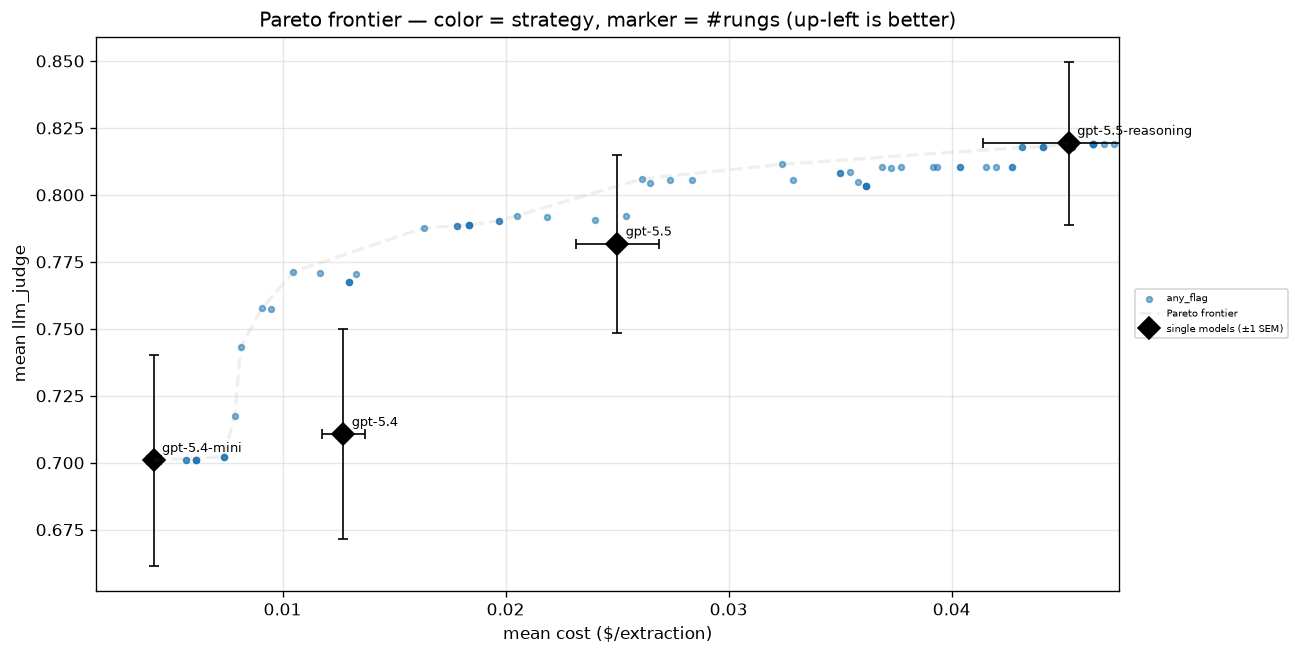
- 読み方:
- 黒いダイヤモンド = 4つのモデルがそれぞれ単独で稼働した場合(能力が上がるとコストも上昇;最も強力な
gpt-5.5-reasoningは、右上に位置し、抽出あたり約0.10ドルで約0.81の品質を示す) - 青い点 = 多数のゲート閾値におけるカスケード;破線は パレートフロンティア を示す
- カスケードのフロンティアは すべてのモデルの左上に位置する:ゲートを調整することで、トップモデルの品質の大部分を、そのコストの大幅な削減で入手できる
- 低コストの段階は、簡単な項目をほぼ無料で処理し、フラグ付きの項目のみが推論モデルのコストを支払う
付録 A: 優れた検証シグナルの条件
- カスケードの品質は検証者の品質に依存します。有用なシグナルと無用なシグナルを分けるものは:
- 範囲を限定し、根拠に基づいていること。
- 1つのフィールドについて、ソースに対して検証可能な yes/no(例:「この値がソースに存在しないか?」)であり、曖昧な「この抽出は良いか?」ではない
- 曖昧な質問は、曖昧で較正されていないスコアをもたらす
- Bad = TRUE、かつ明確な基準。
- 各質問を、エスカレーション ケースが
trueケースとなるように構成し、true/falseの意味を明記する - フィールドごとに行い、
maxで集約する。 - フィールドごとのフラグはエラーを局所化し、疎で強力な状態を維持する
max(「いずれかのフラグが発火」)は、1つの確信のある赤色フラグが沈黙に平均化されるのではなく、エスカレーションされることを保証する- 独立しており、安価であること。
- 専用検証者(ここでは TypeSafe)が出力を判定することで、抽出器自身の盲点を捉える
- 安価でなければならず、さもないと、節約分を回収する余地がなくなる
- 分離可能/較正済みであること。
- 良いシグナルは、実際のエラーに対しては高く、正しいものに対しては低いため、単一の閾値で受理とエスカレーションを明確に分離できる
- その分離こそが、パレート曲線を左上に押し上げる要因である