 JevCode
事前解析値抽出
正規表現で候補となるメールアドレス、電話番号、金額を検出し、その後 TypeSafe が要求されたスパンを選択することで、コードが原文のままの値を正規化できるようにする。
本文はenからの機械翻訳です。校正は未実施で、参考情報としてのみご利用ください。

正規表現が候補値を検出し、TypeSafeが質問で求められているものを選び、 コードはそれをそのままコピーします。
ここでfindとpickのペアは、あなたのドキュメントを指し示すことができるものであり、3つの実例がその使用法を示しています:差出人が領収書を送信したい住所、+14155550177としての電話番号、および請求としてフラグ付けされた1315.50 USDの請求書合計額。
TypeSafeはあなたが渡したオプションの中から1つを選ぶので、候補をまず見つける必要があります。正規表現でそれらを見つけ、TypeSafeが1つを選び、コードがその選択をコピーする、という3つのステップです:
- 正規表現でテキスト内の候補値を検出します。過検出されるように調整してください。
- TypeSafe は、質問が求める候補値を選択し、コードが下流で必要とする属性(通貨、国、金額がクレジットか請求か)を読み取ります。
- コードは選択された値をコピーし、正規化します。
TypeSafeは正規表現が見つけたスパンの中からのみ選択するため、返される値はそれらのスパンのいずれかで、変更せずにコピーされたものです。値を凭空生成したり、桁を並べ替えたりすることはできません。
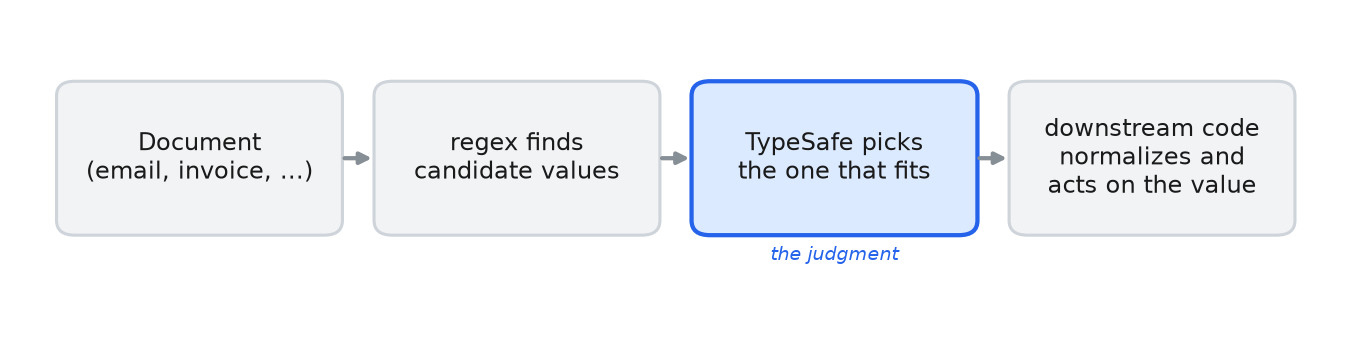
正規表現でドキュメント内の候補値を検出し、TypeSafe が1つを選択し、下流のコードがそれを正規化して処理する。
セットアップ
pip install ipython phonenumbers "typesafe-sdk>=0.5.7" cooksafe --extra-index-url https://pypi.typesafe.ai/その後、TYPESAFE_API_KEYを設定します。
import os
import re
from decimal import Decimal
from pathlib import Path

import phonenumbers
from cooksafe import JsonCache, make_playground_link
from IPython.display import Markdown, display
from typesafe_sdk import Choice, Noul, TypeSafeClient

TYPESAFE_MODEL = "jev-1.12"
NONE = "none"  # the escape hatch on every selection: "none of the candidates fits"

# base_url defaults to https://api.typesafe.ai/ ; the env override points at another deployment.
ts = TypeSafeClient(
    api_key=os.environ.get(
        "TYPESAFE_API_KEY", "cache-only"
    ),  # cached re-renders need no key
    base_url=os.environ.get("TYPESAFE_BASE_URL"),
    timeout=30.0,
)
json_cache = JsonCache(Path("json_cache.json"))
ヘルパー
findは、過剰検出に調整された正規表現を実行し、重複を除去します。pickは、選択肢がfindが返すスパンであるChoice質問であり、その回答はそれらのスパンを正確にコピーしたもの、または該当する候補がない場合はnoneになります。classifyは、通貨と国に対して使用される、固定されたラベルセット上のChoice質問です。
is_trueはNoulであり、ここでは金額がクレジットかどうかを尋ねるために使用されます。
すべての呼び出しは json_cache.json にキャッシュされるため、再描画時に API 呼び出しは行われません。
EMAIL_RE = re.compile(r"[A-Za-z0-9._%+-]+@[A-Za-z0-9.-]+\.[A-Za-z]{2,}")
PHONE_RE = re.compile(r"\(?\+?\d[\d\s()\-.]{6,}\d")
MONEY_RE = re.compile(r"[$€£¥]\s?\d[\d,]*(?:\.\d{2})?")


def find(pattern: re.Pattern, text: str) -> list[str]:
    """Code-side candidate finder: recall-tuned regex, deduped, in document order."""
    seen: set[str] = set()
    out: list[str] = []
    for match in pattern.findall(text):
        span = match.strip()
        if span and span not in seen:
            seen.add(span)
            out.append(span)
    return out


@json_cache
def pick(document: str, candidates: list[str], question: str) -> dict:
    """TypeSafe selects which found span plays the role. Returns {choice, confidence}.

    The options ARE the candidate spans, so ``choice`` is a verbatim copy of one of them (or the
    ``none`` hatch) - the model chooses, code owns the string."""
    criteria = {c: None for c in candidates} | {
        NONE: "None of these is the requested value."
    }
    answer = ts.system_one(
        state=document,
        questions={"pick": Choice(instructions=question, criteria=criteria)},
        model=TYPESAFE_MODEL,
    ).answers["pick"]
    return {"choice": answer.choice, "confidence": answer.confidence}


@json_cache
def classify(document: str, question: str, options: list[str]) -> dict:
    """A small Choice over a fixed label set (currency, country, ...). Returns {choice, confidence}."""
    answer = ts.system_one(
        state=document,
        questions={
            "q": Choice(instructions=question, criteria={o: None for o in options})
        },
        model=TYPESAFE_MODEL,
    ).answers["q"]
    return {"choice": answer.choice, "confidence": answer.confidence}


@json_cache
def is_true(document: str, question: str) -> float:
    """A yes/no Noul. Returns P(yes)."""
    return (
        ts.system_one(
            state=document,
            questions={"q": Noul(instructions=question)},
            model=TYPESAFE_MODEL,
        )
        .answers["q"]
        .noul
    )
メール: 役割に応じて適切なアドレスを選択
ヘッダーには4つの住所がある。本文では、To:請求先エイリアスではなく個人宛の住所に領収書を送るよう求められているため、回答は本文を読む必要がある。ここでは2つの質問がある:領収書はどの住所に送るか、そしてメッセージはどの住所から送られてきたか。
EMAIL_DOC = """From: Dana Whit <[email protected]>
To: [email protected]
Cc: [email protected]
Reply-To: [email protected]

Hi team - please don't use the billing alias for this one. Send my receipt to my
personal address instead. Thanks, Dana."""

emails = find(EMAIL_RE, EMAIL_DOC)
receipt = pick(
    EMAIL_DOC, emails, "Which email address does the sender want their receipt sent to?"
)
sender = pick(
    EMAIL_DOC, emails, "Which email address did this message come from (the From line)?"
)

print("candidates :", emails)
# code copies the picked value verbatim and normalizes (lowercase); it never re-types it
print(
    f"receipt -> : {receipt['choice'].lower():<28} (conf {receipt['confidence']:.2f})"
)
print(f"sender  -> : {sender['choice'].lower():<28} (conf {sender['confidence']:.2f})")
candidates : ['[email protected]', '[email protected]', '[email protected]', '[email protected]']
receipt -> : [email protected] (conf 0.98)
sender -> : [email protected] (conf 1.00)receiptはReply-To:行にある個人用Gmailアドレスであり、本文で求められているものです。senderはFrom行にあるアドレスです。両方とも正規表現のマッチ結果のコピーであり、コード内で小文字に変換されています。
電話:モバイルを選択し、E.164 に正規化する
国コードを伴わない3つの数値。TypeSafeが携帯電話を特定し、テキストから国を読み取ります;phonenumbersはこれらの2つの回答をE.164形式に統合します。E.164は+と国コードで始まる国際形式です。
PHONE_DOC = """Reach our San Francisco office at these numbers: main desk (415) 555-0199,
billing fax (415) 555-0142, and my direct cell (415) 555-0177. Call the cell if it's urgent."""

phones = find(PHONE_RE, PHONE_DOC)
mobile = pick(PHONE_DOC, phones, "Which of these is the direct mobile / cell number?")
region = classify(
    PHONE_DOC,
    "In what country is this office located?",
    ["US", "GB", "DE", "FR", "CA", "AU"],
)

# code copies the picked value and normalizes it with the model-supplied country
parsed = phonenumbers.parse(mobile["choice"], region["choice"])
e164 = phonenumbers.format_number(parsed, phonenumbers.PhoneNumberFormat.E164)

print("candidates :", phones)
print(f"mobile  -> : {mobile['choice']}  (conf {mobile['confidence']:.2f})")
print(f"country -> : {region['choice']}  (conf {region['confidence']:.2f})")
print(f"E.164   -> : {e164}")
candidates : ['(415) 555-0199', '(415) 555-0142', '(415) 555-0177']
mobile -> : (415) 555-0177 (conf 1.00)
country -> : US (conf 0.90)
E.164 -> : +14155550177桁の数字だけでは、どの番号が携帯電話用で、どの国に属するのかが分かりません。それを判断するのは、周囲の言葉です。TypeSafe はそれらの言葉を読み取り、phonenumbers で選ばれた番号を +14155550177 の形式で整形します。
お金:金額を選択し、通貨を分類し、クレジットと請求を区別する
4つの金額が記載された請求書。TypeSafeは未払総額とクレジット額を選択し、通貨を読み取り、選択された各金額を請求またはクレジットとしてフラグ付けします。コードは選択された各文字列をコピーし、それを Decimal に解析します。
MONEY_DOC = """Invoice INV-2087.
Subtotal: $1,200.00
Sales tax: $115.50
Total due: $1,315.50
A $50.00 courtesy credit from last month has already been applied."""

amounts = find(MONEY_RE, MONEY_DOC)
currency = classify(
    MONEY_DOC,
    "What currency are these amounts in?",
    ["USD", "EUR", "GBP", "JPY", "CAD"],
)
total = pick(MONEY_DOC, amounts, "Which amount is the total the customer must pay?")
credit = pick(
    MONEY_DOC, amounts, "Which amount is the courtesy credit that was applied?"
)


def to_decimal(value: str) -> Decimal:
    """Copy the picked value and parse the number in code (US grouping/decimal here)."""
    return Decimal(re.sub(r"[^\d.]", "", value))


for label, chosen in [("total due", total), ("credit", credit)]:
    is_credit = is_true(
        MONEY_DOC,
        f"Is the amount {chosen['choice']} a credit or refund to the customer, not a charge?",
    )
    kind = "credit" if is_credit > 0.5 else "charge"
    print(
        f"{label:<10}: {chosen['choice']:<10} -> {to_decimal(chosen['choice'])} {currency['choice']} "
        f"({kind}, P(credit)={is_credit:.2f})"
    )
print("\ncandidates :", amounts)
total due : $1,315.50 -> 1315.50 USD (charge, P(credit)=0.01)
credit : $50.00 -> 50.00 USD (credit, P(credit)=0.99)
candidates : ['$1,200.00', '$115.50', '$1,315.50', '$50.00']合計支払額は1,315.50米ドル、クレジットは50.00米ドルです。クレジットまたは請求
Noulは合計に対して0.01、クレジットに対して0.99に回答するため、コードは解析する各Decimalの符号を把握します。
to_decimalは、カンマが千の位を区切り、ドットが小数点であると仮定します。これは$1,315.50に当てはまりますが、€1.315,50ではその逆です。文書がどの慣習を採用しているかを問うNoul質問を行い、コード内で分岐してください。
TypeSafe プレイグラウンドで開く
ブラウザでメールスレッドを開く共有リンクで、領収書の質問と、正規表現がオプションの中から見つけた4つのアドレスが含まれています。
receipt_criteria = {e: None for e in emails} | {
    NONE: "None of these is the requested value."
}
playground_link = make_playground_link(
    EMAIL_DOC,
    {
        "receipt": Choice(
            instructions="Which email address does the sender want their receipt sent to?",
            criteria=receipt_criteria,
        )
    },
    models=[TYPESAFE_MODEL],
)
display(
    Markdown(
        f"🔗 [Open this thread + selection in the TypeSafe playground]({playground_link})"
    )
)
このスレッドと選択範囲を TypeSafe プレイグラウンドで開く →
二つの制限
Choiceの質問では、オプションは最大255個までです。それ以上の候補がある場合は、2段階で絞り込みます:まずセクションを選び、その中の範囲を特定します。- 候補の特定が作業の中心です。メールアドレス、電話番号、金額には正規表現で対応できますが、名前には対応できないため、候補は既存のリストか、名前を抽出するエンティティ認識モデルやLLMから得る必要があります。その後、TypeSafeが質問で求められているものを選択します。