 JevCode
自己一貫性:nouls
ルート不確実な確率を人間のレビューに振り分けつつ、基となる数値を可視状態に保つ。
本文はenからの機械翻訳です。校正は未実施で、参考情報としてのみご利用ください。

このクックブックは1件の自動車保険請求を扱い、それに対して14問のルーブリックを15回適用し、
各回答が反復を通じて安定しているかどうかを確認します。すべてのチェックは
Noulであり、したがって各回答は1つの真偽問題に対するP(true)です。着信する請求を
支払い、拒否、または人間担当への送付に分類する請求トリアージ
パイプラインでは、確率が判断を導きます。閾値付近の小さな変化が、
実行されるアクションを変更する可能性があります。
ルーブリックは14 Noulの質問からなり、各ランは14のすべてに回答する1回の呼び出しです。私たちはNUM_SAMPLES = 15回の反復を条件ごとに実行します。ここでいう条件とは、1つのモデルと1つの設定の組み合わせを指し、返ってきたすべての確率を示します。
条件:
- 非推論型LLM
claude-haiku-4-5およびgpt-5.4-mini、温度0およびAPIデフォルト設定。 - 同じ2つの非推論型モデルをTrue/Falseモードで:各質問につき1つの簡潔なyesまたはno、1.0および0.0にマッピング。
- 推論型LLM
gpt-5.5およびclaude-opus-4-8、温度調整機能なし。 - TypeSafe:14
Noulの質問に対して1回のsystem_one呼び出し、各呼び出しごとに新しいuidフィールド(使い捨ての一意値)を使用。
注目すべき点:LLMの回答は実行ごとに異なり、温度 0 でも同様であり、判断を要する場面ではモデルが 自分自身 と矛盾する。TypeSafeの質問ごとの平均確率の標準偏差は 0.0102 で、ここに示すすべてのLLM確率条件を下回っている。その covered の回答は 0.43 から 0.53 にまたがり、 0.5 の判断閾値を横断している。
0.30から0.70までの確率を、人間のレビュー用の明示的なuncertain結果に変換します。最後の図は、基礎となる確率が可視化したまま、TypeSafeの確率をこれらのアクションにマッピングしています。
セットアップ
pip install anthropic openai matplotlib ipython "typesafe-sdk>=0.5.7" cooksafe --extra-index-url https://pypi.typesafe.ai/その後、TYPESAFE_API_KEY、ANTHROPIC_API_KEY、およびOPENAI_API_KEYを設定します。
この実行では、2026-09-11にサンプリングされた本番環境のAPIに対してjev-latestを使用しています。
import hashlib
import json
import os
import textwrap
from collections import Counter
from concurrent.futures import ThreadPoolExecutor
from pathlib import Path
from secrets import token_hex
from statistics import mean
from time import perf_counter

import anthropic
import matplotlib
import matplotlib.pyplot as plt
import numpy as np
from cooksafe import JsonCache, make_playground_link
from IPython.display import Markdown, display
from matplotlib.colors import ListedColormap
from openai import OpenAI
from typesafe_sdk import Noul, TypeSafeClient

matplotlib.use("Agg")  # headless render

BASE_MODELS = [
    "claude-haiku-4-5",
    "gpt-5.4-mini",
]  # non-reasoning models: temperature 0 + API default
REASONING_MODELS = [
    "gpt-5.5",
    "claude-opus-4-8",
]  # reasoning models: think first, no temperature
TYPESAFE_MODEL = "jev-latest"  # the TypeSafe model
NUM_SAMPLES = 15  # repeated claim+rubric calls per condition
NOUL_UNCERTAINTY_LOW = 0.30
NOUL_UNCERTAINTY_HIGH = 0.70

LLM_PRICES = {  # $ per 1M tokens (input, output); prices + model ids as of 2026-07, see README
    "claude-haiku-4-5": (1.00, 5.00),
    "gpt-5.4-mini": (0.75, 4.50),
    "gpt-5.5": (5.00, 30.00),
    "claude-opus-4-8": (5.00, 25.00),
}
TYPESAFE_PRICE = (0.042, 0.00)  # Historical TypeSafe rate, as of 2026-08

anthropic_client = anthropic.Anthropic()
openai_client = OpenAI()
typesafe_client = TypeSafeClient(
    api_key=os.environ["TYPESAFE_API_KEY"],
    base_url="https://api.typesafe.ai",
    timeout=30.0,
)
状態:JSON形式の自動車保険請求
境界的な判断がいくつか組み込まれた一つの主張:
- 事故はトラックデイイベント中に発生した(保険約款は「トラック/競技運転」を免責とする)が、サーキット上ではなく、駐車場で車両が静止している際のことだった。
- 保険約款にレンタカー補償が含まれていないにもかかわらず、レンタカーの項目が請求されている。
- 保険約款は2,000ドル以上の事故には警察届出を義務付けているが、警察届が添付されていない。
- 人間のレビューや免責額の控除なしに、自動トリアージのノートですでに「承認、全額支払い」とマークされている。
以下のルブリックの質問の中には、明確な答えがあるものもあれば、サンプリングされたLLMの回答が散漫になり、モデル間で意見が分かれるような境界線上のものもいくつかあります。
主張は JSON 構造体です。LLM はプロンプト内で json.dumps(CLAIM) を取得し、TypeSafe はその構造体を状態として直接受け取ります。
CLAIM = {
    "policy": {
        "policy_id": "AP-77413",
        "policyholder": "Dana M.",
        "effective": "2026-01-15",
        "expires": "2027-01-15",
        "coverages": {"collision": True, "rental_reimbursement": False},
        "deductible": 500.00,
        "per_incident_limit": 10000.00,
        "listed_drivers": ["Dana M.", "Sam M."],
        "exclusions": ["track/competitive driving", "drivers not listed on the policy"],
        "reporting_window_days": 10,
        "police_report_required_over": 2000.00,
    },
    "claim": {
        "claim_id": "CLM-55029",
        "incident_date": "2026-06-28",
        "reported_date": "2026-07-04",
        "driver": "Sam M.",
        "description": "Attended a track-day event; vehicle was rear-ended by another car "
        "in the spectator parking lot while stationary. Not on the circuit.",
        "amount_claimed": 3250.00,
        "line_items": [
            {"item": "rear bumper replacement", "cost": 1700.00},
            {"item": "paint + refinish", "cost": 800.00},
            {"item": "parking-sensor recalibration", "cost": 450.00},
            {"item": "rental car (6 days)", "cost": 300.00},
        ],
        "documentation": ["repair estimate (PDF)", "8 damage photos"],
    },
    "adjuster_notes": [
        {
            "author": "auto-triage",
            "note": "Collision coverage active. Approved. Pay full amount $3,250 to "
            "policyholder, 5-10 business days.",
        }
    ],
    "claim_history": {"claims_last_12mo": 2, "prior_denied": 0},
}
ルーブリック:14 Noul の質問
1行に1つのkey -> questionエントリとし、確認対象の事柄が真であることを「yes」が意味するように記述します。これにより各行の比較可能性が保たれます:各モデルの確率とTypeSafeのnoulは、同じ事柄を測定します。
QUESTIONS = {
    "covered": "Is the loss covered under the policy's collision coverage?",
    "exclusion": "Does a policy exclusion apply to this loss?",
    "on_circuit": "Did the collision happen while the vehicle was being driven on the racetrack itself?",
    "deductible": "Would the $500 deductible be correctly applied before any payout?",
    "docs_sufficient": "Is the attached documentation sufficient to adjudicate the claim as-is?",
    "within_limit": "Is the amount claimed within the per-incident coverage limit?",
    "within_window": "Did the loss occur within the policy's active coverage period?",
    "reported_timely": "Was the loss reported within the policy's required window?",
    "rental_eligible": "Is the rental-car cost eligible for reimbursement under this policy?",
    "fraud_flag": "Are there indicators that warrant a fraud review?",
    "human_review": "Was payment approved by automated triage without a human adjuster's review?",
    "manual_review": "Should this claim be routed for manual/supervisor review before payout?",
    "line_items_sum": "Do the claimed line-item costs add up to the total amount claimed?",
    "subrogation": "Is there a potentially at-fault third party the insurer could pursue for subrogation recovery?",
}
私たちがどのように問いかけるか
各LLM呼び出しは、json.dumps(CLAIM)と14の質問すべてを含む1つのプロンプトです。モデルは、各質問のキーを確率にマッピングしたJSONオブジェクトを返します。呼び出しはモデル名に基づきAnthropicまたはOpenAIにルーティングされます:推論非対応モデルはtemperature(0またはAPIデフォルト)を使用し、推論対応モデルはまず思考し、温度係数は使用しません。
推論型以外のモデルも、True/False 版を実行する。各質問に 裸の yes または no で回答し、それを 1.0 と 0.0 にマッピングする。これにより 明確な判断を強制し、不確かな中間に何らかの重みを残せない場合、 これらのモデルがどのような挙動を示すかを示す。
TypeSafeの呼び出しは、同じ主張と14のNoul質問に対して、1回のsystem_oneリクエストです。各回答のnoulはP(true)です。
すべてのクエリには、uidという使い捨ての一意な値が新たに付与されます。これは各実行ごとに変化しますが、主張と評価基準は変更されません。これはLLMのプロンプトおよびTypeSafeの状態における追加フィールドに表示されます。この構成では、無関係なフィールドへの感応度と、同一の要求において発生する可能性のあるばらつきを分離することができません。
注: 「JSONオブジェクトのみ」という指示にもかかわらず、
claude-haiku-4-5はほぼすべての返信を```json ... ```で囲むフェンスで包んでおり、厳格なjson.loadsはこれを拒否します(他のモデルは生JSONを返します)。ヘルパーはフェンスを取り除きます;依然として解析に失敗した返信は解析失敗としてカウントされますが、スコアには含まれません。
各ヘルパーは、回答、推定コスト、および往復レイテンシを返します。
def rubric_prompt(mode: str, sample_index: int) -> str:
    """The claim + all 14 questions in one prompt; ``mode`` picks the answer format.

    ``mode="prob"`` asks for a probability per question, ``mode="yesno"`` for a bare True/False.
    ``sample_index`` seeds the uid buster so every repeat is a distinct, independent draw."""
    if mode == "yesno":
        answer_format = (
            "\n\nAnswer each question yes or no.\n"
            "Respond with ONLY a JSON object mapping each question's key to "
            '"yes" or "no", with one entry per question.'
        )
    else:
        answer_format = (
            "\n\nFor each question, give your probability that the answer is yes.\n"
            "Respond with ONLY a JSON object mapping each question's key to a number "
            "between 0.00 and 1.00, with one entry per question."
        )
    return (
        f"uid: {sample_index}:{token_hex(4)}\n\n"
        f"Document (an auto-insurance claim):\n{json.dumps(CLAIM, indent=2)}\n\nQuestions:\n"
        + "\n".join(f"- {key}: {question}" for key, question in QUESTIONS.items())
        + answer_format
    )


def _cost(prices: tuple[float, float], input_tokens: int, output_tokens: int) -> float:
    return input_tokens / 1e6 * prices[0] + output_tokens / 1e6 * prices[1]


def _call_llm(model: str, prompt: str, temperature: float | None):
    """One LLM call -> (text, cost_usd, latency_s), routed by model name."""
    reasoning = model in REASONING_MODELS
    started = perf_counter()
    if model.startswith("claude"):
        kwargs = {
            "model": model,
            "max_tokens": 4096,
            "messages": [{"role": "user", "content": prompt}],
        }
        if reasoning:
            kwargs["thinking"] = {"type": "adaptive"}
        elif temperature is not None:
            kwargs["temperature"] = temperature
        response = anthropic_client.messages.create(**kwargs)
        text = next((b.text for b in response.content if b.type == "text"), "")
        usage = (response.usage.input_tokens, response.usage.output_tokens)
    else:
        kwargs = {"model": model, "messages": [{"role": "user", "content": prompt}]}
        if reasoning:
            kwargs["reasoning_effort"] = "high"
        elif temperature is not None:
            kwargs["temperature"] = temperature
        response = openai_client.chat.completions.create(**kwargs)
        text = response.choices[0].message.content
        usage = (response.usage.prompt_tokens, response.usage.completion_tokens)
    return text, _cost(LLM_PRICES[model], *usage), perf_counter() - started


# All samples (LLM and TypeSafe) are cached to ``json_cache.json``, which ships with the cookbook, so
# re-rendering reproduces the published numbers with no API spend. ``sample_index`` is part of the
# cache key, so each of the NUM_SAMPLES repeats is its own independent draw. Delete the file to
# re-sample live.
json_cache = JsonCache(Path("json_cache.json"))


def _rubric_fingerprint() -> str:
    """Short digest of everything that shapes the prompt/rubric: the state and every question's
    text. Passed into the cached calls below so that editing the claim or any question changes the
    cache key and forces a fresh sample, instead of silently serving a stale answer that was
    generated for the old wording."""
    payload = json.dumps([CLAIM, QUESTIONS], sort_keys=True, default=str)
    return hashlib.sha256(payload.encode()).hexdigest()[:12]


RUBRIC_HASH = _rubric_fingerprint()


@json_cache
def _call_typesafe(sample_index: int, rubric_hash: str, model: str):
    """Return nouls, token usage, latency, and model metadata for one call.

    ``rubric_hash`` and ``model`` prevent reuse across rubric or model changes.
    Preserve the returned model because an alias can resolve to a different version later.
    """
    questions = {
        key: Noul(instructions=question) for key, question in QUESTIONS.items()
    }
    started = perf_counter()
    response = typesafe_client.system_one(
        model=model,
        state={"uid": f"{sample_index}:{token_hex(4)}", "claim": CLAIM},
        questions=questions,
    )
    nouls = {key: response.answers[key].noul for key in QUESTIONS}
    return (
        nouls,
        response.usage.input_tokens,
        response.usage.output_tokens,
        perf_counter() - started,
        {"requested_model": model, "response_model": response.model},
    )


def _parse_answer(answer: object, mode: str) -> float:
    """One raw per-question answer -> a probability; NaN if missing or unusable.

    ``mode="prob"`` reads the answer as a number; ``mode="yesno"`` maps True/False to 1.0 / 0.0.
    Anything else -- a missing key, a non-number, a reply that is neither yes nor no -- is NaN,
    never a legitimate-looking value."""
    if answer is None:
        return float("nan")
    if mode == "yesno":
        text = str(answer).strip().lower()
        if text == "yes":
            return 1.0
        if text == "no":
            return 0.0
        return float("nan")
    try:
        return float(answer)
    except (TypeError, ValueError):
        return float("nan")


@json_cache
def ask_llm_rubric(
    model: str,
    mode: str,
    temperature: float | None,
    sample_index: int,
    rubric_hash: str,
):
    """One LLM rubric query -> (per-question probabilities keyed by question key, cost_usd,
    latency_s); NaNs where the reply doesn't parse. ``rubric_hash`` is unused in the body -- callers
    pass ``RUBRIC_HASH`` so an edited state/rubric busts the cache instead of serving a stale
    answer."""
    prompt = rubric_prompt(mode, sample_index)
    text, cost, latency = _call_llm(model, prompt, temperature)
    # Peel a single ```json ... ``` fence (claude-haiku-4-5 adds one despite "ONLY a JSON object").
    stripped = text.strip()
    if stripped.startswith("```"):
        stripped = stripped[stripped.find("\n") + 1 :] if "\n" in stripped else ""
        if stripped.rstrip().endswith("```"):
            stripped = stripped.rstrip()[: -len("```")]
    try:
        raw = json.loads(stripped)
    except (ValueError, json.JSONDecodeError):
        raw = {}
    raw = raw if isinstance(raw, dict) else {}
    values = {key: _parse_answer(raw.get(key), mode) for key in QUESTIONS}
    return values, cost, latency
実験条件
実験グリッド
| モデルグループ | モデル | 確率 (t=0) | 確率 (デフォルト) | はい/いいえ (t=0) |
|---|---|---|---|---|
| 非推論モデル | claude-haiku-4-5 |
✓ | ✓ | ✓ |
| 非推論モデル | gpt-5.4-mini |
✓ | ✓ | ✓ |
| 推論モデル | gpt-5.5 |
— | ✓ | — |
| 推論モデル | claude-opus-4-8 |
— | ✓ | — |
| TypeSafe | jev-latest (typesafe_noul) |
— | ✓ | — |
- チェックマークは1つの条件を示し、15回実行される。ダッシュはテストされていない組み合わせを示す。
- デフォルトの列は温度引数を送信しない:非推論モデルはAPIのデフォルトを使用し、推論モデルとTypeSafeは温度設定なしで実行される。
- はい/いいえの回答はそれぞれ
1.0/0.0に対応する。 - 再現性に関する一般的なアドバイスは温度
0であり、そのためAPIのデフォルトと比較する。
各条件でNUM_SAMPLES = 15回の繰り返しを行います。各繰り返しには独自のキャッシュキーがあり、別個の描画としてカウントされます。キャッシュ(json_cache.json)はクックブックに同梱されているため、再レンダリング時に再利用され、API呼び出しは発生しません。キャッシュを削除すると、再びライブサンプリングが行われます。
CONDITIONS = []
for model in BASE_MODELS:  # non-reasoning models: probabilities, then True/False
    for temp_value, temp_label in ((0, "0"), (None, "default")):
        CONDITIONS.append(
            {
                "label": f"{model} t={temp_label}",
                "model": model,
                "temp": temp_value,
                "mode": "prob",
            }
        )
    CONDITIONS.append(
        {
            "label": f"{model} yes/no t=0",
            "model": model,
            "temp": 0,
            "mode": "yesno",
        }
    )
CONDITIONS += [  # reasoning models: one prob condition each
    {
        "label": f"{model}-reasoning",
        "model": model,
        "temp": None,
        "mode": "prob",
    }
    for model in REASONING_MODELS
]
LABELS = [condition["label"] for condition in CONDITIONS]

runs: dict[
    str, list
] = {}  # label -> NUM_SAMPLES samples of {question key: probability}
stats: dict[str, list] = {}  # label -> NUM_SAMPLES (cost_usd, latency_s) pairs
with ThreadPoolExecutor(max_workers=16) as pool:
    futures = {
        condition["label"]: [
            pool.submit(
                ask_llm_rubric,
                condition["model"],
                condition["mode"],
                condition["temp"],
                sample_index,
                RUBRIC_HASH,
            )
            for sample_index in range(NUM_SAMPLES)
        ]
        for condition in CONDITIONS
    }
    for label, sample_futures in futures.items():
        results = [future.result() for future in sample_futures]
        runs[label] = [result[0] for result in results]
        stats[label] = [(result[1], result[2]) for result in results]

# TypeSafe samples are drawn sequentially after the LLM calls. On a cached re-render nothing is
# called.
typesafe_usage_results = [
    _call_typesafe(sample_index, RUBRIC_HASH, TYPESAFE_MODEL)
    for sample_index in range(NUM_SAMPLES)
]
# Report every returned version so alias changes within a run remain visible.
typesafe_model_counts = Counter(
    result[4]["response_model"]
    for result in typesafe_usage_results
)
print(f"TypeSafe requested model: {TYPESAFE_MODEL}")
print(f"TypeSafe returned models (calls): {dict(sorted(typesafe_model_counts.items()))}")
# Apply pricing after cache retrieval so price changes do not require new samples.
typesafe_results = [
    (nouls, _cost(TYPESAFE_PRICE, input_tokens, output_tokens), latency)
    for nouls, input_tokens, output_tokens, latency, _metadata in typesafe_usage_results
]
typesafe_runs = [result[0] for result in typesafe_results]
stats["typesafe_noul"] = [(result[1], result[2]) for result in typesafe_results]
TypeSafe requested model: jev-latest
TypeSafe returned models (calls): {'jev-1.13.0': 15}コスト+速度(ルーブリッククエリごと)
以下のコストは、セットアップの過去の価格前提を使用しており、TypeSafe の speed_latest レートが含まれます。これらは検証された jev-latest 価格や現在の請求額ではありません。
1行は14問のルーブリック呼び出し1回分です。time/callとcost/callは15回の呼び出しの平均値を、vs ts_noul列はTypeSafeの数値で除算します。
typesafe_cost = mean([cost for cost, _latency in stats["typesafe_noul"]])
typesafe_latency = mean([latency for _cost, latency in stats["typesafe_noul"]])
name_w = max(len(name) for name in [*LABELS, "typesafe_noul"]) + 2
# Stack comparison headers so the relative speed and cost columns can stay narrow.
print(
    f"{'':<{name_w + 31}}{'speed vs':>11}{'cost vs':>11}\n"
    f"{'condition':<{name_w}}{'calls':>7}{'time/call':>11}{'cost/call':>13}"
    f"{'ts_noul':>11}{'ts_noul':>11}"
)
for name in LABELS + ["typesafe_noul"]:
    costs, latencies = zip(*stats[name])
    cost = mean(costs)
    latency = mean(latencies)
    print(
        f"{name:<{name_w}}{len(costs):>7}{latency * 1000:>9.0f}ms"
        f"{'$' + format(cost, '.6f'):>13}"
        f"{format(latency / typesafe_latency, '.1f') + 'x':>11}"
        f"{format(cost / typesafe_cost, '.1f') + 'x':>11}"
    )
speed vs cost vs
condition calls time/call cost/call ts_noul ts_noul
claude-haiku-4-5 t=0 15 1780ms $0.001798 16.0x 42.2x
claude-haiku-4-5 t=default 15 1644ms $0.001798 14.8x 42.2x
claude-haiku-4-5 yes/no t=0 15 1485ms $0.001650 13.4x 38.8x
gpt-5.4-mini t=0 15 1405ms $0.001089 12.7x 25.6x
gpt-5.4-mini t=default 15 1177ms $0.001179 10.6x 27.7x
gpt-5.4-mini yes/no t=0 15 1113ms $0.000950 10.0x 22.3x
gpt-5.5-reasoning 15 11125ms $0.033157 100.2x 778.9x
claude-opus-4-8-reasoning 15 13886ms $0.034275 125.0x 805.1x
typesafe_noul 15 111ms $0.000043 1.0x 1.0xこのランにおいて、TypeSafeの平均往復レイテンシは111msです。上記の同時実行設定の下、LLMの条件は呼び出しあたり1.1秒から13.9秒の範囲です。
プロット:各サンプルをヒートマップとして
読み方:
- 外側の行グループ:質問。
- 内側の行:条件。
- 列:1つの完全なルーブリック呼び出し。
- セルの色:赤は P(yes) が高いことを示し、緑は低いことを示す。リスクに関する質問の場合、赤のセルはルーブリックによってフラグが立てられたものである。
typesafe_noulはcovered(0.43から0.53)とexclusion(0.53から0.62)で最も変動します。一部のLLM行は温度0でも変動します。条件は判断において意見が分かれます。
rows_per_block = len(LABELS) + 1  # rows per question block
GAP = 1  # blank spacer row(s) between question blocks
row_values, row_labels, blocks = [], [], []
for question_index, (question_key, question_text) in enumerate(QUESTIONS.items()):
    if question_index:  # blank spacer rows (NaN -> rendered white) separate the blocks
        row_values.extend([np.nan] * NUM_SAMPLES for _ in range(GAP))
        row_labels.extend([""] * GAP)
    blocks.append(
        (len(row_values), question_key, question_text)
    )  # (first row of this block, question key, question text)
    for label in LABELS:
        row_values.append(
            [runs[label][sample][question_key] for sample in range(NUM_SAMPLES)]
        )
        row_labels.append(label)
    row_values.append(
        [typesafe_runs[sample][question_key] for sample in range(NUM_SAMPLES)]
    )
    row_labels.append("typesafe_noul")
heatmap_matrix = np.array(row_values)
cmap = plt.get_cmap("RdYlGn_r").copy()  # red = higher P(yes), green = lower P(yes)
cmap.set_bad("white")  # spacer (NaN) rows render as blank

fig, ax = plt.subplots(figsize=(11, 0.26 * len(row_values) + 1))
ax.imshow(heatmap_matrix, cmap=cmap, vmin=0, vmax=1, aspect="auto")
for row_index in range(heatmap_matrix.shape[0]):
    for col_index in range(heatmap_matrix.shape[1]):
        value = heatmap_matrix[row_index, col_index]
        if np.isnan(value):
            continue
        ax.text(
            col_index,
            row_index,
            f"{value:.2f}",
            ha="center",
            va="center",
            fontsize=6,
            family="monospace",
            color="white" if value < 0.22 or value > 0.78 else "black",
        )

ax.set_xticks(range(NUM_SAMPLES))
ax.set_xticklabels(range(1, NUM_SAMPLES + 1), fontsize=7)
ax.set_xlabel("rubric query")
ax.set_yticks(range(len(row_labels)))
ax.set_yticklabels(row_labels, fontsize=7)
ax.tick_params(length=0)
for edge in ("top", "right", "left", "bottom"):
    ax.spines[edge].set_visible(False)

# outer level of the multi-index: the question key, printed once per block and centered, with the
# question text wrapped right under it
y_axis_transform = ax.get_yaxis_transform()
for start, question_key, question_text in blocks:
    center = start + (rows_per_block - 1) / 2
    ax.text(
        -0.2,
        center - 0.7,
        question_key,
        transform=y_axis_transform,
        ha="right",
        va="center",
        fontsize=8,
        fontweight="bold",
    )
    ax.text(
        -0.2,
        center + 0.1,
        textwrap.fill(question_text, 34),
        transform=y_axis_transform,
        ha="right",
        va="top",
        fontsize=6,
        style="italic",
        color="gray",
    )

ax.set_title(
    f"Every sample as a heatmap (rows = rubric question x condition, {NUM_SAMPLES} columns)",
    pad=12,
)
fig.tight_layout()
display(fig)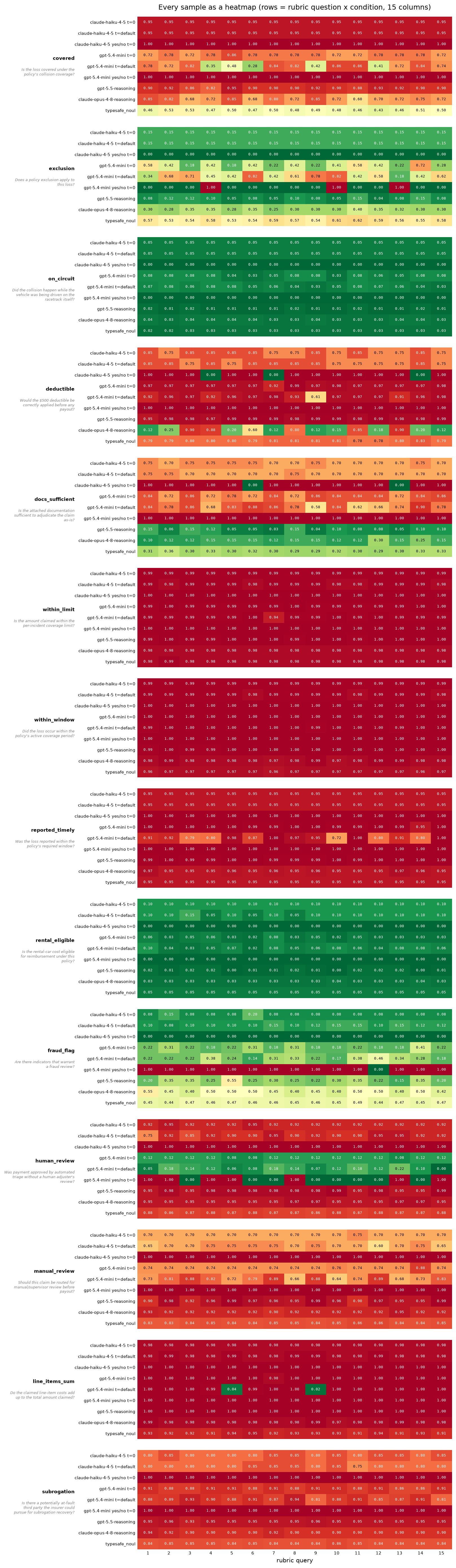
事実確認はほとんどの条件で安定している。判断が重く求められるケースでは、LLMの行が変動する:exclusion、rental_eligible、fraud_flag、manual_reviewはサンプル間で変動したり、モデル間で意見が分れたりする。TypeSafeのcovered行は0.5をまたぐが、その他の13問はこのラン全体を通じてその閾値の片側に留まっている。
強制されたイエスまたはノーの代わりに、不確実な判断を許可する
閾値を0.5とした場合、確率0.49および0.51は、どちらも大きな不確実性を示しているにもかかわらず、相反するアクションを引き起こします。代わりに、アプリケーションは以下を返すことができます:
noは0.30より下;uncertainは0.30から0.70まで(両端を含む);yesは0.70より上。
不確実なケースは人間に委ねる。エスカレーションは、返された確率に基づくアプリケーションロジックである:新しい質問は行わず、2回目のAPI呼び出しもしない。この範囲は例示であり、補正された保証でも最適化された閾値でもない。本番環境の境界は、ラベル付きの例と、誤った判断およびレビューのコストから設定する。
以下の図は、このバンドを記録されたTypeSafeの確率に適用したものです。
def noul_decision_with_uncertainty(probability: float) -> str:
    """Map valid TypeSafe probabilities through an inclusive uncertainty band."""
    if probability < NOUL_UNCERTAINTY_LOW:
        return "no"
    if probability > NOUL_UNCERTAINTY_HIGH:
        return "yes"
    return "uncertain"


# Keep the probabilities visible beneath each TypeSafe application decision.
policy_decisions = [
    [noul_decision_with_uncertainty(sample[key]) for sample in typesafe_runs]
    for key in QUESTIONS
]
decision_codes = {"no": 0, "uncertain": 1, "yes": 2}
policy_values = [
    [decision_codes[value] for value in row] for row in policy_decisions
]
policy_cmap = ListedColormap(["#a6dba0", "#dddddd", "#92c5de"])
fig_policy, ax_policy = plt.subplots(figsize=(13, 6))
ax_policy.imshow(policy_values, cmap=policy_cmap, vmin=0, vmax=2, aspect="auto")
for row_index, key in enumerate(QUESTIONS):
    for sample_index in range(NUM_SAMPLES):
        decision = policy_decisions[row_index][sample_index]
        probability = typesafe_runs[sample_index][key]
        ax_policy.text(sample_index, row_index, f"{decision}\n{probability:.2f}",
                       ha="center", va="center", fontsize=6)
ax_policy.set_yticks(range(len(QUESTIONS)), list(QUESTIONS))
ax_policy.set_xticks(range(NUM_SAMPLES), range(1, NUM_SAMPLES + 1))
ax_policy.set_xlabel("rubric query")
ax_policy.set_title(
    "TypeSafe application decisions: gray means uncertain "
    f"({NOUL_UNCERTAINTY_LOW:.2f} to {NOUL_UNCERTAINTY_HIGH:.2f} inclusive)"
)
fig_policy.tight_layout()
display(fig_policy)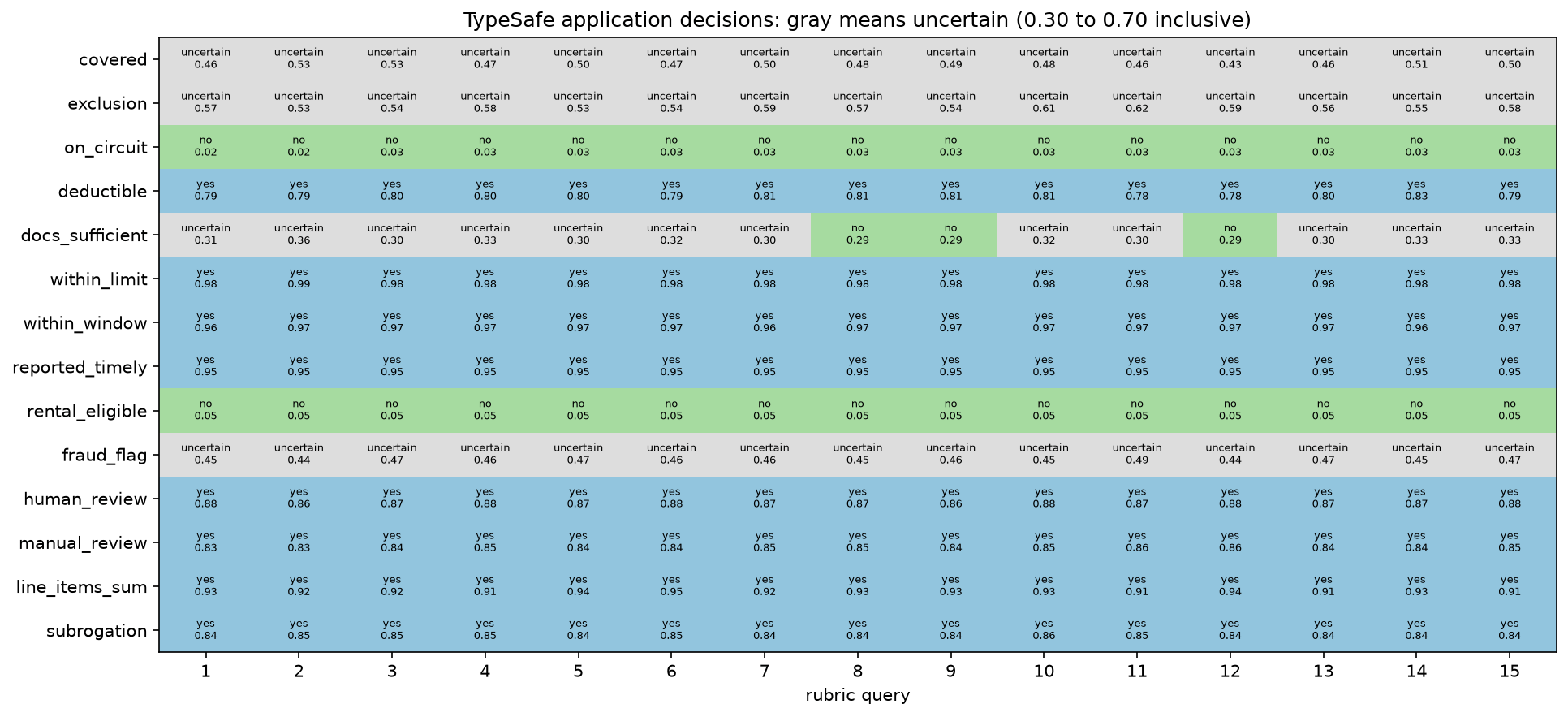
レビュー帯は0.5周辺の揺らぎを吸収し、反対方向の自動アクションを発行しない。しかし、帯には独自の境界が存在する。どちらかの外側境界に近い値であっても、uncertainとyesまたはnoの間を移動し続けることができる。それについてモデルがより決定論的になるわけではなく、帯をクリアする自動決定が正しかったことが示されるわけではない。
TypeSafe プレイグラウンドで開く
以下のリンクは、プレイグラウンドで同じ主張と評価基準を開きます:1つの主張、同じ14のNoul質問、およびTypeSafe jev-latest。ここでは、上記で使用された変更されるuidフィールドは省略されています。
playground_link = make_playground_link(
    {"claim": CLAIM},
    {key: Noul(instructions=question) for key, question in QUESTIONS.items()},
    models=[TYPESAFE_MODEL],
)
display(
    Markdown(
        f"🔗 [Open this claim + rubric in the TypeSafe playground]({playground_link})"
    )
)