JevCode
Hierarchical classification
Classifies documents through deep patent, retail product, biomedical, and source-code hierarchies using parallel beam search over TypeSafe Choice probabilities.

A lot of data exists as structured hierarchies, such as a taxonomies, filesystem
hierarchies, website structures, codebases, org charts, biological ontologies, LLM skills,
moderation policies, etc. The goal of Hierarchical Classification is to traverse the
hierarchy to the correct leaf node, which is the final classification. This is a perfect
fit for typesafe’s Choice primitive. We find the most probable leaf by classifying the
document at each node (starting at the root), and then iteratively proceeding to the next
most-probable node until we end at a leaf (Greedy Search).
The parallel nature of the API also lets us explore multiple paths with parallel questions
using Beam Search to improve performance. The cookbook’s TypeSafe API calls each
simultaneously evaluate K paths of the hierarchy. Beam search keeps the best K paths
by a geometric-mean edge probability: product(edge_probabilities) ** (1 / decisions),
and prunes the rest. The probability is length-normalized so that shallow and deep leaves
are compared fairly.
Decomposing the problem into a hierarchy like this has benefits of its own:
- Observability
- identify which nodes your misclassifications occur most in
- measure the number of times each node and edge is traversed
- Testability
- unit test and measure the impact of hierarchy updates on classification performance
-

Hierarchies used in this cookbook
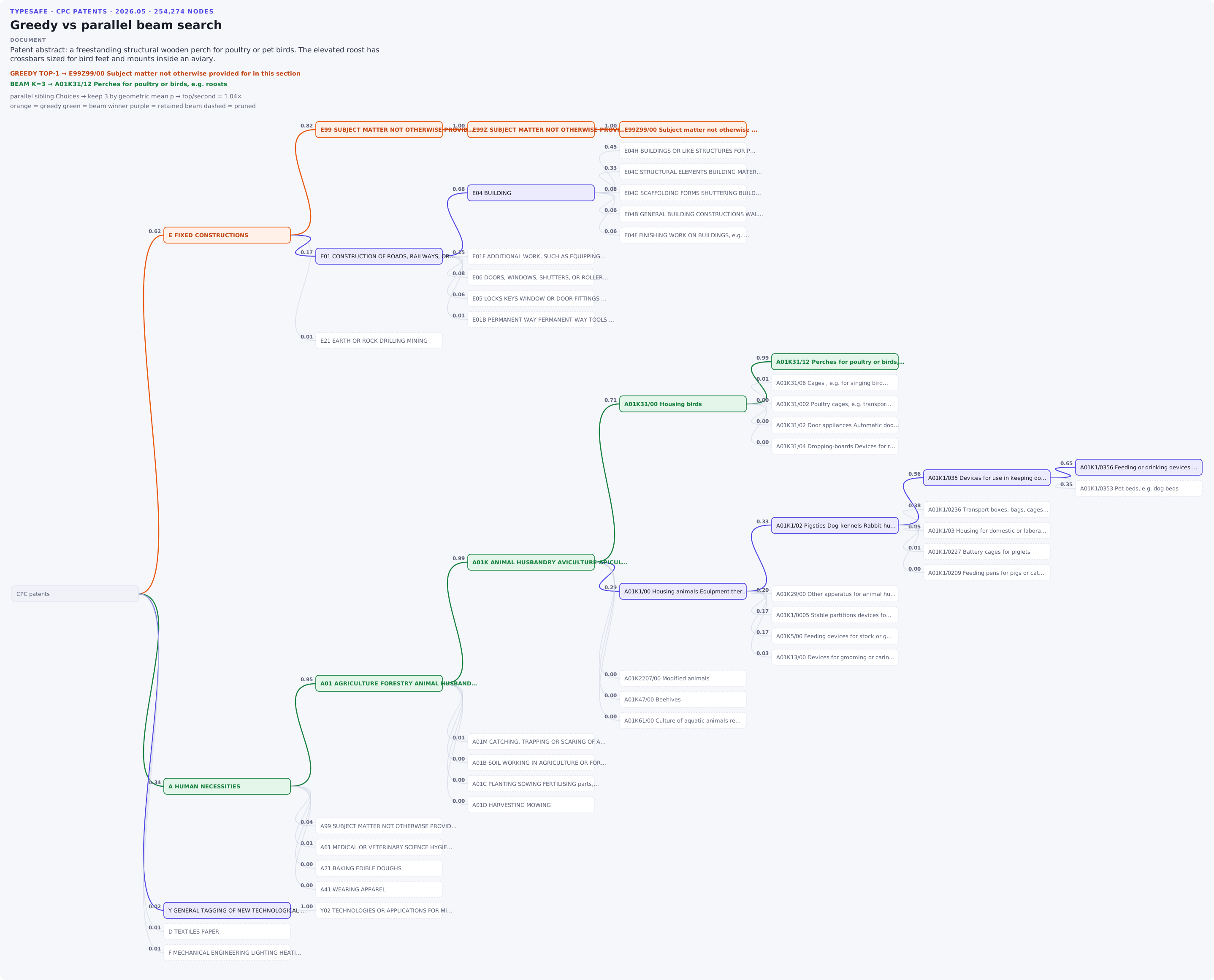
- CPC 2026.05: patent subject matter, from broad technology sections to narrow inventions.
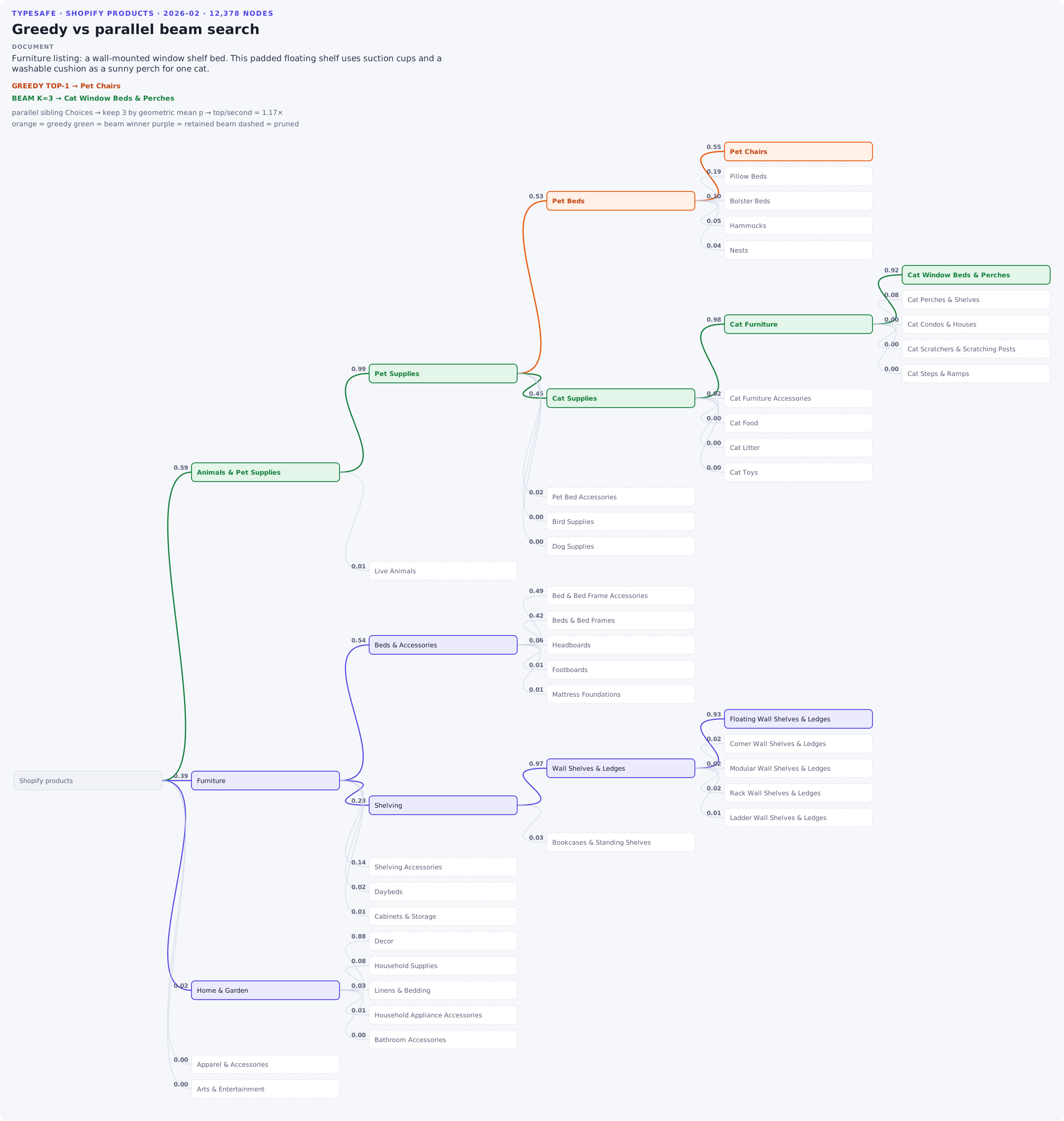
- Shopify 2026-02: retail product categories, from store departments to specific product types.
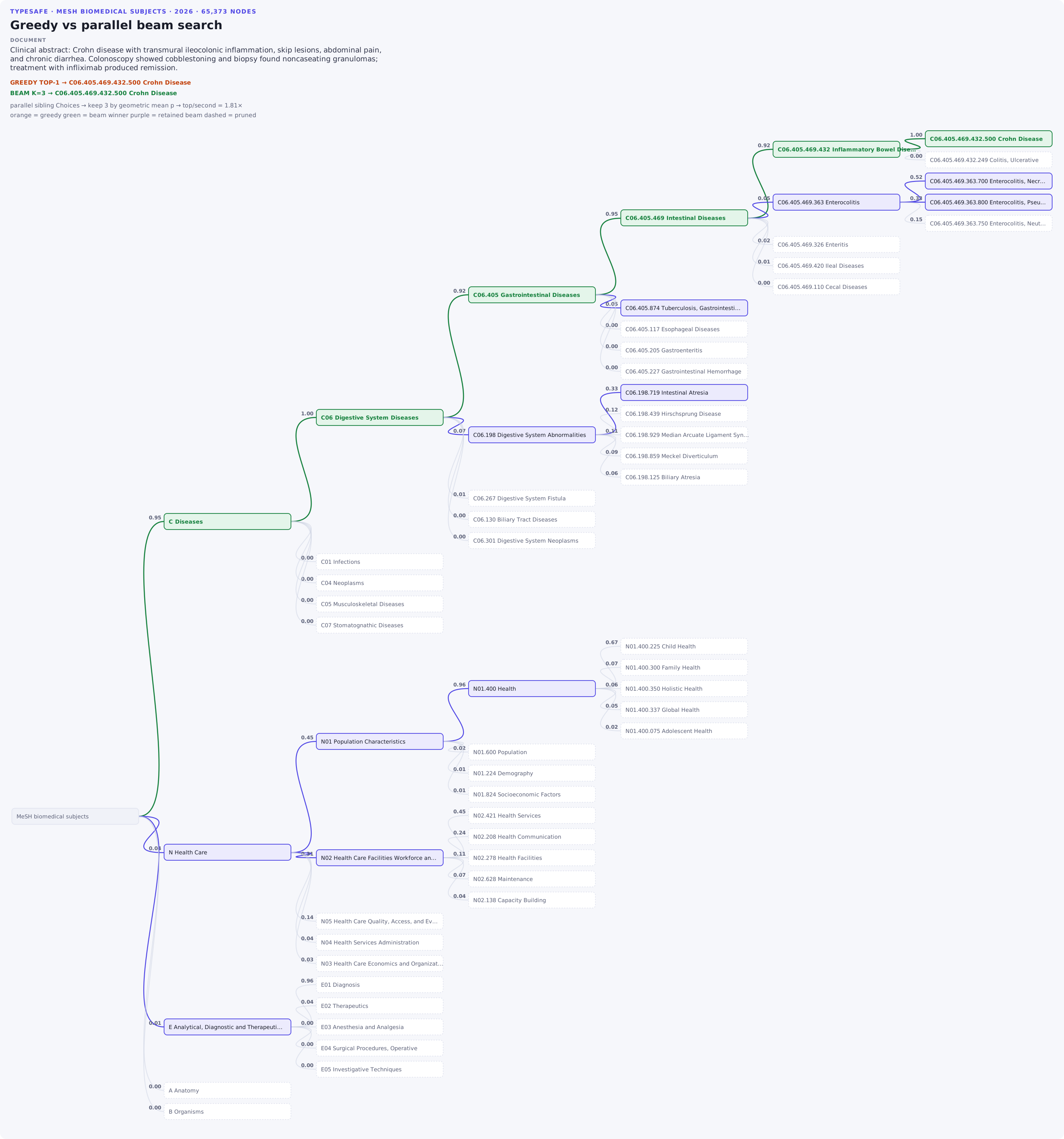
- MeSH 2026: biomedical subjects from broad domains to specific conditions. MeSH is a DAG, so one descriptor can appear under multiple parents; this demo expands its official tree-number paths.
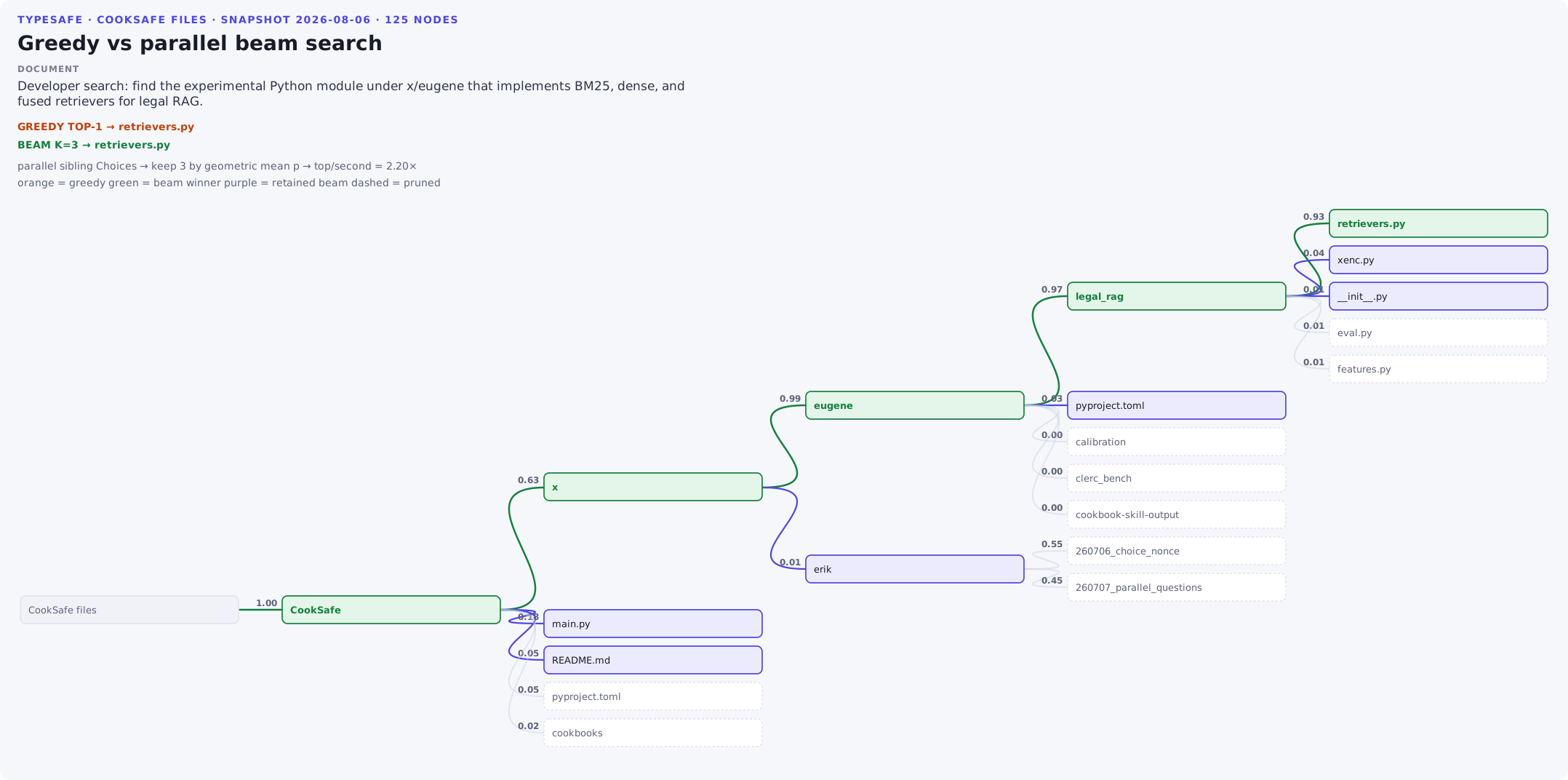
- CookSafe files: TypeSafe’s cookbook repository hierarchy, searched from folders to source files.
Methods
- Greedy search: choose the highest-probability child and discard every alternative. One early mistake cannot be recovered.
- Beam search: retain
Kplausible paths and classify every frontier in parallel. Deeper evidence can repair an ambiguous early decision. The leaf of the path with the highest geometric-mean probability is the final classification. - TypeSafe Choice: every node is a
Choicequestion whose full probability distribution is its edges. Each path of the beam runs as parallel questions, so extra exploration adds little wall-clock latency. - Formula:
path_score = product(edge_probabilities) ** (1 / decisions)- used for pruning and comparing paths
separation = top_path_score / second_path_score- useful metric, but not used for pruning
- the ratio compares the top path’s geometric mean against its nearest rival.
- Near
1×is ambiguous - A large ratio means clear separation.
- Near
- Notes on metrics:
- a different metric such as
min(top_prob/second_top_prob)which would optimize for paths that have very clear decisions at every node. - use
exp(mean(log(probs)))instead ofproduct(edge_probabilities) ** (1 / decisions)to avoid precision errors for hierarchies that are very deep (eg >10 layers)
- a different metric such as
Load and visualize the example hierarchies
These helpers download pinned taxonomy sources, parse them into direct-child trees, and render each search traversal as a static SVG.
import html
import os
import shutil
import textwrap
import urllib.request
from collections import defaultdict
from concurrent.futures import ThreadPoolExecutor
from pathlib import Path
from typing import NamedTuple, TypeAlias
from xml.etree import ElementTree
from zipfile import ZipFile

from cooksafe import JsonCache
from IPython.display import Markdown, display
from typesafe_sdk import Choice, RetryPolicy, TypeSafeClient

Tree: TypeAlias = dict[str, "Tree"]


class Hierarchy(NamedTuple):
    """One query and a complete hierarchy.

    :param slug: filename-safe taxonomy name.
    :param name: display name.
    :param version: pinned dataset version.
    :param source_url: hierarchy source.
    :param node_count: number of loaded hierarchy nodes.
    :param document: unstructured text classified by TypeSafe.
    :param expected_leaf: expected final classification.
    :param tree: nested direct-child menus.
    """

    slug: str
    name: str
    version: str
    source_url: str
    node_count: int
    document: str
    expected_leaf: str
    tree: Tree


CPC_URL = (
    "https://www.cooperativepatentclassification.org/sites/default/files/"
    "cpc/bulk/CPCSchemeXML202605.zip"
)
SHOPIFY_URL = (
    "https://raw.githubusercontent.com/Shopify/product-taxonomy/"
    "v2026-02/dist/en/categories.txt"
)
MESH_URL = "https://nlmpubs.nlm.nih.gov/projects/mesh/MESH_FILES/xmlmesh/desc2026.zip"
MESH_CATEGORIES = {
    "A": "Anatomy",
    "B": "Organisms",
    "C": "Diseases",
    "D": "Chemicals and Drugs",
    "E": "Analytical, Diagnostic and Therapeutic Techniques, and Equipment",
    "F": "Psychiatry and Psychology",
    "G": "Phenomena and Processes",
    "H": "Disciplines and Occupations",
    "I": "Anthropology, Education, Sociology, and Social Phenomena",
    "J": "Technology, Industry, and Agriculture",
    "K": "Humanities",
    "L": "Information Science",
    "M": "Named Groups",
    "N": "Health Care",
    "V": "Publication Characteristics",
    "Z": "Geographicals",
}


def _download(url: str, path: Path) -> Path:
    """Download a pinned dataset once.

    :param url: official dataset URL.
    :param path: local cache path.
    :returns: local dataset path.
    """

    if path.exists():
        return path
    path.parent.mkdir(parents=True, exist_ok=True)
    temporary_path: Path = path.with_suffix(path.suffix + ".tmp")
    request = urllib.request.Request(
        url, headers={"User-Agent": "typesafe-taxonomy/1.0"}
    )
    with urllib.request.urlopen(request, timeout=120) as response:
        with temporary_path.open("wb") as file:
            shutil.copyfileobj(response, file)
    temporary_path.replace(path)
    return path


def _insert(tree: Tree, path: tuple[str, ...]) -> None:
    subtree_value: Tree = tree
    for label in path:
        subtree_value = subtree_value.setdefault(label, {})


def _cpc_title(item: ElementTree.Element) -> str:
    class_title: ElementTree.Element | None = item.find("class-title")
    if class_title is None:
        return ""
    return " ".join(" ".join(class_title.itertext()).split())


def _load_cpc(path: Path) -> tuple[Tree, int]:
    titles: dict[str, str] = {}
    levels: dict[str, int] = {}
    parent_by_symbol: dict[str, str] = {}
    children_by_symbol: defaultdict[str, list[str]] = defaultdict(list)

    def visit(item: ElementTree.Element, parent_symbol: str | None) -> None:
        symbol: str | None = item.findtext("classification-symbol")
        next_parent: str | None = parent_symbol
        if symbol:
            title: str = _cpc_title(item)
            if title:
                titles[symbol] = title
            levels[symbol] = min(levels.get(symbol, 99), int(item.attrib["level"]))
            if (
                parent_symbol
                and parent_symbol != symbol
                and symbol not in parent_by_symbol
            ):
                parent_by_symbol[symbol] = parent_symbol
                children_by_symbol[parent_symbol].append(symbol)
            next_parent = symbol
        for child in item.findall("classification-item"):
            visit(child, next_parent)

    with ZipFile(path) as zip_file:
        names = sorted(
            name
            for name in zip_file.namelist()
            if name.startswith("cpc-scheme-") and name.endswith(".xml")
        )
        for name in names:
            root = ElementTree.fromstring(zip_file.read(name))
            for item in root.findall("classification-item"):
                visit(item, None)

    labels: dict[str, str] = {
        symbol: f"{symbol} {titles.get(symbol, '')}".strip() for symbol in levels
    }

    def build(symbol: str) -> Tree:
        return {
            labels[child]: build(child) for child in children_by_symbol.get(symbol, [])
        }

    root_symbols: list[str] = sorted(
        symbol for symbol, level in levels.items() if level == 2
    )
    tree: Tree = {labels[symbol]: build(symbol) for symbol in root_symbols}
    return tree, len(labels)


def _load_shopify(path: Path) -> tuple[Tree, int]:
    tree: Tree = {}
    category_count: int = 0
    for line in path.read_text().splitlines():
        if not line or line.startswith("#"):
            continue
        _, path_text = line.split(" : ", maxsplit=1)
        category_path: tuple[str, ...] = tuple(path_text.strip().split(" > "))
        _insert(tree, category_path)
        category_count += 1
    return tree, category_count


def _load_mesh(path: Path) -> tuple[Tree, int]:
    """Load every official MeSH tree-number path.

    A descriptor may have multiple tree numbers because MeSH is a DAG. Expanding
    those positions into paths makes it usable by the tree-oriented beam search.

    :param path: MeSH descriptor XML ZIP.
    :returns: expanded tree and position count.
    """

    with ZipFile(path) as zip_file:
        root: ElementTree.Element = ElementTree.fromstring(
            zip_file.read("desc2026.xml")
        )
    names_by_tree_number: dict[str, str] = {
        tree_number.text: descriptor_record.findtext("DescriptorName/String", "")
        for descriptor_record in root.findall("DescriptorRecord")
        for tree_number in descriptor_record.findall("TreeNumberList/TreeNumber")
        if tree_number.text
    }
    tree: Tree = {}
    for tree_number in sorted(names_by_tree_number):
        parts: list[str] = tree_number.split(".")
        prefixes: list[str] = [
            ".".join(parts[:index]) for index in range(1, len(parts) + 1)
        ]
        category_code: str = tree_number[0]
        category_path: tuple[str, ...] = (
            f"{category_code} {MESH_CATEGORIES[category_code]}",
            *(f"{prefix} {names_by_tree_number[prefix]}" for prefix in prefixes),
        )
        _insert(tree, category_path)
    position_count: int = len(names_by_tree_number) + len(tree)
    return tree, position_count


CODEBASE_SNAPSHOT = Path("codebase_files.txt")


def _load_codebase(path: Path) -> tuple[Tree, int]:
    """Load the frozen CookSafe source-file hierarchy.

    The listing is a snapshot of the repository's source files in the order a walk found them,
    taken when this cookbook was rendered, rather than a walk of whatever tree the cookbook
    happens to sit in. A live walk makes the taxonomy -- and every number derived from it --
    depend on the reader's checkout, including untracked scratch files, so the shipped cache
    stops describing the same tree. Line order is significant: sibling options are asked in the
    order they appear here, so it is part of the question, not presentation.

    :param path: file holding one repository-relative source path per line.
    :returns: nested file tree and node count.
    """

    tree: Tree = {}
    node_paths: set[tuple[str, ...]] = set()
    for line in path.read_text(encoding="utf-8").splitlines():
        if not line.strip():
            continue
        hierarchy_path: tuple[str, ...] = ("CookSafe", *line.split("/"))
        _insert(tree, hierarchy_path)
        node_paths.update(
            hierarchy_path[:index] for index in range(1, len(hierarchy_path) + 1)
        )
    return tree, len(node_paths)


def load_hierarchies(data_directory: Path = Path("datasets")) -> tuple[Hierarchy, ...]:
    """Load three public taxonomies and one frozen code hierarchy.

    :param data_directory: cache directory for official raw files.
    :returns: CPC, Shopify, MeSH, and CookSafe examples.
    """

    cpc_tree, cpc_nodes = _load_cpc(
        _download(CPC_URL, data_directory / "CPCSchemeXML202605.zip")
    )
    shopify_tree, shopify_nodes = _load_shopify(
        _download(SHOPIFY_URL, data_directory / "shopify_categories_2026-02.txt")
    )
    mesh_tree, mesh_nodes = _load_mesh(
        _download(MESH_URL, data_directory / "mesh_descriptors_2026.zip")
    )
    codebase_tree, codebase_nodes = _load_codebase(CODEBASE_SNAPSHOT)
    return (
        Hierarchy(
            slug="cpc",
            name="CPC patents",
            version="2026.05",
            source_url=CPC_URL,
            node_count=cpc_nodes,
            document=(
                "Patent abstract: a freestanding structural wooden perch for poultry or "
                "pet birds. The elevated roost has crossbars sized for bird feet and mounts "
                "inside an aviary."
            ),
            expected_leaf="A01K31/12 Perches for poultry or birds, e.g. roosts",
            tree=cpc_tree,
        ),
        Hierarchy(
            slug="shopify",
            name="Shopify products",
            version="2026-02",
            source_url=SHOPIFY_URL,
            node_count=shopify_nodes,
            document=(
                "Furniture listing: a wall-mounted window shelf bed. This padded floating shelf "
                "uses suction cups and a washable cushion as a sunny perch for one cat."
            ),
            expected_leaf="Cat Window Beds & Perches",
            tree=shopify_tree,
        ),
        Hierarchy(
            slug="mesh",
            name="MeSH biomedical subjects",
            version="2026",
            source_url=MESH_URL,
            node_count=mesh_nodes,
            document=(
                "Clinical abstract: Crohn disease with transmural ileocolonic inflammation, "
                "skip lesions, abdominal pain, and chronic diarrhea. Colonoscopy showed "
                "cobblestoning and biopsy found noncaseating granulomas; treatment with "
                "infliximab produced remission."
            ),
            expected_leaf="C06.405.469.432.500 Crohn Disease",
            tree=mesh_tree,
        ),
        Hierarchy(
            slug="codebase",
            name="CookSafe files",
            version="snapshot 2026-08-06",
            source_url=str(CODEBASE_SNAPSHOT),
            node_count=codebase_nodes,
            document=(
                "Developer search: find the experimental Python module under x/eugene that "
                "implements BM25, dense, and fused retrievers for legal RAG."
            ),
            expected_leaf="retrievers.py",
            tree=codebase_tree,
        ),
    )


NODE_W, NODE_H = 300, 38
COL_W, ROW_H = 360, 50
PAD_X = 28
EDGE_TOP_K = 5


def subtree(tree: Tree, path: tuple[str, ...]) -> Tree:
    """Return the direct-child menu below ``path``.

    :param tree: taxonomy root.
    :param path: path from the taxonomy root.
    :returns: child mapping at the path.
    """

    subtree_value: Tree = tree
    for label in path:
        subtree_value = subtree_value[label]
    return subtree_value


def _escape(value: object) -> str:
    return html.escape(str(value), quote=True)


def _truncate(value: str, length: int = 33) -> str:
    return value if len(value) <= length else value[: length - 1] + "…"


def _build_nodes(hierarchy: Hierarchy, result: dict) -> dict:
    records: dict[tuple[str, ...], dict] = {
        tuple(record["parent"]): record for record in result["records"]
    }
    best_path: tuple[str, ...] = tuple(result["beam"][0]["path"])
    greedy_path: tuple[str, ...] = tuple(result["greedy"]["path"])
    retained: set[tuple[str, ...]] = {tuple(path) for path in result["retained_paths"]}

    def grow(path: tuple[str, ...]) -> list[dict]:
        record: dict | None = records.get(path)
        if record is None:
            return []
        children: list[dict] = []
        probabilities: dict[str, float] = record["probabilities"]
        ranked: list[tuple[str, float]] = sorted(
            probabilities.items(), key=lambda item: item[1], reverse=True
        )
        shown_labels: set[str] = {label for label, _ in ranked[:EDGE_TOP_K]}
        shown_labels.update(
            label
            for label, _ in ranked
            if path + (label,) in retained
            or path + (label,) == best_path[: len(path) + 1]
            or path + (label,) == greedy_path[: len(path) + 1]
        )
        for label, probability in ranked:
            if label not in shown_labels:
                continue
            child_path: tuple[str, ...] = path + (label,)
            on_best_path: bool = child_path == best_path[: len(child_path)]
            on_greedy_path: bool = child_path == greedy_path[: len(child_path)]
            kind: str = (
                "winner"
                if on_best_path
                else "greedy"
                if on_greedy_path
                else "beam"
                if child_path in retained
                else "alt"
            )
            children.append(
                {
                    "label": label,
                    "probability": probability,
                    "kind": kind,
                    "children": grow(child_path),
                }
            )
        return children

    return {
        "label": hierarchy.name,
        "probability": None,
        "kind": "root",
        "children": grow(()),
    }


def _layout(root: dict) -> tuple[int, int]:
    rows: list[int] = [0]
    maximum_depth: list[int] = [0]

    def walk(node: dict, depth: int) -> None:
        node["depth"] = depth
        maximum_depth[0] = max(maximum_depth[0], depth)
        if node["children"]:
            for child in node["children"]:
                walk(child, depth + 1)
            node["row"] = (node["children"][0]["row"] + node["children"][-1]["row"]) / 2
        else:
            node["row"] = rows[0]
            rows[0] += 1

    walk(root, 0)
    return maximum_depth[0], rows[0]


def render_svg(hierarchy: Hierarchy, result: dict, path: Path) -> None:
    """Write a standalone traversal SVG matching the Customer_ProdX visual language.

    :param hierarchy: taxonomy demonstration.
    :param result: beam-search result from the notebook.
    :param path: output SVG path.
    """

    root: dict = _build_nodes(hierarchy, result)
    maximum_depth, row_count = _layout(root)
    document_lines: list[str] = textwrap.wrap(
        hierarchy.document,
        width=105,
        break_long_words=False,
        break_on_hyphens=False,
    ) or [""]
    document_y: int = 124
    greedy_y: int = document_y + (len(document_lines) - 1) * 21 + 34
    beam_y: int = greedy_y + 25
    method_y: int = beam_y + 29
    legend_y: int = method_y + 23
    header_height: int = legend_y + 32
    width: int = PAD_X * 2 + maximum_depth * COL_W + NODE_W
    height: int = header_height + max(row_count, 1) * ROW_H + 34
    edges: list[str] = []
    nodes: list[str] = []

    def node_x(node: dict) -> float:
        return PAD_X + node["depth"] * COL_W

    def node_y(node: dict) -> float:
        return header_height + node["row"] * ROW_H

    def walk(node: dict) -> None:
        x_value, y_value = node_x(node), node_y(node)
        for child in node["children"]:
            child_x, child_y = node_x(child), node_y(child)
            x1, y1 = x_value + NODE_W, y_value + NODE_H / 2
            x2, y2 = child_x, child_y + NODE_H / 2
            bend: float = COL_W * 0.38
            edges.append(
                f'<path class="edge {child["kind"]}" '
                f'd="M{x1:.0f},{y1:.0f} C{x1 + bend:.0f},{y1:.0f} '
                f'{x2 - bend:.0f},{y2:.0f} {x2:.0f},{y2:.0f}"/>'
            )
            edges.append(
                f'<text class="prob" x="{x2 - 7:.0f}" y="{y2 - 5:.0f}" '
                f'text-anchor="end">{child["probability"]:.2f}</text>'
            )
            walk(child)

        kind: str = node["kind"]
        label: str = _truncate(node["label"], 40)
        nodes.append(
            f'<g class="node {kind}"><title>{_escape(node["label"])}</title>'
            f'<rect x="{x_value:.0f}" y="{y_value:.0f}" width="{NODE_W}" '
            f'height="{NODE_H}" rx="7"/>'
            f'<text x="{x_value + 11:.0f}" y="{y_value + 24:.0f}">'
            f"{_escape(label)}</text></g>"
        )

    walk(root)
    best: dict = result["beam"][0]
    best_path: tuple[str, ...] = tuple(best["path"])
    greedy_path: tuple[str, ...] = tuple(result["greedy"]["path"])
    beam_leaf: str = best_path[-1] if best_path else "no leaf"
    greedy_leaf: str = greedy_path[-1] if greedy_path else "no leaf"
    beam_width: int = result["beam_width"]
    separation_ratio: float = result["separation_ratio"]
    document_text: str = "".join(
        f'<text class="document" x="24" y="{document_y + index * 21}">'
        f"{_escape(line)}</text>"
        for index, line in enumerate(document_lines)
    )
    separation_text: str = (
        ">999×" if separation_ratio > 999 else f"{separation_ratio:.2f}×"
    )

    svg: str = f'''<svg xmlns="http://www.w3.org/2000/svg" viewBox="0 0 {width} {height}"
  width="{width}" height="{height}" role="img" aria-label="{_escape(hierarchy.name)} taxonomy beam search">
<style>
  .bg {{ fill:#f6f7fb }}
  text {{ font-family:ui-monospace,"SF Mono",Menlo,Consolas,monospace }}
  .eyebrow {{ font-size:14px; font-weight:700; letter-spacing:1.2px; fill:#4f46e5 }}
  .title {{ font:700 28px system-ui,-apple-system,"Segoe UI",sans-serif; fill:#181b28 }}
  .document-label {{ font:700 12px system-ui,-apple-system,"Segoe UI",sans-serif; letter-spacing:1px; fill:#777c91 }}
  .document {{ font:500 17px system-ui,-apple-system,"Segoe UI",sans-serif; fill:#303449 }}
  .copy {{ font-size:14px; fill:#5c6178 }}
  .result {{ font-size:14px; font-weight:700 }}
  .greedy-result {{ fill:#c2410c }}
  .beam-result {{ fill:#15803d }}
  .edge {{ fill:none; stroke:#c9cee0; stroke-width:2 }}
  .edge.winner {{ stroke:#15803d; stroke-width:2.5 }}
  .edge.greedy {{ stroke:#ea580c; stroke-width:2.5 }}
  .edge.beam {{ stroke:#4f46e5; stroke-width:2.2 }}
  .edge.alt {{ opacity:.48 }}
  .prob {{ font-size:12px; font-weight:600; fill:#5c6178 }}
  .node rect {{ stroke-width:1.7 }}
  .node text {{ font-size:13px }}
  .node.root rect {{ fill:#f0f2f8; stroke:#e2e5f0 }}
  .node.root text {{ fill:#5c6178 }}
  .node.winner rect {{ fill:#e4f5ea; stroke:#15803d }}
  .node.winner text {{ fill:#15803d; font-weight:700 }}
  .node.greedy rect {{ fill:#fff0e8; stroke:#ea580c }}
  .node.greedy text {{ fill:#c2410c; font-weight:700 }}
  .node.beam rect {{ fill:#ecebfd; stroke:#4f46e5 }}
  .node.beam text {{ fill:#181b28 }}
  .node.alt rect {{ fill:#fff; stroke:#e2e5f0; stroke-dasharray:3 3 }}
  .node.alt text {{ fill:#5c6178 }}
</style>
<rect class="bg" width="{width}" height="{height}" rx="14"/>
<text class="eyebrow" x="24" y="32">TYPESAFE · {hierarchy.name.upper()} · {hierarchy.version.upper()} · {hierarchy.node_count:,} NODES</text>
<text class="title" x="24" y="69">Greedy vs parallel beam search</text>
<text class="document-label" x="24" y="99">DOCUMENT</text>
{document_text}
<text class="result greedy-result" x="24" y="{greedy_y}">GREEDY TOP-1 → {_escape(_truncate(greedy_leaf, 105))}</text>
<text class="result beam-result" x="24" y="{beam_y}">BEAM K={beam_width} → {_escape(_truncate(beam_leaf, 105))}</text>
<text class="copy" x="24" y="{method_y}">parallel sibling Choices → keep {beam_width} by geometric mean p → top/second = {separation_text}</text>
<text class="copy" x="24" y="{legend_y}">orange = greedy   green = beam winner   purple = retained beam   dashed = pruned</text>
{"".join(edges)}{"".join(nodes)}
</svg>'''
    path.write_text(svg)
Implement greedy and beam search
Each sibling set becomes one Choice question in the next section, which also
implements
both traversal strategies and keeps the probabilities the static diagrams need.
HIERARCHIES = load_hierarchies()
MODEL, BEAM_WIDTH, MAX_DEPTH, EPSILON = "jev-1.12", 3, 12, 1e-9
client = TypeSafeClient(
    api_key=os.environ["TYPESAFE_API_KEY"],
    retry=RetryPolicy(max_retries=5, backoff_initial=1.0, backoff_max=20.0),
)
json_cache = JsonCache(Path("json_cache.json"))


@json_cache
def choose(state: str, labels: tuple[str, ...]) -> dict[str, float]:
    """Ask one atomic direct-child question and return its distribution."""
    if len(labels) == 1:
        return {labels[0]: 1.0}
    question, keys = child_question(labels)
    response = client.system_one(
        state=state, questions={"child": question}, model=MODEL
    )
    probabilities = response.answers["child"].probabilities
    return {label: probabilities[key] for key, label in keys.items()}


def child_question(labels: tuple[str, ...]) -> tuple[Choice, dict[str, str]]:
    """Build the direct-child Choice and its reversible option mapping."""
    keys = {f"c{i}": label for i, label in enumerate(labels)}
    question = Choice(
        instructions="Which direct child category best matches this document?",
        criteria=keys,
    )
    return question, keys


def extend_candidate(
    candidate: dict, label: str, probabilities: dict[str, float]
) -> dict:
    """Append one edge and recompute its geometric-mean path score."""
    is_decision: bool = len(probabilities) > 1
    # Use log space for very deep trees to avoid floating-point precision loss.
    probability_product: float = candidate["probability_product"] * (
        max(probabilities[label], EPSILON) if is_decision else 1.0
    )
    decision_count: int = candidate["decision_count"] + is_decision
    return {
        "path": candidate["path"] + (label,),
        "probability_product": probability_product,
        "decision_count": decision_count,
        "score": probability_product ** (1 / decision_count) if decision_count else 1.0,
    }


def choice_record(path: tuple[str, ...], probabilities: dict[str, float]) -> dict:
    """Package one sibling decision for the traversal diagram."""
    return {"parent": path, "probabilities": probabilities}


def beam_search(hierarchy: Hierarchy) -> dict:
    """Parallel width-three beam search using geometric-mean probability."""
    beam = [{"path": (), "probability_product": 1.0, "decision_count": 0, "score": 1.0}]
    records, retained_paths = [], {()}

    for _ in range(MAX_DEPTH):
        expandable = [
            candidate
            for candidate in beam
            if subtree(hierarchy.tree, candidate["path"])
        ]
        finished = [
            candidate
            for candidate in beam
            if not subtree(hierarchy.tree, candidate["path"])
        ]
        if not expandable:
            break
        with ThreadPoolExecutor(max_workers=BEAM_WIDTH) as executor:
            distributions = list(
                executor.map(
                    lambda candidate: choose(
                        hierarchy.document,
                        tuple(subtree(hierarchy.tree, candidate["path"])),
                    ),
                    expandable,
                )
            )

        expanded = []
        round_records = []
        for candidate, probabilities in zip(expandable, distributions, strict=True):
            round_records.append(choice_record(candidate["path"], probabilities))
            candidate_expanded = []
            for label in probabilities:
                candidate_expanded.append(
                    extend_candidate(candidate, label, probabilities)
                )
            expanded.extend(candidate_expanded)
        beam = sorted(
            finished + expanded,
            key=lambda candidate: candidate["score"],
            reverse=True,
        )[:BEAM_WIDTH]
        retained_paths.update(candidate["path"] for candidate in beam)
        records.extend(round_records)

    beam = sorted(beam, key=lambda candidate: candidate["score"], reverse=True)
    return {
        "beam": beam,
        "records": records,
        "retained_paths": sorted(retained_paths, key=lambda path: (len(path), path)),
    }


def greedy_search(hierarchy: Hierarchy) -> dict:
    """Follow only the locally highest-probability child."""
    path, probability_product, decision_count, records = (), 1.0, 0, []
    for _ in range(MAX_DEPTH):
        labels = tuple(subtree(hierarchy.tree, path))
        if not labels:
            break
        probabilities = choose(hierarchy.document, labels)
        records.append(choice_record(path, probabilities))
        label = max(probabilities, key=probabilities.get)
        if len(probabilities) > 1:
            probability_product *= max(probabilities[label], EPSILON)
            decision_count += 1
        path += (label,)
    score: float = (
        probability_product ** (1 / decision_count) if decision_count else 1.0
    )
    return {"path": path, "score": score, "records": records}


def compare_searches(hierarchy: Hierarchy) -> dict:
    """Run beam and greedy, then merge their queried nodes for rendering."""
    result = beam_search(hierarchy)
    greedy = greedy_search(hierarchy)
    recorded_paths = {tuple(record["parent"]) for record in result["records"]}
    result["records"].extend(
        record
        for record in greedy["records"]
        if tuple(record["parent"]) not in recorded_paths
    )
    result["greedy"] = greedy
    result["beam_width"] = BEAM_WIDTH
    top_score: float = result["beam"][0]["score"]
    second_score: float = result["beam"][1]["score"]
    result["separation_ratio"] = top_score / max(second_score, EPSILON)
    return result
Compare the methods
Run both strategies on four labeled examples, compare their leaves against the expected classifications, and visualize the routes they explored.
with ThreadPoolExecutor(max_workers=len(HIERARCHIES)) as executor:
results = list(executor.map(compare_searches, HIERARCHIES))
rows: list[dict[str, str | int | bool]] = []
for hierarchy, result in zip(HIERARCHIES, results, strict=True):
svg_path: Path = Path(f"{hierarchy.slug}_tree.svg")
render_svg(hierarchy, result, svg_path)
beam_path: tuple[str, ...] = tuple(result["beam"][0]["path"])
greedy_path: tuple[str, ...] = tuple(result["greedy"]["path"])
beam_leaf: str = beam_path[-1]
greedy_leaf: str = greedy_path[-1]
rows.append(
{
"hierarchy": hierarchy.name,
"nodes": hierarchy.node_count,
"expected leaf": hierarchy.expected_leaf,
"greedy leaf": greedy_leaf,
"beam K=3 leaf": beam_leaf,
"greedy correct": greedy_leaf == hierarchy.expected_leaf,
"beam correct": beam_leaf == hierarchy.expected_leaf,
"mean p": f"{result['beam'][0]['score']:.2f}",
"top/second": f"{result['separation_ratio']:.2f}×",
}
)
greedy_correct_count: int = sum(bool(row["greedy correct"]) for row in rows)
beam_correct_count: int = sum(bool(row["beam correct"]) for row in rows)
recovered_names: str = ", ".join(
str(row["hierarchy"])
for row in rows
if not row["greedy correct"] and row["beam correct"]
)
table_lines: list[str] = [
"| Hierarchy | Expected leaf | Greedy leaf | Beam K=3 leaf | Greedy correct | Beam correct |",
"| --- | --- | --- | --- | --- | --- |",
]
table_lines.extend(
"| "
+ " | ".join(
(
str(row["hierarchy"]),
str(row["expected leaf"]),
str(row["greedy leaf"]),
str(row["beam K=3 leaf"]),
"yes" if row["greedy correct"] else "no",
"yes" if row["beam correct"] else "no",
)
)
+ " |"
for row in rows
)
display(
Markdown(
"## Results\n\n"
"Each example has a known expected leaf. "
f"Beam search matched {beam_correct_count} of {len(rows)} expected leaves; "
f"greedy search matched {greedy_correct_count} of {len(rows)}. "
f"Keeping three paths recovered the expected classification for {recovered_names}.\n\n"
+ "\n".join(table_lines)
+ "\n\nThe diagrams show why the methods differ. Orange marks the greedy route, "
"green marks the winning beam route, purple marks other retained paths, and "
"dashed edges were pruned.\n\n"
+ "\n\n".join(
f"### {hierarchy.name}\n\n"
for hierarchy in HIERARCHIES
)
)
)Results
Each example has a known expected leaf. Beam search matched 4 of 4 expected leaves; greedy search matched 2 of 4. Keeping three paths recovered the expected classification for CPC patents, Shopify products.
| Hierarchy | Expected leaf | Greedy leaf | Beam K=3 leaf | Greedy correct | Beam correct |
|---|---|---|---|---|---|
| CPC patents | A01K31/12 Perches for poultry or birds, e.g. roosts | E99Z99/00 Subject matter not otherwise provided for in this section | A01K31/12 Perches for poultry or birds, e.g. roosts | no | yes |
| Shopify products | Cat Window Beds & Perches | Pet Chairs | Cat Window Beds & Perches | no | yes |
| MeSH biomedical subjects | C06.405.469.432.500 Crohn Disease | C06.405.469.432.500 Crohn Disease | C06.405.469.432.500 Crohn Disease | yes | yes |
| CookSafe files | retrievers.py | retrievers.py | retrievers.py | yes | yes |
The diagrams show why the methods differ. Orange marks the greedy route, green marks the winning beam route, purple marks other retained paths, and dashed edges were pruned.
CPC patents
Shopify products
MeSH biomedical subjects
CookSafe files