 JevCode
Function calling
Turns natural-language trading requests into calls to ordinary typed functions by mapping function names and closed-set arguments to confidence-aware TypeSafe questions.

When you order a “large iced oat latte, no sweetener,” the barista does not write your sentence down. They mark four options on a cup. This cookbook does the same thing for a trading API: a sentence goes in, and out comes a function name and its arguments as evaluated enums, each with a confidence.
"plot rolling correlation between nvda and spy for the past month"
    rolling_correlation(symbol='NVDA', benchmark='SPY', window='1mo')   confidence 0.91

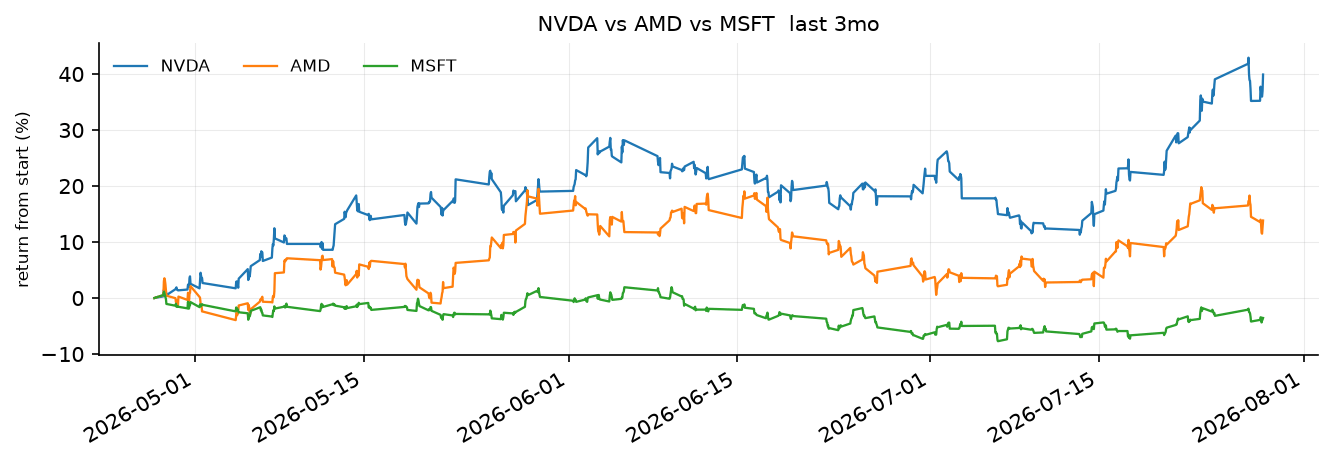
"compare nvda amd and msft over the past three months"
    compare_returns(symbols=['NVDA', 'AMD', 'MSFT'], window='3mo')      confidence 0.94

"show me apple daily with volume"
    plot_price(symbol='AAPL', resolution='1d', include_volume=True)     confidence 0.75

"what tickers do you have"
    list_symbols()                                                     confidence 1.00
Those calls go to ten ordinary functions in a trading assistant. Their arguments take
values from fixed lists, so they are Literals already:
def plot_price(
    symbol: Literal["SPY", "NVDA", "AMD", "AAPL", "MSFT", "TSLA"],
    style: Literal["line", "candles"] = "line",
    resolution: Literal["1m", "5m", "15m", "1h", "1d"] = "15m",
    window: Literal["1d", "1w", "1mo", "3mo"] = "1w",
    include_volume: bool = False,
    moving_average: Literal["9", "20", "50"] | None = None,
    log_scale: bool = False,
): ...
An argument whose values come from a fixed list is a closed set. When it takes one value
out of that list, it gets a Choice question over exactly those values, so whatever
reaches the function is a value the function accepts. You leave the functions alone. What
you add is a spec that says in plain words what each argument means. By the end you have a
Dispatcher you can point at your own functions.
Setup
pip install ipython polars matplotlib numpy "typesafe-sdk>=0.5.7" cooksafe --extra-index-url https://pypi.typesafe.ai/Set TYPESAFE_API_KEY. Two modules sit beside this file. trader.py holds the ten
functions, plus a TypeSafe client that reads answers from a cache, so re-rendering replays
the numbers below without calling the API. dispatch.py holds the code that reads a
signature and a spec and makes the call.
import json
from pathlib import Path

from cooksafe import make_playground_link
from dispatch import ROUTE, Dispatcher, closed_sets
from IPython.display import Markdown, display
from trader import TOOLS, client, load

TYPESAFE_MODEL = "jev-1.12"
print(f"{len(TOOLS)} functions over {load().height:,} one-minute bars")
10 functions over 156,780 one-minute barsFind the closed sets in the signatures
The type hints already say which arguments come from a fixed list, and what is in each
list. closed_sets reads a signature and sorts those arguments into three shapes: a
choice (a Literal, so one value out of the list), a set (a list[Literal[...]],
so any number of them), or a flag (a bool, so on or off). All ten functions are
defined in trader.py.
for name, fn in TOOLS.items():
    shapes = closed_sets(fn)
    print(
        f"  {name:<20}{len(shapes)}  "
        + ", ".join(f"{a}:{s}" for a, (s, _) in shapes.items())
    )
print(
    f"\n{sum(len(closed_sets(fn)) for fn in TOOLS.values())} fillable arguments in total"
)
list_symbols 0
market_summary 1 window:choice
plot_price 7 symbol:choice, style:choice, resolution:choice, window:choice, include_volume:flag, moving_average:choice, log_scale:flag
intraday_pattern 3 symbol:choice, window:choice, metric:choice
compare_returns 3 symbols:set, window:choice, normalize:flag
rolling_correlation 4 symbol:choice, benchmark:choice, window:choice, resolution:choice
summary_stats 2 symbol:choice, window:choice
volatility 3 symbol:choice, window:choice, annualized:flag
top_movers 2 window:choice, direction:choice
drawdown 3 symbol:choice, window:choice, plot:flag
28 fillable arguments in totaltop_movers shows what gets left out. Of its three arguments, two are closed sets. The
third, limit, is an int, so it never gets a question and keeps its default of 3. Free
text, numbers and dates work the same way: no question, and the function’s default stands.
Write the spec
The Literal gives you the strings "1mo" and "3mo". It does not say that a user typing
“this quarter” means the second one. The spec says that. It holds a question per argument,
a line per option, a description per function, and one more question that picks between the
functions. It lives in spec.json, and an LLM can write it for you from the signatures.
SPEC = json.loads(Path("spec.json").read_text())
for argument in ("style", "moving_average"):
    print(
        json.dumps(
            {argument: SPEC["functions"]["plot_price"]["arguments"][argument]}, indent=2
        )
    )
{
"style": {
"question": "Does the user want a plain line or candles?",
"stated": "Does the user say how the chart should be drawn, such as a line, candles, or OHLC bars?",
"options": {
"line": "a simple line through the closing prices",
"candles": "a candlestick or OHLC chart, showing each bar's open, high, low and close"
}
}
}
{
"moving_average": {
"question": "How many bars should the moving average cover - nine, twenty, or fifty?",
"stated": "Does the user ask for a moving average or a smoothed line over the candles?",
"options": {
"9": "a nine-bar moving average, a fast one",
"20": "a twenty-bar moving average",
"50": "a fifty-bar moving average, a slow one"
}
}
}The option keys are the strings the function takes, so nothing has to map a label back to
an argument afterwards. stated makes an argument optional. It is a second yes/no question
asking whether the command says anything about that argument at all. When the answer is no,
the call leaves that argument out and the function’s own default applies.
A set argument gets its question once per member, with {} standing in for the member
name. "Does the user want {} in the comparison?" becomes one question per ticker.
Write each question about the idea rather than the words a user might pick, because the
match is on meaning: “is amd tracking nvidia lately” reaches rolling_correlation even
though neither tracking nor lately appears anywhere in spec.json. Avoid naming a
question after its parameter - "Which resolution?" gives the command nothing to match
against.
Turn the spec into questions
Dispatcher builds the questions from the spec once. Each command is then one request
carrying the choice of function and every function’s arguments, and the dispatcher reads
only the chosen function’s answers.
assistant = Dispatcher(SPEC, TOOLS, client)
print(f"{len(assistant.questions)} questions per command, among them:")
for qid in (
    "__tool__",
    "plot_price.style",
    "plot_price.style?",
    "compare_returns.symbols.NVDA",
):
    question = assistant.questions[qid]
    print(f"  {qid:<30}{question['type']:<8}{str(question['instructions'])[:64]}")
54 questions per command, among them:
__tool__ choice What is the user asking the trading assistant to do?
plot_price.style choice Does the user want a plain line or candles?
plot_price.style? noul Does the user say how the chart should be drawn, such as a line,
compare_returns.symbols.NVDA noul Does the user want NVDA in the comparison?Run fourteen commands
A request occupies one line, and its confidence is the least certain judgement behind
that call.
COMMANDS = [
    "show nvda 1h",
    "plot rolling correlation between nvda and spy for the past month",
    "when during the day does nvda trade the most",
    "what moved today",
    "what tickers do you have",
    "how did the market do this week",
    "candles for tesla with a 20 period moving average",
    "compare nvda amd and msft over the past three months",
    "how volatile is tsla",
    "biggest losers today",
    "worst drawdown for nvda this quarter, and chart it please",
    "spy stats for the last month",
    "show me apple daily with volume",
    "is amd tracking nvidia lately",
]

CALLS = {command: assistant(command) for command in COMMANDS}
for command, call in CALLS.items():
    print(f'  "{command}"')
    print(
        f"      {str(call):<66}confidence {call.confidence:.2f}"
        f"   tool {call.tool.probability:.2f}"
    )
"show nvda 1h"
plot_price(symbol='NVDA', resolution='1h') confidence 0.78 tool 1.00
"plot rolling correlation between nvda and spy for the past month"
rolling_correlation(symbol='NVDA', benchmark='SPY', window='1mo') confidence 0.91 tool 1.00
"when during the day does nvda trade the most"
intraday_pattern(symbol='NVDA') confidence 0.53 tool 1.00
"what moved today"
top_movers(window='1d', direction='gainers') confidence 0.90 tool 0.90
"what tickers do you have"
list_symbols() confidence 1.00 tool 1.00
"how did the market do this week"
market_summary(window='1w') confidence 0.96 tool 0.99
"candles for tesla with a 20 period moving average"
plot_price(symbol='TSLA', style='candles', moving_average='20') confidence 0.69 tool 0.97
"compare nvda amd and msft over the past three months"
compare_returns(symbols=['NVDA', 'AMD', 'MSFT'], window='3mo') confidence 0.94 tool 1.00
"how volatile is tsla"
volatility(symbol='TSLA') confidence 0.96 tool 1.00
"biggest losers today"
top_movers(window='1d', direction='losers') confidence 0.98 tool 0.98
"worst drawdown for nvda this quarter, and chart it please"
drawdown(symbol='NVDA', window='3mo', plot=True) confidence 0.84 tool 0.84
"spy stats for the last month"
summary_stats(symbol='SPY', window='1mo') confidence 0.88 tool 0.88
"show me apple daily with volume"
plot_price(symbol='AAPL', resolution='1d', include_volume=True) confidence 0.75 tool 0.85
"is amd tracking nvidia lately"
rolling_correlation(symbol='AMD', benchmark='NVDA') confidence 0.82 tool 0.82Both long commands came out as asked. “plot rolling correlation between nvda and spy for
the past month” filled four arguments from one sentence. Two of them, symbol and
benchmark, draw from the same six tickers, and each ticker landed in the right argument
because the questions spell out the roles: the one being measured, named first against
the second one named, the yardstick. “compare nvda amd and msft over the past three
months” put three tickers in the set and left the other three out.
Running three of them:
for command in (
    "plot rolling correlation between nvda and spy for the past month",
    "compare nvda amd and msft over the past three months",
    "when during the day does nvda trade the most",
):
    print(f'"{command}"  ->  {CALLS[command]}')
    display(CALLS[command].run())
"plot rolling correlation between nvda and spy for the past month" -> rolling_correlation(symbol='NVDA', benchmark='SPY', window='1mo')
"compare nvda amd and msft over the past three months" -> compare_returns(symbols=['NVDA', 'AMD', 'MSFT'], window='3mo')
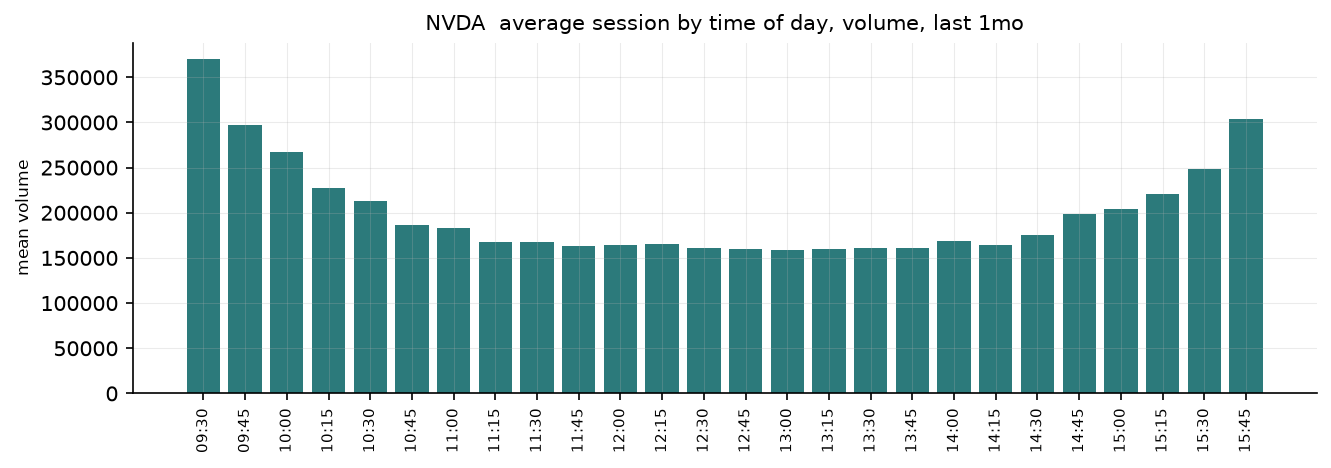
"when during the day does nvda trade the most" -> intraday_pattern(symbol='NVDA')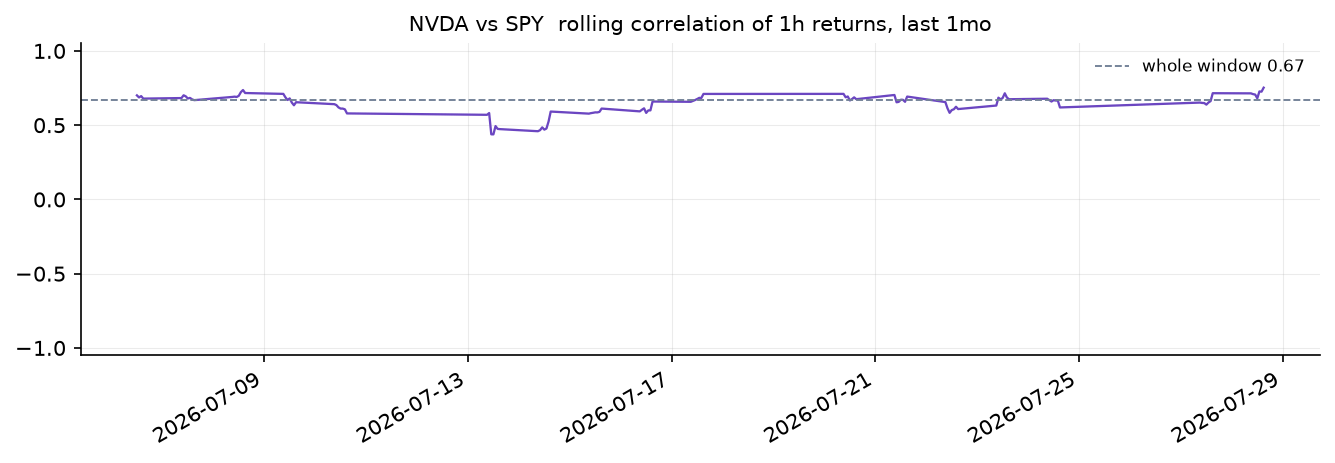
And the ones that answer in text:
for command in ("how did the market do this week", "biggest losers today"):
    print(f'"{command}"  ->  {CALLS[command]}')
    print(CALLS[command].run(), "\n")
"how did the market do this week" -> market_summary(window='1w')
the board over 1w
NVDA 254.12 9.62% 389,465,563
AMD 184.20 1.51% 182,740,497
AAPL 258.71 0.97% 223,818,998
SPY 664.86 0.40% 138,617,365
MSFT 451.35 0.26% 113,427,173
TSLA 320.22 -0.97% 266,317,023
"biggest losers today" -> top_movers(window='1d', direction='losers')
top 3 losers over 1d
AMD -0.57% -> 184.20
MSFT 0.67% -> 451.35
AAPL 1.40% -> 258.71 Read the confidence
confidence reports the least certain judgement in the call, rather than the product of
all of them, since one wrong argument is enough to spoil the result. A product answers a
different question (“is every part right”), and it falls as a function takes more
arguments, whether or not any one judgement is shaky.
Where that number came from, argument by argument:
call = CALLS["is amd tracking nvidia lately"]
print(f'"is amd tracking nvidia lately"  ->  {call}   confidence {call.confidence:.2f}')
for name, argument in call.arguments.items():
    top = sorted(argument.distribution.items(), key=lambda kv: -kv[1])[:3]
    shown = "omitted, default stands" if argument.omitted else repr(argument.value)
    print(
        f"  {name:<12}{shown:<26}p {argument.probability:.2f}   "
        + "  ".join(f"{k} {v:.2f}" for k, v in top)
    )
print(f"  weakest argument: {call.weakest().name}")
"is amd tracking nvidia lately" -> rolling_correlation(symbol='AMD', benchmark='NVDA') confidence 0.82
symbol 'AMD' p 0.87 AMD 0.87 NVDA 0.13 AAPL 0.00
benchmark 'NVDA' p 0.78 NVDA 0.92 AMD 0.08 AAPL 0.00
window omitted, default stands p 0.96
resolution omitted, default stands p 0.99
weakest argument: benchmarkwindow and resolution are both omitted here, because “lately” does not say how far back
or on what bars, so rolling_correlation runs on its own defaults of one month and hourly
bars. That is what the stated question is for. Without it, the choice would have to name
some window, and it would have named one confidently.
Open it in the playground
The link below holds one command and the questions for the function it picked: the choice
over the ten function descriptions, and rolling_correlation’s four arguments. Edit the
command there and the arguments change with it.
COMMAND = "plot rolling correlation between nvda and spy for the past month"
picked = CALLS[COMMAND]
playground_link = make_playground_link(
    COMMAND,
    {ROUTE: assistant.questions[ROUTE]}
    | {q: v for q, v in assistant.questions.items() if q.startswith(f"{picked.name}.")},
    models=[TYPESAFE_MODEL],
)
display(
    Markdown(
        f"🔗 [Open the command and its questions in the TypeSafe playground]({playground_link})"
    )
)
Open the command and its questions in the TypeSafe playground →