 JevCode
Date extraction
Extracts absolute and relative dates by asking TypeSafe for the parts named in a document, then resolving and validating them in code with confidence-based review.

Read a date’s parts off the text with TypeSafe, then resolve them to a date in code.
The function you build here, extract_date(document, role), takes a document and a
phrase naming the date you want, such as “the deadline to return the form”, and hands
back a date with a confidence. It flags a low-confidence read, and one whose parts do
not add up to a date at all, including a date the document never states. The date can be
spelled out (“August 14, 2027”) or written relative to today (“tomorrow”, “next
Thursday”).
TypeSafe answers Choice questions about the date in one call: what kind of date it is,
and
which month, day, year, or weekday the text names. Code turns those answers into a date.
The model reads what the text says and never does the calendar math.
The cells below run that function over four short documents, print each date with its confidence, and split the results into the ones code accepts and the ones a person should look at.
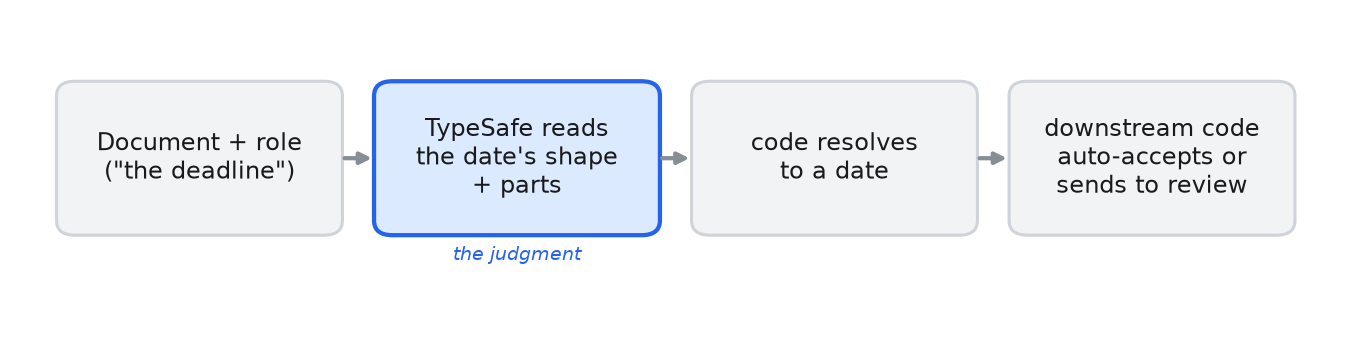
TypeSafe reads how the date is written and which parts the text names. Code turns those
answers into a date, counting from today when the date is relative, and either accepts
it or sends it to review.
Setup
pip install ipython "typesafe-sdk>=0.5.7" cooksafe --extra-index-url https://pypi.typesafe.ai/then set TYPESAFE_API_KEY.
import os
from datetime import date, timedelta
from pathlib import Path

from cooksafe import JsonCache, make_playground_link
from IPython.display import Markdown, display
from typesafe_sdk import Choice, TypeSafeClient

TYPESAFE_MODEL = "jev-1.12"
TODAY = date(
    2026, 7, 30
)  # fixed reference "today" so relative dates resolve reproducibly
REVIEW_BELOW = 0.60  # gate: a date below this confidence is flagged for a human

MONTHS = {
    "January": 1,
    "February": 2,
    "March": 3,
    "April": 4,
    "May": 5,
    "June": 6,
    "July": 7,
    "August": 8,
    "September": 9,
    "October": 10,
    "November": 11,
    "December": 12,
}
WEEKDAYS = [
    "Monday",
    "Tuesday",
    "Wednesday",
    "Thursday",
    "Friday",
    "Saturday",
    "Sunday",
]
YEAR_WINDOW = list(range(1900, 2051))  # 1900..2050

# Cached to json_cache.json (shipped with the cookbook, so re-rendering replays the published
# results with no API spend); delete it to re-run live.
json_cache = JsonCache(Path("json_cache.json"))
# The demo cells below run when this file is executed as the cookbook; the constants and the pure
# resolve/assemble code stay importable, so the calendar math can be unit-tested on its own.
if __name__ == "__cookbook__":
client = TypeSafeClient(
api_key=os.environ.get(
"TYPESAFE_API_KEY", "cache-only"
), # cached re-renders need no key
base_url=os.environ.get("TYPESAFE_BASE_URL"),
timeout=30.0,
)The questions
Seven Choice questions go out in one call. mode says how the date is written:
absolute
for a date that names a month, relative for one written relative to today, and none
when the document does not state the date at all.
The other six read the pieces. An absolute date needs month, day, and year. A
relative one needs day_anchor: today, tomorrow, the day after, or a named weekday. When
it names a weekday, weekday and week_offset say which one and which week. Code reads
only the pieces mode calls for.
year lists one option per year from 1900 to 2050, plus two escapes. none means the text
states no year and code fills one in. out_of_range means the text states a year outside
the list, and code flags that instead of guessing. If a list that long bothers you, pull
the year-like numbers out of the text first and offer the model only those.
def date_questions(role: str) -> dict[str, Choice]:
    """Seven typed choices that read a date's shape and parts off the text -- no math."""
    absent = "The document does not state this, or it is not this kind of date."
    return {
        "mode": Choice(
            instructions=(
                f"How is {role} written? 'absolute' = a calendar date naming a month (e.g. "
                "'August 14', 'the 3rd of March'); 'relative' = given relative to today (today, "
                "tomorrow, the day after tomorrow, or a named weekday such as 'next Thursday'); "
                "'none' = the document does not state this date."
            ),
            criteria={"absolute": None, "relative": None, "none": None},
        ),
        "month": Choice(
            instructions=f"If {role} is an absolute calendar date, which month is it in?",
            criteria={m: None for m in MONTHS} | {"none": absent},
        ),
        "day": Choice(
            instructions=f"If {role} is an absolute calendar date, which day of the month (1-31)?",
            criteria={str(d): None for d in range(1, 32)} | {"none": absent},
        ),
        "year": Choice(
            instructions=(
                f"If {role} is an absolute calendar date, which year? Pick 'none' if the document "
                "states no year (code infers it), or 'out_of_range' if a year is stated but not "
                "in the list."
            ),
            criteria={str(y): None for y in YEAR_WINDOW}
            | {
                "out_of_range": "A year is stated for this date but is outside the listed range.",
                "none": "No year is stated for this date.",
            },
        ),
        "day_anchor": Choice(
            instructions=(
                f"If {role} is relative to today, which day is it? 'today', 'tomorrow', "
                "'day_after' (the day after tomorrow), or 'weekday' (a named day of the week)."
            ),
            criteria={
                "today": None,
                "tomorrow": None,
                "day_after": None,
                "weekday": None,
                "none": absent,
            },
        ),
        "weekday": Choice(
            instructions=f"If {role} names a day of the week, which one?",
            criteria={w: None for w in WEEKDAYS} | {"none": absent},
        ),
        "week_offset": Choice(
            instructions=(
                f"If {role} names a weekday, which week is it in? 'next' for 'next Thursday' or "
                "'Thursday next week'; 'current' for 'this Thursday'; 'none' for a bare weekday "
                "with no qualifier (just 'Thursday' / 'on Thursday')."
            ),
            criteria={"current": None, "next": None, "none": absent},
        ),
    }
Resolve it in code
read_parts makes the call. assemble turns the answers into a date: it fills in the
year when the text states none, and it works out which day a named weekday points at. Both
of those count from TODAY, which is pinned so relative dates come out the same on every
run. assemble also reports the lowest confidence among the parts it used, so a weak
answer on any one part can send the whole date to review.
“next Thursday” can mean two different days, so code decides which. A weekday with no
qualifier means the next one on or after today. next means the following calendar week,
and current means this week.
@json_cache
def read_parts(document: str, role: str) -> dict:
    """One TypeSafe call -> {part: {choice, confidence}} for the seven questions."""
    answers = client.system_one(
        state=document, questions=date_questions(role), model=TYPESAFE_MODEL
    ).answers
    return {
        part: {"choice": ans.choice, "confidence": ans.confidence}
        for part, ans in answers.items()
    }


def resolve_weekday(today: date, weekday: str, week_offset: str) -> date:
    """Which date a named weekday points to, by our stated convention: a bare weekday is the next
    occurrence on or after today; 'next' is the following calendar week; 'current' is this week."""
    w = WEEKDAYS.index(weekday)
    this_monday = today - timedelta(days=today.weekday())
    if week_offset == "next":
        return this_monday + timedelta(days=7 + w)
    if week_offset == "current":
        return this_monday + timedelta(days=w)
    return today + timedelta(days=(w - today.weekday()) % 7)


def assemble(parts: dict, today: date = TODAY) -> dict:
    """Resolve the parts TypeSafe read into a concrete date, in code. Confidence is the weakest of
    the parts the shape actually used."""
    mode = parts["mode"]["choice"]
    confs = [parts["mode"]["confidence"]]

    def result(resolved: date | None, note: str) -> dict:
        usable = [c for c in confs if c is not None]
        confidence = min(usable) if usable else None
        needs_review = (
            resolved is None or confidence is None or confidence < REVIEW_BELOW
        )
        return {
            "date": resolved,
            "confidence": confidence,
            "needs_review": needs_review,
            "note": note,
        }

    if mode == "none":
        return result(None, "no such date stated")

    if mode == "absolute":
        month, day, year = (
            parts["month"]["choice"],
            parts["day"]["choice"],
            parts["year"]["choice"],
        )
        confs += [
            parts["month"]["confidence"],
            parts["day"]["confidence"],
            parts["year"]["confidence"],
        ]
        if "none" in (month, day) or not day.isdigit() or month not in MONTHS:
            return result(None, "absolute date incomplete")
        if (
            year == "out_of_range"
        ):  # a year is stated but off the list -> flag, don't guess
            return result(None, f"year outside {YEAR_WINDOW[0]}-{YEAR_WINDOW[-1]}")
        if (
            year == "none"
        ):  # no year stated -> infer this year, bumped to next if well past
            try:
                resolved = date(today.year, MONTHS[month], int(day))
            except (
                ValueError
            ):  # e.g. February 30 -- an inconsistent read, not a real date
                return result(None, f"impossible date: {month} {day}")
            if resolved < today - timedelta(days=31):
                resolved = date(today.year + 1, MONTHS[month], int(day))
            return result(resolved, "")
        try:  # a stated, in-range year
            return result(date(int(year), MONTHS[month], int(day)), "")
        except ValueError:
            return result(None, f"impossible date: {year}-{month}-{day}")

    if mode == "relative":
        anchor = parts["day_anchor"]["choice"]
        confs.append(parts["day_anchor"]["confidence"])
        if anchor == "today":
            return result(today, "")
        if anchor == "tomorrow":
            return result(today + timedelta(days=1), "")
        if anchor == "day_after":
            return result(today + timedelta(days=2), "")
        if anchor == "weekday":
            weekday, offset = parts["weekday"]["choice"], parts["week_offset"]["choice"]
            confs += [
                parts["weekday"]["confidence"],
                parts["week_offset"]["confidence"],
            ]
            if weekday not in WEEKDAYS:
                return result(None, "relative weekday not read")
            return result(resolve_weekday(today, weekday, offset), "")
        return result(None, "relative day not read")

    return result(None, f"unrecognized mode: {mode}")


def extract_date(document: str, role: str) -> dict:
    return assemble(read_parts(document, role))
Run it
Six questions across four short documents: two dates from a contract that states its years,
a form deadline written without a year, a survey that closes “today”, a review set for
“next Thursday”, and a date the form never mentions. All of them resolve against TODAY =
2026-07-30, a Thursday.
CONTRACT = "This agreement is effective January 1, 2025 and expires December 31, 2027."
FORM = "Please return the signed form by August 14."
SURVEY = "Heads up - the customer survey closes today at 5pm."
REVIEW = "Let's schedule the design review for next Thursday."

# (document, question phrase, expected date) -- the expected value is only for the scorecard.
EXAMPLES = [
    (CONTRACT, "the date the agreement takes effect", date(2025, 1, 1)),
    (CONTRACT, "the date the agreement expires", date(2027, 12, 31)),
    (FORM, "the deadline to return the form", date(2026, 8, 14)),
    (FORM, "the date of the kickoff call", None),
    (SURVEY, "the date the survey closes", date(2026, 7, 30)),
    (REVIEW, "the date of the design review", date(2026, 8, 6)),
]

if __name__ == "__cookbook__":
    print(f"{'':3}{'question':<38}{'expected':<12}{'got':<12}{'conf':>6}  flags")
    print("-" * 84)
    for document, role, expected in EXAMPLES:
        r = extract_date(document, role)
        got = r["date"].isoformat() if r["date"] else "none"
        exp = expected.isoformat() if expected else "none"
        mark = "OK" if r["date"] == expected else "XX"
        conf = f"{r['confidence']:.2f}" if r["confidence"] is not None else " n/a"
        flags = "  <== review" if r["needs_review"] else ""
        if r["note"]:
            flags += f"  ({r['note']})"
        print(f"{mark:<3}{role:<38}{exp:<12}{got:<12}{conf:>6}{flags}")
question expected got conf flags
------------------------------------------------------------------------------------
OK the date the agreement takes effect 2025-01-01 2025-01-01 0.97
OK the date the agreement expires 2027-12-31 2027-12-31 0.91
OK the deadline to return the form 2026-08-14 2026-08-14 0.95
OK the date of the kickoff call none none 0.46 <== review (absolute date incomplete)
OK the date the survey closes 2026-07-30 2026-07-30 0.94
OK the date of the design review 2026-08-06 2026-08-06 0.92The contract states both of its years, so those came off the text. The form states no year, so code filled in 2026: it takes the current year and moves to the next one only when the date is already more than a month past. “today” and “next Thursday” went through the same function as the spelled-out dates.
The kickoff call is the one the form never mentions. There is a date in that form, just not
this one, and the note absolute date incomplete means mode came back absolute with no
month to go with it. The date came back empty, the confidence reads 0.46, and the row is
flagged for a person.
Confidence to route on
Every answer comes back with a calibrated confidence, and a date’s confidence is the lowest
one among the parts that went into it. A date under REVIEW_BELOW = 0.60 goes to a person,
and so does a date code could not assemble at all. The rest go straight through.
if __name__ == "__cookbook__":
    confident = [
        (doc, role)
        for doc, role, _ in EXAMPLES
        if not extract_date(doc, role)["needs_review"]
    ]
    review = [
        (doc, role)
        for doc, role, _ in EXAMPLES
        if extract_date(doc, role)["needs_review"]
    ]
    print(f"auto-accept ({len(confident)}):")
    for _doc, role in confident:
        print(f"  - {role}")
    print(f"\nsend to review ({len(review)}):")
    for _doc, role in review:
        r = extract_date(_doc, role)
        print(
            f"  - {role}  (conf {r['confidence']:.2f} / {r['note'] or 'low confidence'})"
        )
auto-accept (5):
- the date the agreement takes effect
- the date the agreement expires
- the deadline to return the form
- the date the survey closes
- the date of the design review
send to review (1):
- the date of the kickoff call (conf 0.46 / absolute date incomplete)Open it in the TypeSafe playground
The link below carries the “next Thursday” message and the same questions the code sends. Open it to see the answers and their confidences, and to change the wording without writing any code.
if __name__ == "__cookbook__":
    playground_link = make_playground_link(
        REVIEW, date_questions("the date of the design review"), models=[TYPESAFE_MODEL]
    )
    display(
        Markdown(
            f"🔗 [Open this document + questions in the TypeSafe playground]({playground_link})"
        )
    )