JevCode
Classification hiérarchique
Classe les documents à travers des hiérarchies approfondies de brevets, de produits de détail, de biomédecine et de code source, en utilisant une recherche par faisceaux parallèles sur les probabilités de choix TypeSafe.
Traduit automatiquement depuis le en, non relu. À utiliser comme référence rapide uniquement.

Une grande quantité de données existe sous forme de hiérarchies structurées, telles que des taxonomies, des hiérarchies de systèmes de fichiers, des structures de sites web, des bases de code, des organigrammes, des ontologies biologiques, des compétences des LLM, des politiques de modération, etc. L’objectif de la Classification Hiérarchique est de parcourir la hiérarchie jusqu’au nœud feuille correct, qui constitue la classification finale. Cela correspond parfaitement au primitif Choice de typesafe. Nous trouvons la feuille la plus probable en classant le document à chaque nœud (en commençant par la racine), puis en procédant itérativement au nœud suivant le plus probable jusqu’à ce que nous aboutissions à une feuille (Recherche Gloutonne).
La nature parallèle de l’API nous permet également d’explorer plusieurs chemins avec des questions parallèles
en utilisant Beam Search pour améliorer les performances. Les appels d’API TypeSafe du guide appellent chacun
simultanément K chemins de la hiérarchie. La recherche par faisceau conserve les meilleurs K chemins
selon une probabilité de bord en moyenne géométrique : product(edge_probabilities) ** (1 / decisions),
et élimine les autres. La probabilité est normalisée par la longueur afin que les feuilles peu profondes et profondes
soient comparées équitablement.
Décomposer le problème en une hiérarchie comme celle-ci présente ses propres avantages :
- Observabilité
- identifier les nœuds où vos erreurs de classification se produisent le plus souvent
- mesurer le nombre de fois que chaque nœud et chaque arête est traversé
- Testabilité
- tester unitairement et mesurer l’impact des mises à jour de la hiérarchie sur les performances de classification
-

Hiérarchies utilisées dans ce guide
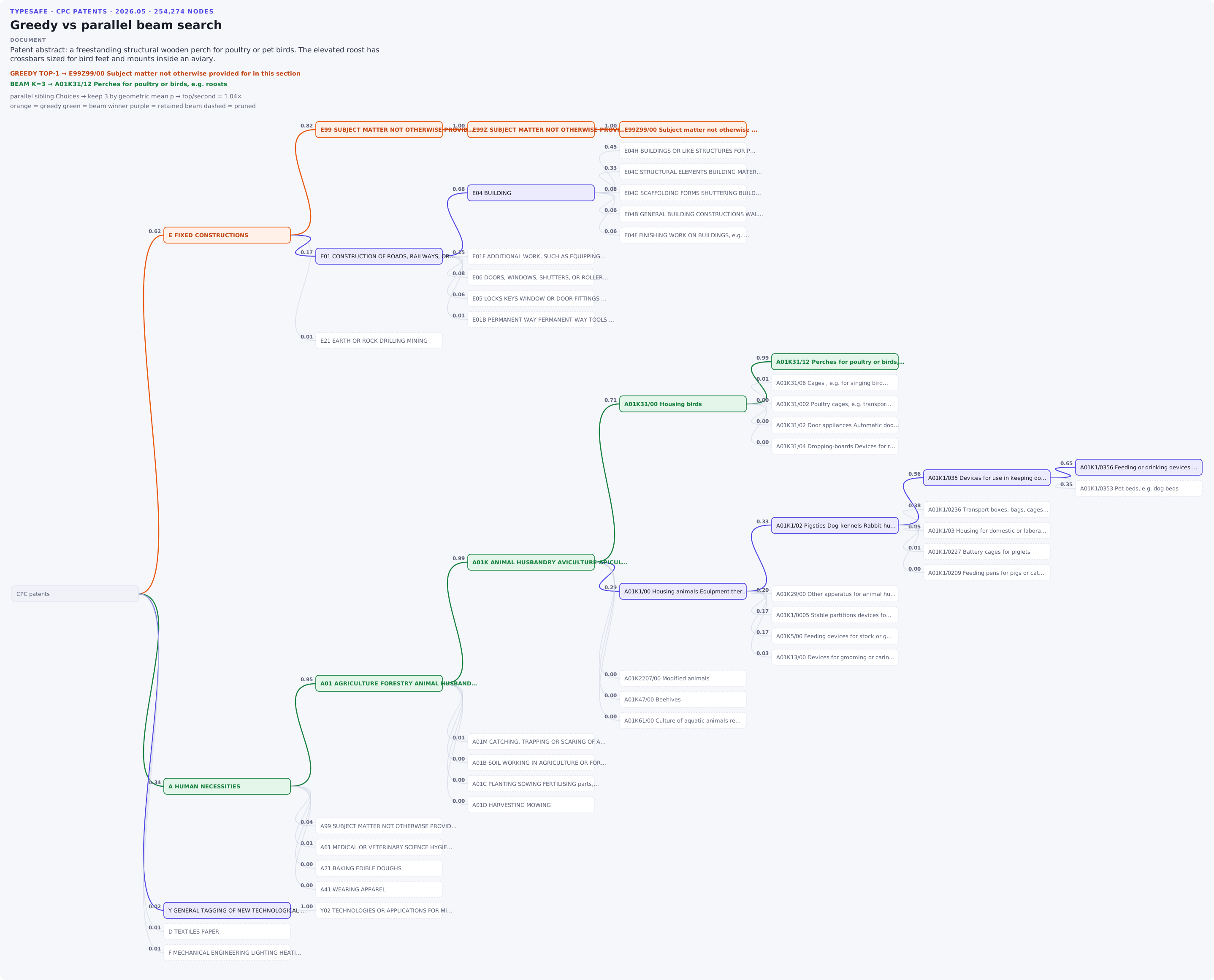
- CPC 2026.05: objet du brevet, allant des sections technologiques larges aux inventions spécifiques.
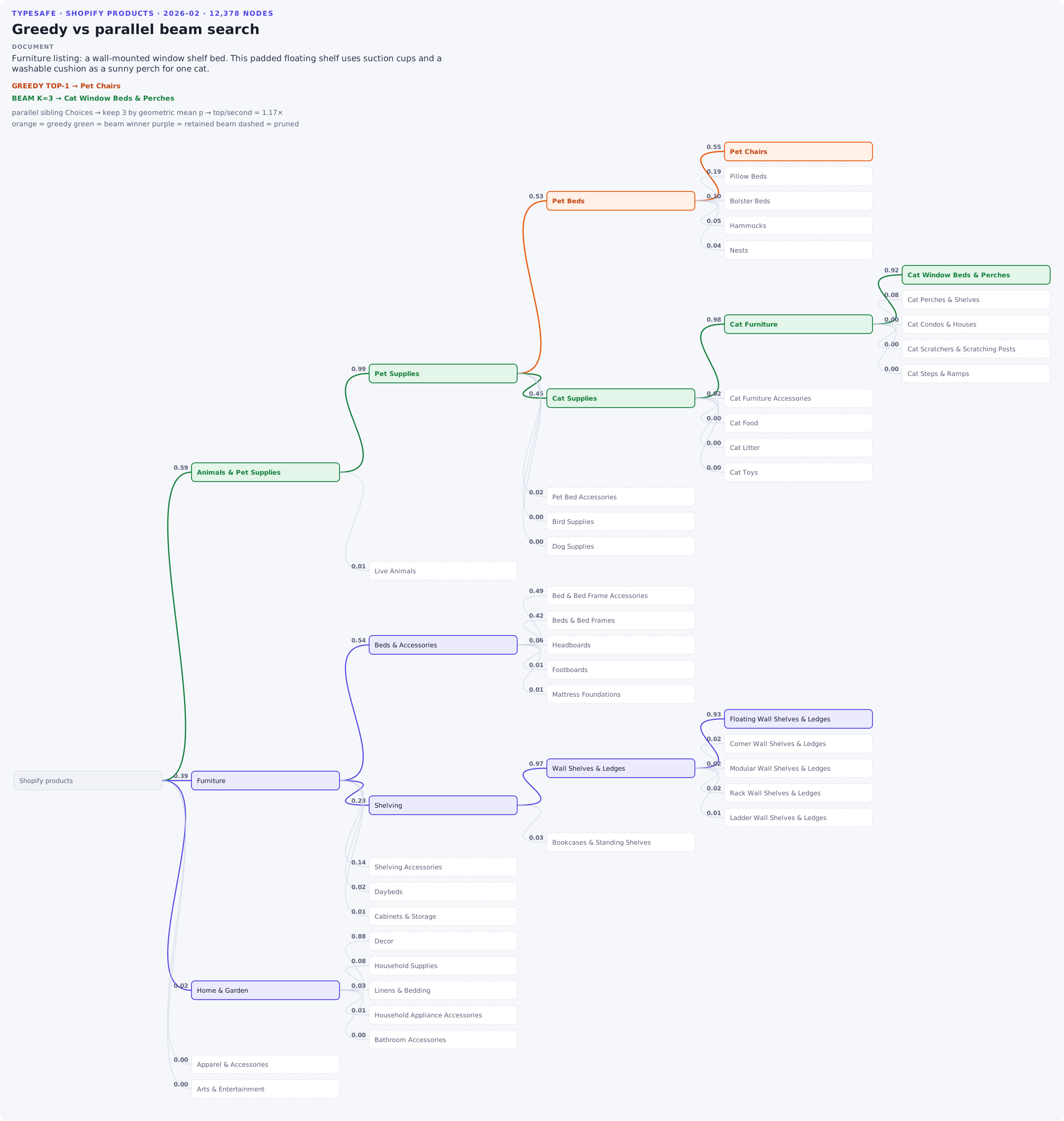
- Shopify 2026-02: catégories de produits de détail, allant des départements de magasin aux types de produits spécifiques.
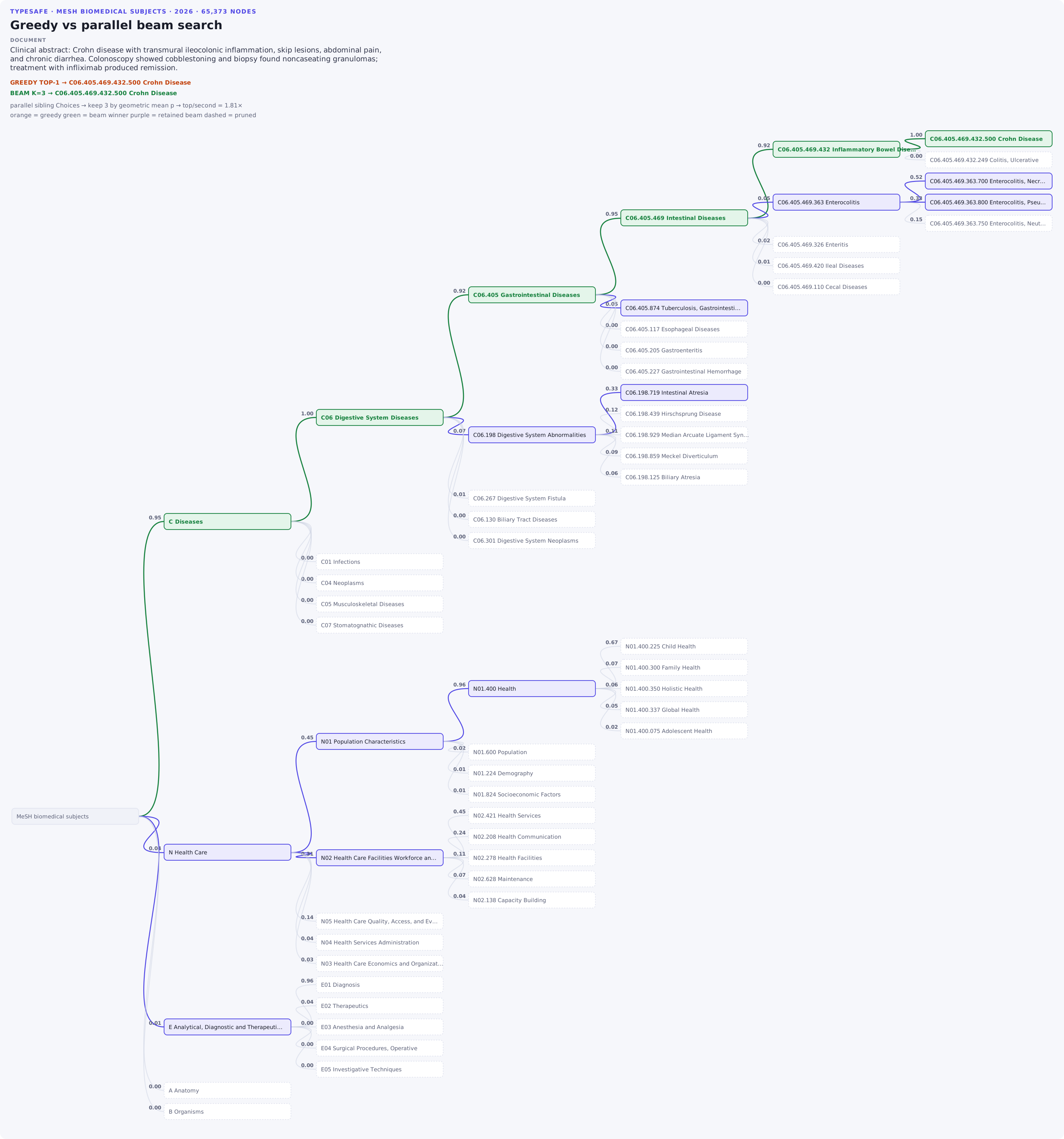
- MeSH 2026: sujets biomédicaux, allant des domaines larges aux conditions spécifiques. MeSH étant un DAG, un descripteur peut apparaître sous plusieurs parents ; cette démo étend ses chemins officiels de numéro d’arbre.
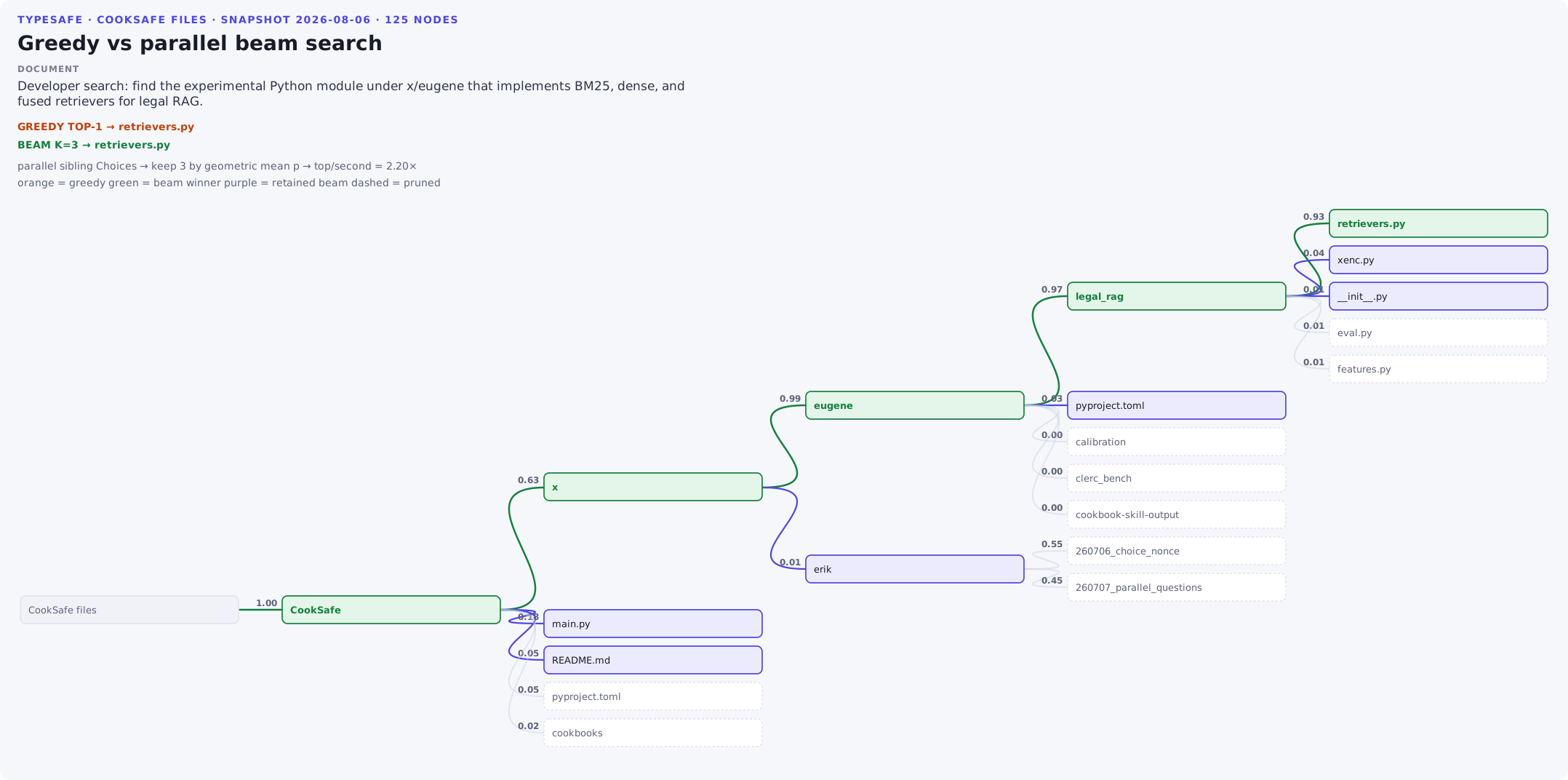
- Fichiers CookSafe : hiérarchie du dépôt de recettes de TypeSafe, recherchée des dossiers aux fichiers source.
Méthodes
- Recherche gourmande (Greedy search) : choisir l’enfant ayant la probabilité la plus élevée et rejeter toutes les autres alternatives. Une première erreur ne peut pas être rattrapée.
- Recherche par faisceau (Beam search) : conserver
Kchemins plausibles et classifier chaque frontière en parallèle. Des preuves plus profondes peuvent réparer une décision précoce ambiguë. La feuille du chemin ayant la probabilité moyenne géométrique la plus élevée constitue la classification finale. - TypeSafe Choice : chaque nœud est une
Choicequestion dont la distribution de probabilité complète est constituée par ses arêtes. Chaque chemin du faisceau s’exécute sous forme de questions parallèles, de sorte que l’exploration supplémentaire ajoute peu de latence en temps réel. - Formule :
path_score = product(edge_probabilities) ** (1 / decisions)- utilisée pour l’élagage et la comparaison des chemins
separation = top_path_score / second_path_score- métrique utile, mais non utilisée pour l’élagage
- le rapport compare la moyenne géométrique du premier chemin contre celle de son rival le plus proche.
- Proche de
1×signifie ambiguïté - Un grand rapport indique une séparation nette.
- Remarques sur les métriques :
- une métrique différente telle que
min(top_prob/second_top_prob)qui optimiserait les chemins ayant des décisions très claires à chaque nœud. - utiliser
exp(mean(log(probs)))au lieu deproduct(edge_probabilities) ** (1 / decisions)pour éviter les erreurs de précision dans les hiérarchies très profondes (par ex. >10 niveaux)
Charger et visualiser les hiérarchies d’exemple
Ces utilitaires téléchargent les sources de taxonomie épinglées, les analysent en arbres d’enfants directs, et rendent chaque parcours de recherche sous forme de SVG statique.
import html
import os
import shutil
import textwrap
import urllib.request
from collections import defaultdict
from concurrent.futures import ThreadPoolExecutor
from pathlib import Path
from typing import NamedTuple, TypeAlias
from xml.etree import ElementTree
from zipfile import ZipFile

from cooksafe import JsonCache
from IPython.display import Markdown, display
from typesafe_sdk import Choice, RetryPolicy, TypeSafeClient

Tree: TypeAlias = dict[str, "Tree"]


class Hierarchy(NamedTuple):
    """One query and a complete hierarchy.

    :param slug: filename-safe taxonomy name.
    :param name: display name.
    :param version: pinned dataset version.
    :param source_url: hierarchy source.
    :param node_count: number of loaded hierarchy nodes.
    :param document: unstructured text classified by TypeSafe.
    :param expected_leaf: expected final classification.
    :param tree: nested direct-child menus.
    """

    slug: str
    name: str
    version: str
    source_url: str
    node_count: int
    document: str
    expected_leaf: str
    tree: Tree


CPC_URL = (
    "https://www.cooperativepatentclassification.org/sites/default/files/"
    "cpc/bulk/CPCSchemeXML202605.zip"
)
SHOPIFY_URL = (
    "https://raw.githubusercontent.com/Shopify/product-taxonomy/"
    "v2026-02/dist/en/categories.txt"
)
MESH_URL = "https://nlmpubs.nlm.nih.gov/projects/mesh/MESH_FILES/xmlmesh/desc2026.zip"
MESH_CATEGORIES = {
    "A": "Anatomy",
    "B": "Organisms",
    "C": "Diseases",
    "D": "Chemicals and Drugs",
    "E": "Analytical, Diagnostic and Therapeutic Techniques, and Equipment",
    "F": "Psychiatry and Psychology",
    "G": "Phenomena and Processes",
    "H": "Disciplines and Occupations",
    "I": "Anthropology, Education, Sociology, and Social Phenomena",
    "J": "Technology, Industry, and Agriculture",
    "K": "Humanities",
    "L": "Information Science",
    "M": "Named Groups",
    "N": "Health Care",
    "V": "Publication Characteristics",
    "Z": "Geographicals",
}


def _download(url: str, path: Path) -> Path:
    """Download a pinned dataset once.

    :param url: official dataset URL.
    :param path: local cache path.
    :returns: local dataset path.
    """

    if path.exists():
        return path
    path.parent.mkdir(parents=True, exist_ok=True)
    temporary_path: Path = path.with_suffix(path.suffix + ".tmp")
    request = urllib.request.Request(
        url, headers={"User-Agent": "typesafe-taxonomy/1.0"}
    )
    with urllib.request.urlopen(request, timeout=120) as response:
        with temporary_path.open("wb") as file:
            shutil.copyfileobj(response, file)
    temporary_path.replace(path)
    return path


def _insert(tree: Tree, path: tuple[str, ...]) -> None:
    subtree_value: Tree = tree
    for label in path:
        subtree_value = subtree_value.setdefault(label, {})


def _cpc_title(item: ElementTree.Element) -> str:
    class_title: ElementTree.Element | None = item.find("class-title")
    if class_title is None:
        return ""
    return " ".join(" ".join(class_title.itertext()).split())


def _load_cpc(path: Path) -> tuple[Tree, int]:
    titles: dict[str, str] = {}
    levels: dict[str, int] = {}
    parent_by_symbol: dict[str, str] = {}
    children_by_symbol: defaultdict[str, list[str]] = defaultdict(list)

    def visit(item: ElementTree.Element, parent_symbol: str | None) -> None:
        symbol: str | None = item.findtext("classification-symbol")
        next_parent: str | None = parent_symbol
        if symbol:
            title: str = _cpc_title(item)
            if title:
                titles[symbol] = title
            levels[symbol] = min(levels.get(symbol, 99), int(item.attrib["level"]))
            if (
                parent_symbol
                and parent_symbol != symbol
                and symbol not in parent_by_symbol
            ):
                parent_by_symbol[symbol] = parent_symbol
                children_by_symbol[parent_symbol].append(symbol)
            next_parent = symbol
        for child in item.findall("classification-item"):
            visit(child, next_parent)

    with ZipFile(path) as zip_file:
        names = sorted(
            name
            for name in zip_file.namelist()
            if name.startswith("cpc-scheme-") and name.endswith(".xml")
        )
        for name in names:
            root = ElementTree.fromstring(zip_file.read(name))
            for item in root.findall("classification-item"):
                visit(item, None)

    labels: dict[str, str] = {
        symbol: f"{symbol} {titles.get(symbol, '')}".strip() for symbol in levels
    }

    def build(symbol: str) -> Tree:
        return {
            labels[child]: build(child) for child in children_by_symbol.get(symbol, [])
        }

    root_symbols: list[str] = sorted(
        symbol for symbol, level in levels.items() if level == 2
    )
    tree: Tree = {labels[symbol]: build(symbol) for symbol in root_symbols}
    return tree, len(labels)


def _load_shopify(path: Path) -> tuple[Tree, int]:
    tree: Tree = {}
    category_count: int = 0
    for line in path.read_text().splitlines():
        if not line or line.startswith("#"):
            continue
        _, path_text = line.split(" : ", maxsplit=1)
        category_path: tuple[str, ...] = tuple(path_text.strip().split(" > "))
        _insert(tree, category_path)
        category_count += 1
    return tree, category_count


def _load_mesh(path: Path) -> tuple[Tree, int]:
    """Load every official MeSH tree-number path.

    A descriptor may have multiple tree numbers because MeSH is a DAG. Expanding
    those positions into paths makes it usable by the tree-oriented beam search.

    :param path: MeSH descriptor XML ZIP.
    :returns: expanded tree and position count.
    """

    with ZipFile(path) as zip_file:
        root: ElementTree.Element = ElementTree.fromstring(
            zip_file.read("desc2026.xml")
        )
    names_by_tree_number: dict[str, str] = {
        tree_number.text: descriptor_record.findtext("DescriptorName/String", "")
        for descriptor_record in root.findall("DescriptorRecord")
        for tree_number in descriptor_record.findall("TreeNumberList/TreeNumber")
        if tree_number.text
    }
    tree: Tree = {}
    for tree_number in sorted(names_by_tree_number):
        parts: list[str] = tree_number.split(".")
        prefixes: list[str] = [
            ".".join(parts[:index]) for index in range(1, len(parts) + 1)
        ]
        category_code: str = tree_number[0]
        category_path: tuple[str, ...] = (
            f"{category_code} {MESH_CATEGORIES[category_code]}",
            *(f"{prefix} {names_by_tree_number[prefix]}" for prefix in prefixes),
        )
        _insert(tree, category_path)
    position_count: int = len(names_by_tree_number) + len(tree)
    return tree, position_count


CODEBASE_SNAPSHOT = Path("codebase_files.txt")


def _load_codebase(path: Path) -> tuple[Tree, int]:
    """Load the frozen CookSafe source-file hierarchy.

    The listing is a snapshot of the repository's source files in the order a walk found them,
    taken when this cookbook was rendered, rather than a walk of whatever tree the cookbook
    happens to sit in. A live walk makes the taxonomy -- and every number derived from it --
    depend on the reader's checkout, including untracked scratch files, so the shipped cache
    stops describing the same tree. Line order is significant: sibling options are asked in the
    order they appear here, so it is part of the question, not presentation.

    :param path: file holding one repository-relative source path per line.
    :returns: nested file tree and node count.
    """

    tree: Tree = {}
    node_paths: set[tuple[str, ...]] = set()
    for line in path.read_text(encoding="utf-8").splitlines():
        if not line.strip():
            continue
        hierarchy_path: tuple[str, ...] = ("CookSafe", *line.split("/"))
        _insert(tree, hierarchy_path)
        node_paths.update(
            hierarchy_path[:index] for index in range(1, len(hierarchy_path) + 1)
        )
    return tree, len(node_paths)


def load_hierarchies(data_directory: Path = Path("datasets")) -> tuple[Hierarchy, ...]:
    """Load three public taxonomies and one frozen code hierarchy.

    :param data_directory: cache directory for official raw files.
    :returns: CPC, Shopify, MeSH, and CookSafe examples.
    """

    cpc_tree, cpc_nodes = _load_cpc(
        _download(CPC_URL, data_directory / "CPCSchemeXML202605.zip")
    )
    shopify_tree, shopify_nodes = _load_shopify(
        _download(SHOPIFY_URL, data_directory / "shopify_categories_2026-02.txt")
    )
    mesh_tree, mesh_nodes = _load_mesh(
        _download(MESH_URL, data_directory / "mesh_descriptors_2026.zip")
    )
    codebase_tree, codebase_nodes = _load_codebase(CODEBASE_SNAPSHOT)
    return (
        Hierarchy(
            slug="cpc",
            name="CPC patents",
            version="2026.05",
            source_url=CPC_URL,
            node_count=cpc_nodes,
            document=(
                "Patent abstract: a freestanding structural wooden perch for poultry or "
                "pet birds. The elevated roost has crossbars sized for bird feet and mounts "
                "inside an aviary."
            ),
            expected_leaf="A01K31/12 Perches for poultry or birds, e.g. roosts",
            tree=cpc_tree,
        ),
        Hierarchy(
            slug="shopify",
            name="Shopify products",
            version="2026-02",
            source_url=SHOPIFY_URL,
            node_count=shopify_nodes,
            document=(
                "Furniture listing: a wall-mounted window shelf bed. This padded floating shelf "
                "uses suction cups and a washable cushion as a sunny perch for one cat."
            ),
            expected_leaf="Cat Window Beds & Perches",
            tree=shopify_tree,
        ),
        Hierarchy(
            slug="mesh",
            name="MeSH biomedical subjects",
            version="2026",
            source_url=MESH_URL,
            node_count=mesh_nodes,
            document=(
                "Clinical abstract: Crohn disease with transmural ileocolonic inflammation, "
                "skip lesions, abdominal pain, and chronic diarrhea. Colonoscopy showed "
                "cobblestoning and biopsy found noncaseating granulomas; treatment with "
                "infliximab produced remission."
            ),
            expected_leaf="C06.405.469.432.500 Crohn Disease",
            tree=mesh_tree,
        ),
        Hierarchy(
            slug="codebase",
            name="CookSafe files",
            version="snapshot 2026-08-06",
            source_url=str(CODEBASE_SNAPSHOT),
            node_count=codebase_nodes,
            document=(
                "Developer search: find the experimental Python module under x/eugene that "
                "implements BM25, dense, and fused retrievers for legal RAG."
            ),
            expected_leaf="retrievers.py",
            tree=codebase_tree,
        ),
    )


NODE_W, NODE_H = 300, 38
COL_W, ROW_H = 360, 50
PAD_X = 28
EDGE_TOP_K = 5


def subtree(tree: Tree, path: tuple[str, ...]) -> Tree:
    """Return the direct-child menu below ``path``.

    :param tree: taxonomy root.
    :param path: path from the taxonomy root.
    :returns: child mapping at the path.
    """

    subtree_value: Tree = tree
    for label in path:
        subtree_value = subtree_value[label]
    return subtree_value


def _escape(value: object) -> str:
    return html.escape(str(value), quote=True)


def _truncate(value: str, length: int = 33) -> str:
    return value if len(value) <= length else value[: length - 1] + "…"


def _build_nodes(hierarchy: Hierarchy, result: dict) -> dict:
    records: dict[tuple[str, ...], dict] = {
        tuple(record["parent"]): record for record in result["records"]
    }
    best_path: tuple[str, ...] = tuple(result["beam"][0]["path"])
    greedy_path: tuple[str, ...] = tuple(result["greedy"]["path"])
    retained: set[tuple[str, ...]] = {tuple(path) for path in result["retained_paths"]}

    def grow(path: tuple[str, ...]) -> list[dict]:
        record: dict | None = records.get(path)
        if record is None:
            return []
        children: list[dict] = []
        probabilities: dict[str, float] = record["probabilities"]
        ranked: list[tuple[str, float]] = sorted(
            probabilities.items(), key=lambda item: item[1], reverse=True
        )
        shown_labels: set[str] = {label for label, _ in ranked[:EDGE_TOP_K]}
        shown_labels.update(
            label
            for label, _ in ranked
            if path + (label,) in retained
            or path + (label,) == best_path[: len(path) + 1]
            or path + (label,) == greedy_path[: len(path) + 1]
        )
        for label, probability in ranked:
            if label not in shown_labels:
                continue
            child_path: tuple[str, ...] = path + (label,)
            on_best_path: bool = child_path == best_path[: len(child_path)]
            on_greedy_path: bool = child_path == greedy_path[: len(child_path)]
            kind: str = (
                "winner"
                if on_best_path
                else "greedy"
                if on_greedy_path
                else "beam"
                if child_path in retained
                else "alt"
            )
            children.append(
                {
                    "label": label,
                    "probability": probability,
                    "kind": kind,
                    "children": grow(child_path),
                }
            )
        return children

    return {
        "label": hierarchy.name,
        "probability": None,
        "kind": "root",
        "children": grow(()),
    }


def _layout(root: dict) -> tuple[int, int]:
    rows: list[int] = [0]
    maximum_depth: list[int] = [0]

    def walk(node: dict, depth: int) -> None:
        node["depth"] = depth
        maximum_depth[0] = max(maximum_depth[0], depth)
        if node["children"]:
            for child in node["children"]:
                walk(child, depth + 1)
            node["row"] = (node["children"][0]["row"] + node["children"][-1]["row"]) / 2
        else:
            node["row"] = rows[0]
            rows[0] += 1

    walk(root, 0)
    return maximum_depth[0], rows[0]


def render_svg(hierarchy: Hierarchy, result: dict, path: Path) -> None:
    """Write a standalone traversal SVG matching the Customer_ProdX visual language.

    :param hierarchy: taxonomy demonstration.
    :param result: beam-search result from the notebook.
    :param path: output SVG path.
    """

    root: dict = _build_nodes(hierarchy, result)
    maximum_depth, row_count = _layout(root)
    document_lines: list[str] = textwrap.wrap(
        hierarchy.document,
        width=105,
        break_long_words=False,
        break_on_hyphens=False,
    ) or [""]
    document_y: int = 124
    greedy_y: int = document_y + (len(document_lines) - 1) * 21 + 34
    beam_y: int = greedy_y + 25
    method_y: int = beam_y + 29
    legend_y: int = method_y + 23
    header_height: int = legend_y + 32
    width: int = PAD_X * 2 + maximum_depth * COL_W + NODE_W
    height: int = header_height + max(row_count, 1) * ROW_H + 34
    edges: list[str] = []
    nodes: list[str] = []

    def node_x(node: dict) -> float:
        return PAD_X + node["depth"] * COL_W

    def node_y(node: dict) -> float:
        return header_height + node["row"] * ROW_H

    def walk(node: dict) -> None:
        x_value, y_value = node_x(node), node_y(node)
        for child in node["children"]:
            child_x, child_y = node_x(child), node_y(child)
            x1, y1 = x_value + NODE_W, y_value + NODE_H / 2
            x2, y2 = child_x, child_y + NODE_H / 2
            bend: float = COL_W * 0.38
            edges.append(
                f'<path class="edge {child["kind"]}" '
                f'd="M{x1:.0f},{y1:.0f} C{x1 + bend:.0f},{y1:.0f} '
                f'{x2 - bend:.0f},{y2:.0f} {x2:.0f},{y2:.0f}"/>'
            )
            edges.append(
                f'<text class="prob" x="{x2 - 7:.0f}" y="{y2 - 5:.0f}" '
                f'text-anchor="end">{child["probability"]:.2f}</text>'
            )
            walk(child)

        kind: str = node["kind"]
        label: str = _truncate(node["label"], 40)
        nodes.append(
            f'<g class="node {kind}"><title>{_escape(node["label"])}</title>'
            f'<rect x="{x_value:.0f}" y="{y_value:.0f}" width="{NODE_W}" '
            f'height="{NODE_H}" rx="7"/>'
            f'<text x="{x_value + 11:.0f}" y="{y_value + 24:.0f}">'
            f"{_escape(label)}</text></g>"
        )

    walk(root)
    best: dict = result["beam"][0]
    best_path: tuple[str, ...] = tuple(best["path"])
    greedy_path: tuple[str, ...] = tuple(result["greedy"]["path"])
    beam_leaf: str = best_path[-1] if best_path else "no leaf"
    greedy_leaf: str = greedy_path[-1] if greedy_path else "no leaf"
    beam_width: int = result["beam_width"]
    separation_ratio: float = result["separation_ratio"]
    document_text: str = "".join(
        f'<text class="document" x="24" y="{document_y + index * 21}">'
        f"{_escape(line)}</text>"
        for index, line in enumerate(document_lines)
    )
    separation_text: str = (
        ">999×" if separation_ratio > 999 else f"{separation_ratio:.2f}×"
    )

    svg: str = f'''<svg xmlns="http://www.w3.org/2000/svg" viewBox="0 0 {width} {height}"
  width="{width}" height="{height}" role="img" aria-label="{_escape(hierarchy.name)} taxonomy beam search">
<style>
  .bg {{ fill:#f6f7fb }}
  text {{ font-family:ui-monospace,"SF Mono",Menlo,Consolas,monospace }}
  .eyebrow {{ font-size:14px; font-weight:700; letter-spacing:1.2px; fill:#4f46e5 }}
  .title {{ font:700 28px system-ui,-apple-system,"Segoe UI",sans-serif; fill:#181b28 }}
  .document-label {{ font:700 12px system-ui,-apple-system,"Segoe UI",sans-serif; letter-spacing:1px; fill:#777c91 }}
  .document {{ font:500 17px system-ui,-apple-system,"Segoe UI",sans-serif; fill:#303449 }}
  .copy {{ font-size:14px; fill:#5c6178 }}
  .result {{ font-size:14px; font-weight:700 }}
  .greedy-result {{ fill:#c2410c }}
  .beam-result {{ fill:#15803d }}
  .edge {{ fill:none; stroke:#c9cee0; stroke-width:2 }}
  .edge.winner {{ stroke:#15803d; stroke-width:2.5 }}
  .edge.greedy {{ stroke:#ea580c; stroke-width:2.5 }}
  .edge.beam {{ stroke:#4f46e5; stroke-width:2.2 }}
  .edge.alt {{ opacity:.48 }}
  .prob {{ font-size:12px; font-weight:600; fill:#5c6178 }}
  .node rect {{ stroke-width:1.7 }}
  .node text {{ font-size:13px }}
  .node.root rect {{ fill:#f0f2f8; stroke:#e2e5f0 }}
  .node.root text {{ fill:#5c6178 }}
  .node.winner rect {{ fill:#e4f5ea; stroke:#15803d }}
  .node.winner text {{ fill:#15803d; font-weight:700 }}
  .node.greedy rect {{ fill:#fff0e8; stroke:#ea580c }}
  .node.greedy text {{ fill:#c2410c; font-weight:700 }}
  .node.beam rect {{ fill:#ecebfd; stroke:#4f46e5 }}
  .node.beam text {{ fill:#181b28 }}
  .node.alt rect {{ fill:#fff; stroke:#e2e5f0; stroke-dasharray:3 3 }}
  .node.alt text {{ fill:#5c6178 }}
</style>
<rect class="bg" width="{width}" height="{height}" rx="14"/>
<text class="eyebrow" x="24" y="32">TYPESAFE · {hierarchy.name.upper()} · {hierarchy.version.upper()} · {hierarchy.node_count:,} NODES</text>
<text class="title" x="24" y="69">Greedy vs parallel beam search</text>
<text class="document-label" x="24" y="99">DOCUMENT</text>
{document_text}
<text class="result greedy-result" x="24" y="{greedy_y}">GREEDY TOP-1 → {_escape(_truncate(greedy_leaf, 105))}</text>
<text class="result beam-result" x="24" y="{beam_y}">BEAM K={beam_width} → {_escape(_truncate(beam_leaf, 105))}</text>
<text class="copy" x="24" y="{method_y}">parallel sibling Choices → keep {beam_width} by geometric mean p → top/second = {separation_text}</text>
<text class="copy" x="24" y="{legend_y}">orange = greedy   green = beam winner   purple = retained beam   dashed = pruned</text>
{"".join(edges)}{"".join(nodes)}
</svg>'''
    path.write_text(svg)
Implémenter la recherche gloutonne et la recherche par faisceau
Chaque ensemble de frères devient une Choice question dans la section suivante, qui implémente également les deux stratégies de traversal et conserve les probabilités que les diagrammes statiques nécessitent.
HIERARCHIES = load_hierarchies()
MODEL, BEAM_WIDTH, MAX_DEPTH, EPSILON = "jev-1.12", 3, 12, 1e-9
client = TypeSafeClient(
    api_key=os.environ["TYPESAFE_API_KEY"],
    retry=RetryPolicy(max_retries=5, backoff_initial=1.0, backoff_max=20.0),
)
json_cache = JsonCache(Path("json_cache.json"))


@json_cache
def choose(state: str, labels: tuple[str, ...]) -> dict[str, float]:
    """Ask one atomic direct-child question and return its distribution."""
    if len(labels) == 1:
        return {labels[0]: 1.0}
    question, keys = child_question(labels)
    response = client.system_one(
        state=state, questions={"child": question}, model=MODEL
    )
    probabilities = response.answers["child"].probabilities
    return {label: probabilities[key] for key, label in keys.items()}


def child_question(labels: tuple[str, ...]) -> tuple[Choice, dict[str, str]]:
    """Build the direct-child Choice and its reversible option mapping."""
    keys = {f"c{i}": label for i, label in enumerate(labels)}
    question = Choice(
        instructions="Which direct child category best matches this document?",
        criteria=keys,
    )
    return question, keys


def extend_candidate(
    candidate: dict, label: str, probabilities: dict[str, float]
) -> dict:
    """Append one edge and recompute its geometric-mean path score."""
    is_decision: bool = len(probabilities) > 1
    # Use log space for very deep trees to avoid floating-point precision loss.
    probability_product: float = candidate["probability_product"] * (
        max(probabilities[label], EPSILON) if is_decision else 1.0
    )
    decision_count: int = candidate["decision_count"] + is_decision
    return {
        "path": candidate["path"] + (label,),
        "probability_product": probability_product,
        "decision_count": decision_count,
        "score": probability_product ** (1 / decision_count) if decision_count else 1.0,
    }


def choice_record(path: tuple[str, ...], probabilities: dict[str, float]) -> dict:
    """Package one sibling decision for the traversal diagram."""
    return {"parent": path, "probabilities": probabilities}


def beam_search(hierarchy: Hierarchy) -> dict:
    """Parallel width-three beam search using geometric-mean probability."""
    beam = [{"path": (), "probability_product": 1.0, "decision_count": 0, "score": 1.0}]
    records, retained_paths = [], {()}

    for _ in range(MAX_DEPTH):
        expandable = [
            candidate
            for candidate in beam
            if subtree(hierarchy.tree, candidate["path"])
        ]
        finished = [
            candidate
            for candidate in beam
            if not subtree(hierarchy.tree, candidate["path"])
        ]
        if not expandable:
            break
        with ThreadPoolExecutor(max_workers=BEAM_WIDTH) as executor:
            distributions = list(
                executor.map(
                    lambda candidate: choose(
                        hierarchy.document,
                        tuple(subtree(hierarchy.tree, candidate["path"])),
                    ),
                    expandable,
                )
            )

        expanded = []
        round_records = []
        for candidate, probabilities in zip(expandable, distributions, strict=True):
            round_records.append(choice_record(candidate["path"], probabilities))
            candidate_expanded = []
            for label in probabilities:
                candidate_expanded.append(
                    extend_candidate(candidate, label, probabilities)
                )
            expanded.extend(candidate_expanded)
        beam = sorted(
            finished + expanded,
            key=lambda candidate: candidate["score"],
            reverse=True,
        )[:BEAM_WIDTH]
        retained_paths.update(candidate["path"] for candidate in beam)
        records.extend(round_records)

    beam = sorted(beam, key=lambda candidate: candidate["score"], reverse=True)
    return {
        "beam": beam,
        "records": records,
        "retained_paths": sorted(retained_paths, key=lambda path: (len(path), path)),
    }


def greedy_search(hierarchy: Hierarchy) -> dict:
    """Follow only the locally highest-probability child."""
    path, probability_product, decision_count, records = (), 1.0, 0, []
    for _ in range(MAX_DEPTH):
        labels = tuple(subtree(hierarchy.tree, path))
        if not labels:
            break
        probabilities = choose(hierarchy.document, labels)
        records.append(choice_record(path, probabilities))
        label = max(probabilities, key=probabilities.get)
        if len(probabilities) > 1:
            probability_product *= max(probabilities[label], EPSILON)
            decision_count += 1
        path += (label,)
    score: float = (
        probability_product ** (1 / decision_count) if decision_count else 1.0
    )
    return {"path": path, "score": score, "records": records}


def compare_searches(hierarchy: Hierarchy) -> dict:
    """Run beam and greedy, then merge their queried nodes for rendering."""
    result = beam_search(hierarchy)
    greedy = greedy_search(hierarchy)
    recorded_paths = {tuple(record["parent"]) for record in result["records"]}
    result["records"].extend(
        record
        for record in greedy["records"]
        if tuple(record["parent"]) not in recorded_paths
    )
    result["greedy"] = greedy
    result["beam_width"] = BEAM_WIDTH
    top_score: float = result["beam"][0]["score"]
    second_score: float = result["beam"][1]["score"]
    result["separation_ratio"] = top_score / max(second_score, EPSILON)
    return result
Comparer les méthodes
Exécutez les deux stratégies sur quatre exemples étiquetés, comparez leurs feuilles avec les classifications attendues et visualisez les chemins qu’elles ont explorés.
with ThreadPoolExecutor(max_workers=len(HIERARCHIES)) as executor:
results = list(executor.map(compare_searches, HIERARCHIES))
rows: list[dict[str, str | int | bool]] = []
for hierarchy, result in zip(HIERARCHIES, results, strict=True):
svg_path: Path = Path(f"{hierarchy.slug}_tree.svg")
render_svg(hierarchy, result, svg_path)
beam_path: tuple[str, ...] = tuple(result["beam"][0]["path"])
greedy_path: tuple[str, ...] = tuple(result["greedy"]["path"])
beam_leaf: str = beam_path[-1]
greedy_leaf: str = greedy_path[-1]
rows.append(
{
"hierarchy": hierarchy.name,
"nodes": hierarchy.node_count,
"expected leaf": hierarchy.expected_leaf,
"greedy leaf": greedy_leaf,
"beam K=3 leaf": beam_leaf,
"greedy correct": greedy_leaf == hierarchy.expected_leaf,
"beam correct": beam_leaf == hierarchy.expected_leaf,
"mean p": f"{result['beam'][0]['score']:.2f}",
"top/second": f"{result['separation_ratio']:.2f}×",
}
)
greedy_correct_count: int = sum(bool(row["greedy correct"]) for row in rows)
beam_correct_count: int = sum(bool(row["beam correct"]) for row in rows)
recovered_names: str = ", ".join(
str(row["hierarchy"])
for row in rows
if not row["greedy correct"] and row["beam correct"]
)
table_lines: list[str] = [
"| Hierarchy | Expected leaf | Greedy leaf | Beam K=3 leaf | Greedy correct | Beam correct |",
"| --- | --- | --- | --- | --- | --- |",
]
table_lines.extend(
"| "
+ " | ".join(
(
str(row["hierarchy"]),
str(row["expected leaf"]),
str(row["greedy leaf"]),
str(row["beam K=3 leaf"]),
"yes" if row["greedy correct"] else "no",
"yes" if row["beam correct"] else "no",
)
)
+ " |"
for row in rows
)
display(
Markdown(
"## Results\n\n"
"Each example has a known expected leaf. "
f"Beam search matched {beam_correct_count} of {len(rows)} expected leaves; "
f"greedy search matched {greedy_correct_count} of {len(rows)}. "
f"Keeping three paths recovered the expected classification for {recovered_names}.\n\n"
+ "\n".join(table_lines)
+ "\n\nThe diagrams show why the methods differ. Orange marks the greedy route, "
"green marks the winning beam route, purple marks other retained paths, and "
"dashed edges were pruned.\n\n"
+ "\n\n".join(
f"### {hierarchy.name}\n\n"
for hierarchy in HIERARCHIES
)
)
)Résultats
Chaque exemple possède une feuille attendue connue. La recherche en faisceau a permis de retrouver 4 des 4 feuilles attendues ; la recherche gloutonne en a retrouvé 2 sur 4. Le maintien de trois chemins a permis de récupérer la classification attendue pour les brevets CPC et les produits Shopify.
| Hiérarchie | Feuille attendue | Feuille gloutonne | Feuille faisceau K=3 | Correct glouton | Correct faisceau |
|---|---|---|---|---|---|
| Brevets CPC | A01K31/12 Perchoirs pour volailles ou oiseaux, ex. perchoirs | E99Z99/00 Matière non prévue ailleurs dans cette section | A01K31/12 Perchoirs pour volailles ou oiseaux, ex. perchoirs | non | oui |
| Produits Shopify | Lits et perchoirs pour chats | Chaises pour animaux de compagnie | Lits et perchoirs pour chats | non | oui |
| Sujets biomédicaux MeSH | C06.405.469.432.500 Maladie de Crohn | C06.405.469.432.500 Maladie de Crohn | C06.405.469.432.500 Maladie de Crohn | oui | oui |
| Fichiers CookSafe | retrievers.py | retrievers.py | retrievers.py | oui | oui |
Les diagrammes montrent pourquoi les méthodes diffèrent. L’orange marque le chemin glouton, le vert marque le chemin de faisceau gagnant, le violet marque les autres chemins conservés, et les arêtes en pointillés ont été élaguées.
Brevets CPC
Produits Shopify
Sujets MeSH biomédicaux
Fichiers CookSafe