 JevCode
Descubrimiento de la función de investigación automática
Ejecuta un bucle de autoresearch que propone preguntas TypeSafe, convierte texto libre en características numéricas y utiliza los errores del modelo para mejorar un regresor supervisado CatBoost.
Traducido automáticamente del en, sin revisión. Solo como referencia rápida.

Las preguntas de TypeSafe convierten el texto libre en características numéricas para un modelo supervisado de CatBoost; utiliza un bucle de autoresearch para descubrirlas.
CatBoost necesita una tabla de números, y una nota de cata no lo es. Este libro de recetas construye la tabla a partir de preguntas sobre la nota, y ninguna de ellas se escribe a mano. Una LLM propone las preguntas, TypeSafe las responde para cada fila, y CatBoost entrena con las respuestas. La parte de autoresearch es lo que viene a continuación: CatBoost informa qué preguntas utilizó y en qué filas sigue fallando, la siguiente llamada de propuesta lee ese informe, y el bucle se repite.
Al final tienes un bucle que puedes apuntar a tu propio texto etiquetado, una curva del error retenido por ronda y una tabla de las preguntas que el modelo final utilizó más.
tasting note
    |
    v
38 TypeSafe answers
    |-- 29 score questions x 2 columns = 58
    |     expected rubric level + answer uncertainty
    `--  9 noul questions  x 1 column  =  9
          probability true
    |
    v
67 numeric columns --> CatBoost --> predicted critic score
                                     held-out RMSE: 1.77 points
Una respuesta de Score se convierte en dos columnas: el nivel promedio al que apuntan los puntos de la respuesta y qué tan dispersos están alrededor de ese promedio. Una respuesta Noul es una sola probabilidad, por lo que es una columna.
Los datos son 2,000 reseñas de vino: una nota de cata como entrada, la puntuación del crítico en una escala de 80-100 como salida. El RMSE mide el error de predicción en puntos de la puntuación del crítico, donde los errores mayores tienen más peso, y cuanto menor sea, mejor. Cada número de la tabla siguiente proviene de las 800 reseñas que ni el modelo ni el bucle han visto nunca.
| cómo la nota se convierte en puntuación | RMSE |
|---|---|
| predecir la puntuación media de las filas de entrenamiento | 3.09 |
| el mismo CatBoost, leyendo la nota como conteos de palabras | 2.47 |
| pedir a TypeSafe la puntuación en sí, reescalada y desplazada | 2.15 |
| 18 preguntas de una sola llamada de propuesta, sin bucle | 1.87 |
| 38 preguntas tras cinco rondas del bucle | 1.77 |
Las dos últimas filas son el bucle. Una llamada de propuesta, sin nada sobre lo que basarse aún, llega a 1.87. Cuatro rondas más de lectura de sus peores predicciones llegan a 1.77. La mayor parte de la ganancia está en esa primera llamada, y cuánto añaden las cuatro rondas posteriores se mide más adelante.
Consejo — ¿Quieres llevar este cuaderno más allá o aplicarlo a otro problema? Consulta Próximos pasos.
from __future__ import annotations
import json
import os
import random
import textwrap
import urllib.request
from concurrent.futures import ThreadPoolExecutor
from pathlib import Path
from time import perf_counter
from typing import NamedTuple
import matplotlib
import matplotlib.pyplot as plt
import numpy as np
from catboost import CatBoostRegressor
from cooksafe import JsonCache, make_playground_link
from IPython.display import Markdown, display
from typesafe_sdk import Noul, NoulCriteria, Score, TypeSafeClient
matplotlib.use("Agg") # headless render
TYPESAFE_MODEL = "jev-1.12"
FOLDS, REPEATS = 5, 3 # repeats steady the error at this sample size
CATBOOST = dict(
iterations=400,
depth=4,
learning_rate=0.05,
loss_function="RMSE",
verbose=0,
random_seed=0,
thread_count=1,
allow_writing_files=False,
)
client = TypeSafeClient(
# keyless kernels replay the cache
api_key=os.environ.get("TYPESAFE_API_KEY", "cache-only"),
base_url=os.environ.get("TYPESAFE_ENDPOINT"),
timeout=120.0,
)
json_cache = JsonCache(Path("json_cache.json"))
# ----------------------------------------------------------------- the specification
INTENSITY_LEVELS = [
"Not present in this note at all",
"Barely present - mentioned once, in passing",
"Present at a moderate level",
"Present strongly - the note dwells on it",
"Dominant - the note is largely about this",
]
PRESENCE_CRITERIA = NoulCriteria(
true="The note states this or clearly implies it",
false="The note gives no indication of this",
)
# Asking for the score outright: ten quality bands, rescaled onto the 80-100 critic scale.
SCORE_LEVELS = [
"Faulty or unpleasant - the note is mostly criticism",
"Barely acceptable - drinkable, with nothing to recommend it",
"Simple and sound - correct, plain, forgettable",
"Pleasant everyday wine - some appeal, little depth",
"Good - clear varietal character, well made",
"Very good - balanced, with something to say",
"Excellent - complex and structured",
"Outstanding - depth and length, built to age",
"Superb - among the best of its type",
"Profound - the note treats it as exceptional",
]
# Structured output requires every property in `required`, so unused fields come back empty.
PROPOSAL_SCHEMA = {
"type": "object",
"properties": {
"actions": {
"type": "array",
"items": {
"type": "object",
"properties": {
"op": {"type": "string", "enum": ["add", "revise", "drop"]},
"target": {"type": "string"},
"name": {"type": "string"},
"kind": {"type": "string", "enum": ["intensity", "presence"]},
"question": {"type": "string"},
},
"required": ["op", "target", "name", "kind", "question"],
"additionalProperties": False,
},
}
},
"required": ["actions"],
"additionalProperties": False,
}
PROPOSALS = 18 # actions the proposer may return per round
# The one string that knows this is about wine. Point it at your own label and text.
PROPOSER_TASK = f"""You are designing numeric features for a gradient-boosting model that
predicts the score a wine critic gave (an integer from 80 to 100) from the tasting note alone.
The model sees nothing but the features you design.
Return up to {PROPOSALS} actions. Each action is one of:
- {{"op": "add", "target": "", "name": ..., "kind": ..., "question": ...}}
A new feature.
- {{"op": "revise", "target": <name of an existing feature>, "name": ..., "kind": ...,
"question": ...}}
Replace that feature's question with better wording. Use this when a feature measures the
right thing badly: too narrow, too vague, or worded so nearly every note answers the same.
- {{"op": "drop", "target": <name of an existing feature>, "name": "", "kind": "intensity",
"question": ""}}
Remove a feature that is not earning its place.
`kind` is "intensity" for something with a degree, or "presence" for a yes/no fact.
`question` is what gets asked about one tasting note.
An "intensity" question is graded against this fixed five-level rubric, so word it so that the
levels make sense:
{chr(10).join(f" {i}. {level}" for i, level in enumerate(INTENSITY_LEVELS))}
A "presence" question is answered as the probability that it is true of the note.
Good features can be judged from the note's own words, vary from note to note, and carry
information about quality that the other features do not. Reviewers describe structure, fruit,
oak, length, complexity, and drinkability, and they also signal quality through word choice."""
class Split(NamedTuple):
"""The rows, their labels, and which half the loop is allowed to read."""
notes: list[str]
scores: np.ndarray
dev: np.ndarray
test: np.ndarray
# ----------------------------------------------------------------- the data
WINEMAG_CSV = (
"https://huggingface.co/datasets/GroNLP/ik-nlp-22_winemag/resolve/"
"90eb39f35fc64e556fc17f06d4137a4a69ec3297/train.csv"
)
@json_cache
def load_slice(n_dev: int, n_test: int, seed: int) -> dict:
"""Fetch the pinned CSV and take a seeded sample of note + score, one row per note."""
import csv
import io
request = urllib.request.Request(
WINEMAG_CSV, headers={"User-Agent": "typesafe-cookbook/1.0"}
)
with urllib.request.urlopen(request, timeout=300) as response:
text = response.read().decode()
rows, seen = [], set()
for row in csv.DictReader(io.StringIO(text)): # a few notes repeat verbatim
if not row["description"] or not row["points"] or row["description"] in seen:
continue
seen.add(row["description"])
rows.append((row["description"], float(row["points"])))
random.Random(seed).shuffle(rows)
picked = rows[: n_dev + n_test]
return {"notes": [r[0] for r in picked], "points": [r[1] for r in picked]}
def example_rows(split: Split, out_of_fold: np.ndarray | None, n: int) -> list[int]:
"""Select representative dev rows for a proposer round."""
dev = split.dev
if out_of_fold is None:
ranked = dev[np.argsort(split.scores[dev], kind="stable")]
return [int(ranked[round(q * (len(ranked) - 1))]) for q in np.linspace(0, 1, n)]
error = np.abs(split.scores[dev] - out_of_fold)
order = np.argsort(-error, kind="stable")
worst = [int(dev[i]) for i in order[: n // 2]]
best = [int(dev[i]) for i in order[len(order) - (n - n // 2) :]]
return worst + best
def example_block(
rows: list[int],
split: Split,
out_of_fold: np.ndarray | None,
previous: np.ndarray | None = None,
) -> str:
"""Format selected rows for the proposer."""
if out_of_fold is None:
head = "Example notes, with the score each one was given:"
body = [f"- scored {split.scores[r]:.0f}: {split.notes[r]}" for r in rows]
return head + "\n" + "\n".join(body)
head = (
"Dev notes, worst-predicted first. The first half is where your current questions "
"miss by the most and the second half is where they are already right, so what "
"separates the halves is what the questions have not captured."
)
if previous is not None:
head += (
" Each line also carries what the previous round predicted, so you can see which "
"notes your last batch of questions moved."
)
body = []
for r in rows:
line = f"- scored {split.scores[r]:.0f}, predicted {out_of_fold[r]:.1f}"
if previous is not None:
line += f" (last round {previous[r]:.1f})"
body.append(f"{line}: {split.notes[r]}")
return head + "\n" + "\n".join(body)
def load_split(n_dev: int, n_test: int, seed: int = 0) -> Split:
# keyword, because the cache key is the function name plus how each argument was spelled
data = load_slice(n_dev, n_test, seed=seed)
return Split(
notes=data["notes"],
scores=np.array(data["points"]),
dev=np.arange(n_dev),
test=np.arange(n_dev, n_dev + n_test),
)
# ----------------------------------------------------------------- step 1: propose
def proposal_prompt(examples: str, feedback: str, accepted: list[dict]) -> str:
parts = [PROPOSER_TASK, "\n" + examples]
if accepted:
parts.append(
"\nThe features you have now. `add` must not duplicate one of these; `revise` and "
"`drop` refer to one by name:\n"
+ "\n".join(
f"- {f['name']} ({f['kind']}): {f['question']}" for f in accepted
)
)
if feedback:
parts.append("\nHow the model did with those features:\n" + feedback)
return "\n".join(parts)
@json_cache
def propose(model: str, round_index: int, prompt: str) -> dict:
"""One proposal call. Every number in `prompt` is rounded so a replay hits the cache."""
if model.startswith("claude"):
import anthropic
response = anthropic.Anthropic(
api_key=os.environ.get("ANTHROPIC_API_KEY", "cache-only")
).messages.create(
model=model,
max_tokens=16000,
output_config={
"effort": "medium",
"format": {"type": "json_schema", "schema": PROPOSAL_SCHEMA},
},
messages=[{"role": "user", "content": prompt}],
)
body = next(block.text for block in response.content if block.type == "text")
usage = [response.usage.input_tokens or 0, response.usage.output_tokens or 0]
else:
from openai import OpenAI
response = OpenAI(
api_key=os.environ.get("OPENAI_API_KEY", "cache-only")
).chat.completions.create(
model=model,
reasoning_effort="high",
max_completion_tokens=16000,
response_format={"type": "json_object"},
messages=[
{
"role": "user",
"content": prompt
+ "\n\nReply with JSON matching this schema:\n"
+ json.dumps(PROPOSAL_SCHEMA),
}
],
)
body = response.choices[0].message.content
usage = [response.usage.prompt_tokens, response.usage.completion_tokens]
return {"actions": json.loads(body)["actions"][:PROPOSALS], "usage": usage}
def slug(name: str, taken: set[str]) -> str:
"""Names become question ids and column labels, so keep them plain and unique."""
base = (
"".join(c if c.isalnum() else "_" for c in name.lower()).strip("_") or "feature"
)
candidate, n = base, 2
while candidate in taken:
candidate, n = f"{base}_{n}", n + 1
return candidate
def to_candidates(actions: list[dict], accepted: list[dict], round_index: int) -> tuple:
"""Split a round's actions into screenable candidates and a list of names to drop."""
live = {f["name"] for f in accepted}
drops = [a["target"] for a in actions if a["op"] == "drop" and a["target"] in live]
replacing = {
a["target"] for a in actions if a["op"] == "revise" and a["target"] in live
}
# a revision may keep the name it replaces, since that feature is on its way out
taken, candidates = live - replacing, []
for action in actions:
if action["op"] == "drop":
continue
if action["op"] == "revise" and action["target"] not in live:
continue # a revision of something that is not there
name = slug(action["name"], taken)
taken.add(name)
candidates.append(
{
"id": f"{name}@{round_index}", # unique, so earlier rounds keep their columns
"name": name,
"kind": action["kind"],
"question": action["question"],
"replaces": action["target"] if action["op"] == "revise" else "",
}
)
return candidates, drops
# ----------------------------------------------------------------- step 2: answer
def feature_questions(features: list[dict]) -> dict:
questions = {}
for feature in features:
if feature["kind"] == "intensity":
questions[feature["name"]] = Score(
instructions=feature["question"], criteria=INTENSITY_LEVELS
)
else:
questions[feature["name"]] = Noul(
instructions=feature["question"], criteria=PRESENCE_CRITERIA
)
return questions
@json_cache
def answer(model: str, note: str, features_json: str) -> dict:
"""One request per note; every question of the round rides it. Keeps every probability."""
features = json.loads(features_json)
started = perf_counter()
response = client.system_one(
state=note, questions=feature_questions(features), model=model
)
raw = {}
for feature in features:
got = response.answers[feature["name"]]
if feature["kind"] == "intensity":
raw[feature["name"]] = [
got.probabilities.get(i, 0.0) for i in range(len(INTENSITY_LEVELS))
]
else:
raw[feature["name"]] = [got.noul]
return {
"raw": raw,
"seconds": round(perf_counter() - started, 2),
"input_tokens": response.usage.input_tokens or 0,
"output_tokens": response.usage.output_tokens or 0,
}
def featurize(notes: list[str], features: list[dict]) -> dict:
"""Answer one question set for many notes: one request each, eight in flight."""
payload = json.dumps(features, sort_keys=True)
with ThreadPoolExecutor(max_workers=8) as pool:
results = list(
pool.map(lambda note: answer(TYPESAFE_MODEL, note, payload), notes)
)
return {
f["name"]: np.array([r["raw"][f["name"]] for r in results], dtype=float)
for f in features
}
def encode(feature: dict, probabilities: np.ndarray, mode: str) -> list[tuple]:
"""Turn one question's probabilities into named columns."""
name = feature["name"]
if feature["kind"] == "presence":
return [(name, probabilities[:, 0])] # one number is all there is
levels = np.arange(probabilities.shape[1])
mean = probabilities @ levels
if mode == "mean":
return [(name, mean)]
if mode == "mean_spread":
variance = probabilities @ (levels**2) - mean**2
return [(name, mean), (f"{name}_sd", np.sqrt(np.clip(variance, 0, None)))]
return [(f"{name}_p{i}", probabilities[:, i]) for i in levels]
def design(features: list[dict], answers_for: dict, mode: str) -> tuple:
"""Stack every feature's columns into one matrix, plus a label per column."""
columns, labels = [], []
for feature in features:
for label, column in encode(feature, answers_for[feature["id"]], mode):
columns.append(column)
labels.append(label)
return np.column_stack(columns), labels
def plain(features: list[dict]) -> list[dict]:
"""What goes on the wire and into the cache key: no id, no bookkeeping."""
return [
{"name": f["name"], "kind": f["kind"], "question": f["question"]}
for f in features
]
# ----------------------------------------------------------------- step 3: fit
def rmse(y: np.ndarray, p: np.ndarray) -> float:
return float(np.sqrt(np.mean((y - p) ** 2)))
def spearman(a: np.ndarray, b: np.ndarray) -> float:
"""Rank correlation: does the model order the wines the way the critic did?"""
ranks = (
np.argsort(np.argsort(a)).astype(float),
np.argsort(np.argsort(b)).astype(float),
)
return float(np.corrcoef(*ranks)[0, 1])
def folds(y: np.ndarray, k: int, seed: int) -> list[np.ndarray]:
"""Label-stratified k-fold: sort by the label with a seeded tiebreak, then deal off the top."""
rng = np.random.default_rng(seed)
order = np.lexsort((rng.random(len(y)), y))
return [np.sort(order[i::k]) for i in range(k)]
def cross_validate(X: np.ndarray, y: np.ndarray) -> tuple[np.ndarray, float]:
out_of_fold = np.zeros((REPEATS, len(y)))
for repeat in range(REPEATS):
for fold in folds(y, FOLDS, seed=repeat):
train = np.setdiff1d(np.arange(len(y)), fold)
model = CatBoostRegressor(**CATBOOST).fit(X[train], y[train])
out_of_fold[repeat, fold] = model.predict(X[fold])
scores = [rmse(y, out_of_fold[repeat]) for repeat in range(REPEATS)]
return out_of_fold.mean(axis=0), float(np.mean(scores))
def importances(X: np.ndarray, y: np.ndarray) -> np.ndarray:
return CatBoostRegressor(**CATBOOST).fit(X, y).get_feature_importance()
def paired_gain(y: np.ndarray, before: np.ndarray, after: np.ndarray) -> tuple:
"""Bootstrap the paired held-out RMSE change."""
squared = ((y - before) ** 2, (y - after) ** 2)
rng = np.random.default_rng(0)
drawn = []
for _ in range(2000):
rows = rng.integers(0, len(y), len(y))
drawn.append(
np.sqrt(squared[1][rows].mean()) - np.sqrt(squared[0][rows].mean())
)
drawn = np.array(drawn)
return (
rmse(y, after) - rmse(y, before),
float(np.percentile(drawn, 2.5)),
float(np.percentile(drawn, 97.5)),
)
def fit_predict(X: np.ndarray, split: Split) -> np.ndarray:
model = CatBoostRegressor(**CATBOOST).fit(X[split.dev], split.scores[split.dev])
return model.predict(X[split.test])
def fit_predict_text(split: Split) -> np.ndarray:
"""The reference arm: the same model, handed the note instead of the columns."""
from catboost import Pool
raw = np.array([[note] for note in split.notes], dtype=object)
model = CatBoostRegressor(**CATBOOST).fit(
Pool(raw[split.dev], split.scores[split.dev], text_features=[0])
)
return model.predict(Pool(raw[split.test], text_features=[0]))
def evaluate(
features: list[dict], answers_for: dict, split: Split, mode: str
) -> tuple[np.ndarray, float]:
"""Cross-validated error on the dev rows for one candidate question set."""
X, _ = design(features, answers_for, mode)
return cross_validate(X[split.dev], split.scores[split.dev])
def swap_in(accepted: list[dict], feature: dict) -> list[dict] | None:
"""The accepted set with `feature` in place of the one it revises, or None if it is gone."""
at = next(
(i for i, f in enumerate(accepted) if f["name"] == feature["replaces"]), None
)
if at is None:
return None
trial = list(accepted)
trial[at] = {k: feature[k] for k in ("id", "name", "kind", "question")}
return trial
def try_change(
trial: list[dict],
accepted: list[dict],
cv: float,
answers_for: dict,
split: Split,
mode: str,
tolerance: float,
) -> tuple[list[dict], float, str, bool]:
"""Refit with the change and keep it only if the dev error improves. No API calls."""
_, cv_trial = evaluate(trial, answers_for, split, mode)
if cv_trial <= cv + tolerance:
return trial, cv_trial, f"CV {cv:.3f} -> {cv_trial:.3f}", True
return accepted, cv, f"would cost {cv_trial - cv:+.3f}", False
def owner_of(label: str, features: list[dict]) -> dict:
"""Which feature a column label belongs to - encodings suffix the name."""
exact = next((f for f in features if f["name"] == label), None)
if exact:
return exact
return next(f for f in features if label.startswith(f["name"] + "_"))
def importance_per_feature(
features: list[dict], labels: list[str], column_importances: np.ndarray
) -> dict:
"""Sum each question's CatBoost column importances.
Intensity questions can produce multiple model columns. Combining their normalized
importances gives one percentage share per question.
"""
total = {f["name"]: 0.0 for f in features}
for label, column_importance in zip(labels, column_importances):
total[owner_of(label, features)["name"]] += float(column_importance)
return total
def feedback_for(
history: list[float],
accepted: list[dict],
answers_for: dict,
split: Split,
mode: str,
out_of_fold: np.ndarray,
previous: np.ndarray | None,
) -> str:
"""The scoreboard the next proposal call reads. The notes themselves arrive separately,
through `example_block`. Numbers are rounded before they enter the prompt."""
X, labels = design(accepted, answers_for, mode)
dev, scores = split.dev, split.scores
by_name = importance_per_feature(accepted, labels, importances(X[dev], scores[dev]))
lines = ["Cross-validated RMSE in points so far, lower is better:"]
lines += [f" round {i + 1}: {v:.2f}" for i, v in enumerate(history)]
if previous is not None:
now, before = np.abs(scores[dev] - out_of_fold), np.abs(scores[dev] - previous)
better, worse = int((now < before - 0.1).sum()), int((now > before + 0.1).sum())
lines.append(
f"\nAgainst the previous round, {better} of the {len(dev)} dev notes are now "
f"predicted better by more than 0.1 points and {worse} are predicted worse."
)
lines.append(
"\nYour features, with importance as a percentage of the total and the spread of the "
"column across the dev rows. Low importance or low spread means the question is not "
"doing much; revise or drop it."
)
for feature in sorted(accepted, key=lambda f: -by_name.get(f["name"], 0.0)):
column = encode(feature, answers_for[feature["id"]], mode)[0][1]
lines.append(
f" {feature['name']} ({feature['kind']}): "
f"{by_name.get(feature['name'], 0.0):.1f}% importance, "
f"spread {column[dev].std():.2f}"
)
return "\n".join(lines)
# ----------------------------------------------------------------- the loop itself
class Discovery(NamedTuple):
"""Artifacts returned by the discovery loop."""
accepted: list[dict] # the question set it ended with
answers_for: dict # feature id -> (rows x levels) probabilities
snapshots: list[list[dict]] # the set as it stood at the end of each round
history: list[float] # dev CV error after each round
batches: list[tuple] # what each round sent, for the request table
journal: list[tuple] # every action and what became of it
def run_loop(
split: Split,
proposer: str,
rounds: int,
examples: int,
mode: str,
min_spread: float,
tolerance: float,
) -> Discovery:
"""Run the propose, answer, fit, and feedback loop."""
shown = example_rows(split, None, examples) # round 1 has nothing predicted yet
out_of_fold = previous = None
got_from = Discovery([], {}, [], [], [], [])
accepted, answers_for = got_from.accepted, got_from.answers_for
snapshots, history = got_from.snapshots, got_from.history
batches, journal = got_from.batches, got_from.journal
feedback = ""
for round_index in range(1, rounds + 1):
block = example_block(shown, split, out_of_fold, previous)
actions = propose(
proposer, round_index, proposal_prompt(block, feedback, accepted)
)["actions"]
keep, drops = to_candidates(actions, accepted, round_index)
if keep: # one request per row, carrying every question this round proposed
batches.append((round_index, plain(keep)))
answers = featurize(split.notes, plain(keep))
for feature in keep:
answers_for[feature["id"]] = answers[feature["name"]]
for (
feature
) in keep: # an add goes in; importance says later whether it earned it
if feature["replaces"]:
continue
column = encode(feature, answers_for[feature["id"]], mode)[0][1]
flat = float(column[split.dev].std()) < min_spread
journal.append(
(round_index, "flat" if flat else "add", feature["name"], "")
)
if not flat:
accepted.append(
{k: feature[k] for k in ("id", "name", "kind", "question")}
)
_, cv = evaluate(accepted, answers_for, split, mode)
trial_args = (answers_for, split, mode, tolerance)
for feature in [f for f in keep if f["replaces"]]: # every revision is tried
trial = swap_in(accepted, feature)
if trial is None: # it revises something an earlier round already dropped
journal.append(
(round_index, "stale", feature["name"], "target is gone")
)
continue
accepted[:], cv, note, took = try_change(trial, accepted, cv, *trial_args)
what = "revise" if took else "reject"
journal.append(
(
round_index,
what,
feature["name"],
f"was {feature['replaces']}, {note}",
)
)
for name in drops: # and so is every drop
trial = [f for f in accepted if f["name"] != name]
if not trial:
continue
accepted[:], cv, note, took = try_change(trial, accepted, cv, *trial_args)
journal.append((round_index, "drop" if took else "keep", name, note))
previous, (out_of_fold, cv) = (
out_of_fold,
evaluate(accepted, answers_for, split, mode),
)
history.append(cv)
snapshots.append(list(accepted))
feedback = feedback_for(
history, accepted, answers_for, split, mode, out_of_fold, previous
)
# next round reads the rows these questions get most wrong, and as many they get right
shown = example_rows(split, out_of_fold, examples)
report(round_index, keep, drops, journal, accepted, cv)
return got_from
def report(
round_index: int,
keep: list[dict],
drops: list[str],
journal: list[tuple],
accepted: list[dict],
cv: float,
) -> None:
"""One block per round: the counts, the names it added, then everything with a number."""
revised = sum(1 for f in keep if f["replaces"])
print(
f"round {round_index}: {len(keep) - revised} add, {revised} revise, "
f"{len(drops)} drop"
)
this_round = [j for j in journal if j[0] == round_index]
added = [name for _, what, name, _ in this_round if what == "add"]
if added:
print(
textwrap.fill(
", ".join(added),
88,
initial_indent=" added ",
subsequent_indent=" " * 10,
)
)
for _, what, name, note in this_round: # everything carrying a number of its own
if what != "add":
print(f" {what:<7}{name:<34}{note}")
print(f" -> {len(accepted)} features, dev CV RMSE {cv:.3f}\n")
# ----------------------------------------------------------------- asking for the score
@json_cache
def ask_score(model: str, note: str) -> dict:
"""One `Score` over ten quality bands, read as a level and rescaled to 80-100."""
response = client.system_one(
state=note,
questions={
"quality": Score(
instructions=(
"Judging only by what this tasting note says, how good is the wine?"
),
criteria=SCORE_LEVELS,
)
},
model=model,
)
got = response.answers["quality"]
top = len(SCORE_LEVELS) - 1
expected = sum(k * v for k, v in got.probabilities.items())
return {
# level 0 is the bottom of the critic's scale, level 9 the top
"expected": 80.0 + 20.0 * expected / top,
"picked": 80.0 + 20.0 * got.score / top,
"input_tokens": response.usage.input_tokens or 0,
"output_tokens": response.usage.output_tokens or 0,
}
# ----------------------------------------------------------------- charts
SURFACE, INK, INK2, MUTED = "#fcfcfb", "#0b0b0b", "#52514e", "#898781"
GRID, AXIS, BLUE, ORANGE = "#e1e0d9", "#c3c2b7", "#2a78d6", "#eb6834"
def style(ax) -> None:
ax.set_facecolor(SURFACE)
for side in ("top", "right"):
ax.spines[side].set_visible(False)
for side in ("left", "bottom"):
ax.spines[side].set_color(AXIS)
ax.tick_params(colors=MUTED, labelcolor=INK2, labelsize=9)
ax.set_axisbelow(True)
def polarity(feature: dict, answers_for: dict, split: Split) -> float:
"""Rank correlation between a question's answer and the critic score, on the dev rows.
Positive means a higher answer goes with a better review, negative the opposite. It is
what orders the rows of the feature map, so the map reads as a gradient that flips.
"""
column = encode(feature, answers_for[feature["id"]], "mean")[0][1]
return spearman(column[split.dev], split.scores[split.dev])
def reviews_heatmap(
plt,
questions: list[dict],
answers_for: dict,
split: Split,
rows: tuple,
):
"""Compare held-out reviews across the discovered questions, best-signal first.
Rows arrive sorted from the questions that rise with the score to the ones that fall with
it, so a row above the divider shades left to right and a row below it shades right to
left.
"""
def value_of(feature: dict, row: int) -> float:
return float(encode(feature, answers_for[feature["id"]], "mean")[0][1][row])
signs = [polarity(question, answers_for, split) for question in questions]
flip = next((i for i, s in enumerate(signs) if s < 0), len(questions))
raw = np.array(
[[value_of(question, row) for row in rows] for question in questions]
)
normalized = np.array(
[
values / (4 if question["kind"] == "intensity" else 1)
for question, values in zip(questions, raw)
]
)
cmap = matplotlib.colors.LinearSegmentedColormap.from_list(
"typesafe_heat", [SURFACE, "#f7c7ad", ORANGE]
)
fig, ax = plt.subplots(
figsize=(9.5, 1.8 + 0.58 * len(questions)), facecolor=SURFACE
)
image = ax.imshow(normalized, aspect="auto", cmap=cmap, vmin=0, vmax=1)
row_labels = []
for question, sign in zip(questions, signs):
kind = "score" if question["kind"] == "intensity" else "noul"
prefix = f"{sign:+.2f} ({kind}) "
lines = textwrap.wrap(
" ".join(question["question"].split()),
width=52,
max_lines=2,
placeholder="...",
break_long_words=False,
break_on_hyphens=False,
)
row_labels.append(prefix + (f"\n{' ' * len(prefix)}").join(lines))
column_labels = [
f"#{i}\n{split.scores[row]:.0f} points\n{' '.join(split.notes[row].split())[:15]}..."
for i, row in enumerate(rows, 1)
]
ax.set_yticks(np.arange(len(questions)), row_labels)
ax.set_xticks(np.arange(len(rows)), column_labels)
ax.tick_params(
axis="x", top=True, labeltop=True, bottom=False, labelbottom=False, pad=8
)
ax.tick_params(axis="y", labelsize=8.5)
for side in ax.spines.values():
side.set_visible(False)
ax.set_xticks(np.arange(-0.5, len(rows), 1), minor=True)
ax.set_yticks(np.arange(-0.5, len(questions), 1), minor=True)
ax.grid(which="minor", color=SURFACE, linewidth=2)
ax.tick_params(which="minor", bottom=False, left=False)
for i, question in enumerate(questions):
for j, value in enumerate(raw[i]):
label = (
f"{value:.1f}" if question["kind"] == "intensity" else f"{value:.2f}"
)
color = SURFACE if normalized[i, j] > 0.58 else INK2
ax.text(j, i, label, ha="center", va="center", color=color, fontsize=8)
# the line where the questions stop rising with the score and start falling with it
if 0 < flip < len(questions):
ax.axhline(flip - 0.5, color=INK, linewidth=1.2)
ax.annotate(
"a higher answer means a worse review, below this line",
(len(rows) - 0.5, flip - 0.5),
xytext=(-4, 5),
textcoords="offset points",
va="bottom",
ha="right",
color=INK2,
fontsize=8.5,
)
colorbar = fig.colorbar(image, ax=ax, fraction=0.025, pad=0.025)
colorbar.set_ticks([0, 0.5, 1])
colorbar.set_label("normalized answer", color=INK2, fontsize=8.5)
colorbar.ax.tick_params(labelsize=8, colors=INK2)
fig.suptitle(
"Every question, on five held-out reviews from worst to best",
x=0.01,
y=0.995,
ha="left",
color=INK,
fontsize=11,
)
fig.text(
0.01,
0.972,
"sorted by how the answer moves with the score, so each row above the line shades "
"left to right and each row below it shades the other way",
color=MUTED,
fontsize=9,
)
fig.text(
0.01,
0.005,
"Row labels lead with the rank correlation between that question's answer and the "
"critic score. Cell text is each question's native scale: score 0-4, noul 0-1.",
color=MUTED,
fontsize=8.5,
)
return fig
def rounds_chart(
plt, curve: list[tuple], history: list[float], n_test: int, gain: tuple
):
"""Dev error and held-out error per round. The trend is the point, not the gap."""
rounds = list(range(1, len(curve) + 1))
values = [v for _, v in curve]
fig, ax = plt.subplots(figsize=(7, 3.9), facecolor=SURFACE)
style(ax)
ax.grid(axis="y", color=GRID, linewidth=0.8)
# each dev fold trains on four fifths of the rows, so the dev line sits the higher of the two
ax.fill_between(rounds, history, values, color=GRID, alpha=0.75, linewidth=0)
ax.plot(
rounds,
history,
marker="o",
color=BLUE,
linewidth=2,
linestyle="--",
label="dev, cross-validated - what the loop optimises",
)
ax.plot(
rounds,
values,
marker="o",
color=ORANGE,
linewidth=2,
label="held out - what that actually buys",
)
# label each point on the outside of the pair, so neither line crowds its own numbers
for x, dev_value, test_value in zip(rounds, history, values):
for value, other in ((dev_value, test_value), (test_value, dev_value)):
ax.annotate(
f"{value:.2f}",
(x, value),
textcoords="offset points",
xytext=(0, 8 if value >= other else -16),
ha="center",
color=INK2,
fontsize=8.5,
)
ax.set_xticks(
rounds, [f"round {x}\n{n} features" for x, (n, _) in zip(rounds, curve)]
)
ax.set_ylabel("RMSE in points (lower is better)", color=INK2, fontsize=9)
# tight around the two lines: the whole finding lives inside 0.15 of a point
low, high = min(values + history), max(values + history)
ax.set_ylim(low - 0.10, high + 0.05)
difference, low_ci, high_ci = gain
ax.set_title(
f"{len(rounds)} rounds of the loop, scored on {n_test} held-out reviews",
loc="left",
color=INK,
fontsize=11,
pad=20,
)
# the number the chart is really about: is the held-out move bigger than the noise?
ax.text(
0,
1.015,
f"round 1 to round {len(rounds)}, held out: {difference:+.3f} points, "
f"95% CI [{low_ci:+.3f}, {high_ci:+.3f}]",
transform=ax.transAxes,
color=MUTED,
fontsize=9,
)
ax.legend(frameon=False, labelcolor=INK2, fontsize=9, loc="lower left")
return figConfiguración
pip install anthropic openai catboost numpy matplotlib ipython "typesafe-sdk>=0.5.7" cooksafe --extra-index-url https://pypi.typesafe.ai/entonces establece TYPESAFE_API_KEY y ANTHROPIC_API_KEY. Cada llamada a la API se almacena en caché en
json_cache.json, que se incluye con el libro de recetas, por lo que un nuevo renderizado reproduce estos números
sin realizar ninguna llamada. Elimínalo para volver a ejecutar en tiempo real. Los números provienen de TypeSafe
jev-1.12 y claude-sonnet-5 el 2026-08-03. propose() tiene una segunda rama para
gpt-5.6-luna, que no se ejecutó.
La primera celda de código es toda la implementación: llamadas a la API, codificaciones, métricas, estilo de gráficos. Está ahí para que este archivo se ejecute por sí solo, y el sitio de documentación la oculta. Omítela en una primera lectura; la receta comienza debajo de ella.
N_DEV, N_TEST = 1200, 800  # the loop reads dev labels only; test is scored once
ROUNDS = 5  # a round answers questions for all 2,000 rows: 2,000 requests
PROPOSER = "claude-sonnet-5"  # or "gpt-5.6-luna"; the cache holds the Anthropic run
EXAMPLES = 60  # dev notes the proposer reads per round, half of them its worst misses
MIN_SPREAD = 0.05  # a column this flat cannot separate anything, so it is not kept
CHANGE_TOLERANCE = 0.0  # a revision or drop has to improve dev error, not just not hurt
ENCODING = "mean_spread"  # a score answer becomes two columns: its mean and spread

split = load_split(N_DEV, N_TEST, seed=0)
NOTES, SCORES, DEV, TEST = split.notes, split.scores, split.dev, split.test

print(
    f"{len(DEV)} dev rows, {len(TEST)} held out; scores run "
    f"{SCORES.min():.0f}-{SCORES.max():.0f}, mean {SCORES.mean():.2f}, sd {SCORES.std():.2f}"
)
print(f"\none of the notes:\n{NOTES[0]}")
1200 dev rows, 800 held out; scores run 80-98, mean 88.73, sd 3.17
one of the notes:
A Champagne that is very much wine. The structure and the richness are just right for a food wine, showing ripe acidity, flavors of plums and apricots, and balancing these primary fruits with a dense, complex structure that takes in yeast, maturity and a tight apple skin finish.El bucle lee las mismas 1,200 de las 2,000 filas (las filas de desarrollo) una y otra vez, y conserva una pregunta cuando ayuda a predecir esas 1,200 puntuaciones. Evaluar en las mismas filas mediría principalmente qué tan bien el bucle se ajustó a ellas, por lo que las otras 800 se mantienen fuera y se evalúan una sola vez, al final.
Dos tipos de preguntas
Una pregunta propuesta es de uno de dos tipos, y el tipo determina qué número se devuelve.
intensityse convierte en unScore, para cualquier cosa que se mida en grados. Sus cinco niveles se imprimen a continuación, y la columna es el nivel promedio, por lo que una nota que se sitúa entre “moderado” y “fuerte” aparece entre ambos.presencese convierte en unNoul, para un hecho de sí/no como si se nombra una falla. La columna es esa probabilidad.
El método
questions <- {}
repeat for each round:
    notes  <- round 1 ? 60 dev notes across the score range
                      : the 30 worst-predicted dev notes + the 30 best,
                        each with its score, this prediction and the last
    actions <- LLM(brief, questions, notes, importance and error so far)
    answers[q] <- TypeSafe(note, all new questions of this round) for every row
    for each added q:      keep it unless its column is flat
    for each revised q:    refit; keep the change only if dev error drops
    for each dropped q:    refit; drop it only if dev error drops
    out_of_fold <- k-fold CatBoost on the columns   # judges, and picks next round's notes
No se filtra ninguna pregunta antes de ser respondida. Todas las preguntas de una ronda se envían en la misma solicitud, por lo que añadir una pregunta más no genera una solicitud adicional. Una pregunta que aplica a una de cada diez filas puede parecer inútil en las 60 notas que lee el proponente, y aun así ser la columna más útil del conjunto.
k-fold significa dividir las filas de desarrollo en k partes y predecir cada parte con un modelo entrenado en las otras partes. Esas predicciones cumplen tres funciones: juzgan cada revisión y descarte, seleccionan las notas que la siguiente ronda leerá, y le indican al proponente cuáles de sus preguntas ayudaron, en qué medida se han movido desde la ronda anterior.
print("every intensity question is graded on these five levels:\n")
for i, level in enumerate(INTENSITY_LEVELS):
    print(f"  {i}. {level}")
print("\nevery presence question is judged true or false against these:\n")
print(f"  true:  {PRESENCE_CRITERIA['true']}")
print(f"  false: {PRESENCE_CRITERIA['false']}")
print("\nthe brief the proposer works from:\n")
print("\n".join(PROPOSER_TASK.splitlines()[:6]) + "\n  ...")
every intensity question is graded on these five levels:
0. Not present in this note at all
1. Barely present - mentioned once, in passing
2. Present at a moderate level
3. Present strongly - the note dwells on it
4. Dominant - the note is largely about this
every presence question is judged true or false against these:
true: The note states this or clearly implies it
false: The note gives no indication of this
the brief the proposer works from:
You are designing numeric features for a gradient-boosting model that
predicts the score a wine critic gave (an integer from 80 to 100) from the tasting note alone.
The model sees nothing but the features you design.
Return up to 18 actions. Each action is one of:
...El bucle de autoresearch
run_loop ejecuta las cinco rondas e imprime un bloque por ronda. Una pregunta añadida entra directamente: sus respuestas ya han sido obtenidas, y su importancia mostrará más adelante si valió la pena preguntar. Una revisión o una eliminación quita una columna que el modelo ya está usando, por lo que cada una se prueba primero: se ajusta con el cambio, y se mantiene solo si el error de desarrollo disminuye. Un ajuste no cuesta llamadas a la API, por lo que probar un cambio y rechazarlo es gratis.
run = run_loop(
    split, PROPOSER, ROUNDS, EXAMPLES, ENCODING, MIN_SPREAD, CHANGE_TOLERANCE
)
accepted, answers_for = run.accepted, run.answers_for
snapshots, history = run.snapshots, run.history
round 1: 18 add, 0 revise, 0 drop
added complexity, fruit_intensity, tannin_structure, acidity_intensity,
oak_intensity, finish_length, balance_harmony, aging_potential,
positive_superlative_language, negative_critical_language,
drinkability_easiness, body_richness, sweetness_level, texture_descriptors,
earthy_savory_notes, flaw_or_defect_mentioned,
single_vineyard_or_prestige_signal, varietal_blend_detail
-> 18 features, dev CV RMSE 1.903
round 2: 5 add, 3 revise, 3 drop
added power_concentration_language, flavor_distinctiveness, generic_fruit_language,
candied_artificial_flavor, rustic_authentic_character
reject oak_dominance was oak_intensity, would cost +0.005
revise negative_critical_language was negative_critical_language, CV 1.897 -> 1.894
revise single_vineyard_or_prestige_signalwas single_vineyard_or_prestige_signal, CV 1.894 -> 1.881
keep finish_length would cost +0.009
keep texture_descriptors would cost +0.001
keep varietal_blend_detail would cost +0.023
-> 23 features, dev CV RMSE 1.881
round 3: 7 add, 2 revise, 1 drop
added elegance_finesse_language, minerality_precision_language,
hedged_qualified_praise, underripe_green_character,
reviewer_overall_verdict_strength, unusual_or_funky_descriptor_valence,
botrytis_or_special_winemaking_signal
revise negative_critical_language was negative_critical_language, CV 1.868 -> 1.864
revise finish_quality was finish_length, CV 1.864 -> 1.861
keep candied_artificial_flavor would cost +0.014
-> 30 features, dev CV RMSE 1.861
round 4: 5 add, 2 revise, 3 drop
added excess_or_imbalance_signal, descriptive_detail_density,
critic_enthusiasm_confidence, savory_food_wine_seriousness,
note_overall_tone_positivity
revise rustic_authentic_character was rustic_authentic_character, CV 1.843 -> 1.838
reject hedged_qualified_praise was hedged_qualified_praise, would cost +0.014
keep botrytis_or_special_winemaking_signalwould cost +0.011
keep candied_artificial_flavor would cost +0.009
keep unusual_or_funky_descriptor_valencewould cost +0.010
-> 35 features, dev CV RMSE 1.838
round 5: 4 add, 2 revise, 8 drop
added structural_seriousness, youthful_tension_signal, surface_prettiness_vs_depth,
price_value_signal
reject unconventional_character_as_virtuewas rustic_authentic_character, would cost +0.010
revise flavor_distinctiveness was flavor_distinctiveness, CV 1.849 -> 1.843
keep candied_artificial_flavor would cost +0.002
keep botrytis_or_special_winemaking_signalwould cost +0.003
keep hedged_qualified_praise would cost +0.006
keep excess_or_imbalance_signal would cost +0.005
drop underripe_green_character CV 1.843 -> 1.840
keep unusual_or_funky_descriptor_valencewould cost +0.002
keep texture_descriptors would cost +0.001
keep generic_fruit_language would cost +0.000
-> 38 features, dev CV RMSE 1.840Apuntándolo a tus propios datos
PROPOSER_TASK es la única cadena que menciona vino, y featurize() acepta cualquier lista de cadenas. Editar ese breve cambia la propuesta de prompt, y el prompt es parte de la clave de caché, por lo que la próxima ejecución llama a la API nuevamente por cada ronda.
El número de solicitudes crece con las filas, no con las preguntas: una solicitud por fila por ronda, por lo que 100.000 filas equivalen a 100.000 solicitudes por ronda. Una revisión cuenta como una nueva pregunta, por lo que cuesta otra pasada por cada fila. Aumenta el grupo de trabajadores lentamente. Ocho ya es suficiente para alcanzar un límite de velocidad en una clave compartida.
Lo que ven las preguntas
Cinco reseñas retenidas, una en cada cuarto del rango de puntuación, frente a quince de las 38 preguntas: las ocho preguntas de puntuación más importantes por importancia, más los siete nouls superiores.
Esas quince filas se ordenan luego según la dirección en que se mueve la respuesta con la puntuación del crítico. Las preguntas cuya respuesta aumenta con la puntuación van primero, las preguntas cuya respuesta disminuye con ella van después del separador. Así, de izquierda a derecha, desde la peor reseña hasta la mejor, las respuestas por encima del separador deberían ascender y las respuestas por debajo deberían descender.
X, labels = design(accepted, answers_for, ENCODING)
column_importances = importances(X[DEV], SCORES[DEV])
# an encoding gives a feature more than one column, so add a feature's columns back up
feature_importances = importance_per_feature(accepted, labels, column_importances)
ranked = sorted(accepted, key=lambda f: -feature_importances[f["name"]])
score_questions = [f for f in ranked if f["kind"] == "intensity"][:8]
noul_questions = [f for f in ranked if f["kind"] == "presence"][:7]
# ordered by which way the answer moves with the score, so the map flips halfway down
heatmap_questions = sorted(
    score_questions + noul_questions,
    key=lambda f: -polarity(f, answers_for, split),
)
ordered_test = TEST[np.argsort(SCORES[TEST], kind="stable")]
positions = np.linspace(0, len(ordered_test) - 1, 5).round().astype(int)
review_rows = tuple(ordered_test[positions])

print("the five held-out heatmap columns:\n")
for i, row in enumerate(review_rows, 1):
    excerpt = " ".join(NOTES[row].split())
    print(f"  {i}. {SCORES[row]:.0f} points: {excerpt[:100]}...")

fig = reviews_heatmap(plt, heatmap_questions, answers_for, split, review_rows)
display(fig)
plt.close(fig)
the five held-out heatmap columns:
1. 80 points: Raw cherry and plum aromas are resiny and suggest wet cement. This is shearing and so jacked up with...
2. 86 points: A slight spritz brightens the mouthfeel of this lemony wine. Aromas are a bit musky, but flavors of ...
3. 89 points: This is a European-style Syrah, cofermented with 2% Viognier. It's soft and round, medium in body, a...
4. 91 points: From the producer's dry-farmed estate vineyard, and supported by small amounts of Merlot and Caberne...
5. 97 points: A thoroughly elegant, serious and yet immensely enjoyable wine that stays lively many days after ope...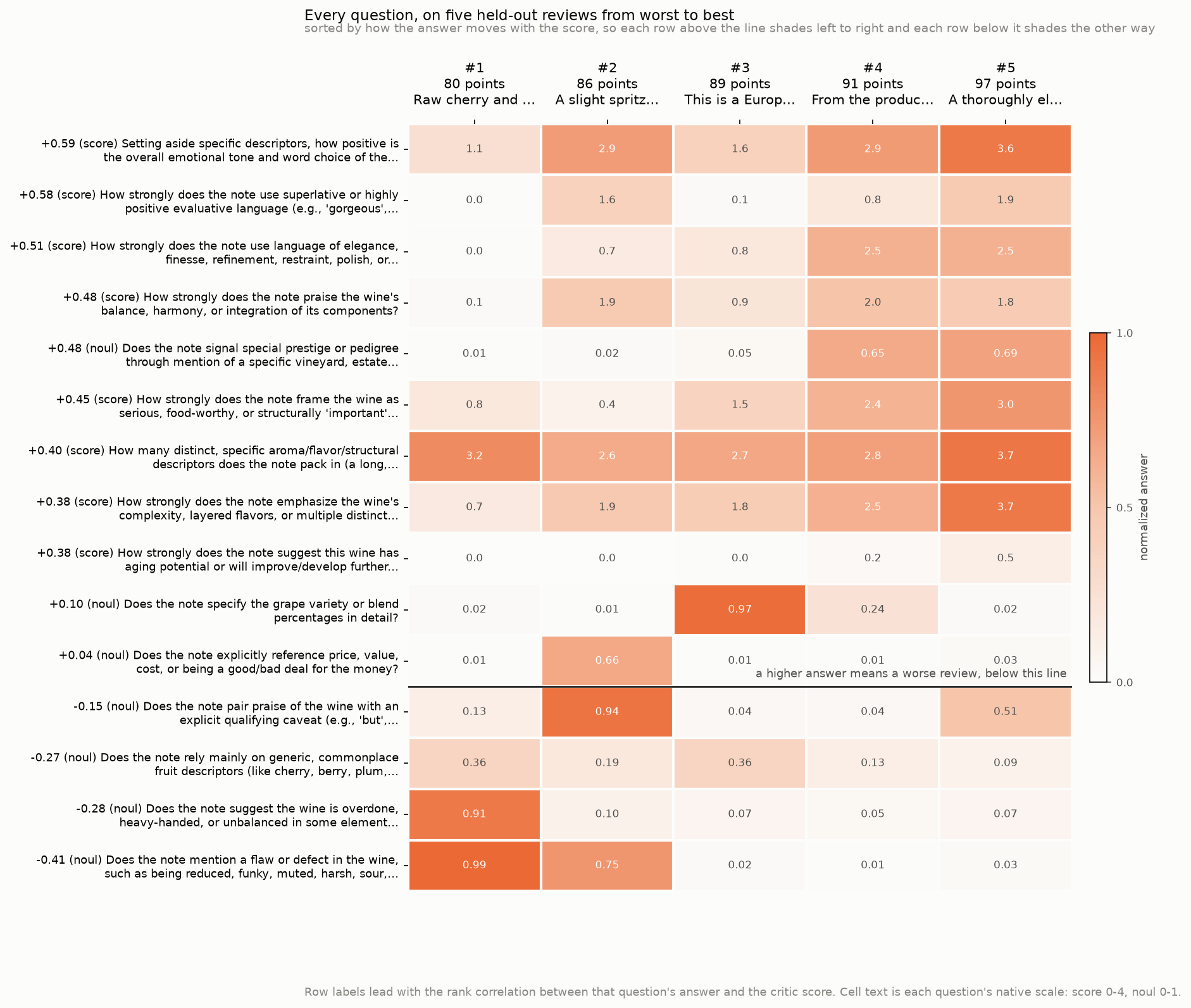
La tabla de la parte superior de la página, calculada. Los cinco brazos se puntuaron una vez en las mismas 800 filas retenidas, y los tres primeros omiten el descubrimiento de características. Uno predice la media de las puntuaciones de desarrollo y no lee nada de la nota en absoluto. Uno pasa la nota al mismo CatBoost a través de su manejo text_features, lo que la convierte en recuentos de palabras. Uno solicita a TypeSafe la puntuación en sí.
Ese tercero es un único Score por fila sobre diez bandas de calidad, desde “defectuoso o
desagradable” hasta “profundo”. Diez porque diez niveles es lo máximo que una pregunta Score
toma -
once devuelve un error de servidor. El nivel 0 se asigna a 80 puntos y el nivel 9 a 100.
Distribuir las bandas en la escala de esa manera no es suficiente por sí solo, porque nada en
la pregunta indica dónde se sitúan realmente las puntuaciones de esta publicación en ella. Por lo tanto, cada respuesta
se desplaza luego por un único desplazamiento, medido en las puntuaciones de dev. Ese desplazamiento se imprime en
la etiqueta de la fila, y es lo único que este atajo aprende de las puntuaciones.
Spearman es la correlación de rangos, donde 1.0 colocaría los vinos de la prueba exactamente en el orden del crítico. La fila de conteo de palabras es el propio manejo de texto de CatBoost, no una tubería ajustada de regresión de texto. Todo esto es un único conjunto de datos y una única ejecución del bucle.
predicted = fit_predict(X, split)
text_predicted = fit_predict_text(split)

# ask TypeSafe for the score itself, one request per row
with ThreadPoolExecutor(max_workers=8) as pool:
    direct = list(pool.map(lambda note: ask_score(TYPESAFE_MODEL, note), NOTES))
asked = np.array([d["expected"] for d in direct])
shift = float(SCORES[DEV].mean() - asked[DEV].mean())  # one number, from the dev labels

# what one proposal call gets you, before any feedback: the set round 1 ended with
first_round, _ = design(snapshots[0], answers_for, ENCODING)

print(f"{'arm':<46}{'RMSE':>7}{'spearman':>10}")
for label, p in (
    ("predict the mean of the dev rows", np.full(len(TEST), SCORES[DEV].mean())),
    ("the note as word counts, same CatBoost", text_predicted),
    (f"ask for the score itself, shifted {shift:+.2f}", asked[TEST] + shift),
    (
        f"{len(snapshots[0])} questions from round 1, no loop",
        fit_predict(first_round, split),
    ),
    (f"{len(accepted)} questions after all {ROUNDS} rounds", predicted),
):
    print(f"{label:<46}{rmse(SCORES[TEST], p):>7.3f}{spearman(SCORES[TEST], p):>10.3f}")
arm RMSE spearman
predict the mean of the dev rows 3.088 -0.014
the note as word counts, same CatBoost 2.466 0.605
ask for the score itself, shifted -1.71 2.145 0.761
18 questions from round 1, no loop 1.869 0.778
38 questions after all 5 rounds 1.772 0.799¿Ayudaron las rondas de autoresearch?
Ambas líneas grafican el error del conjunto de preguntas al final de cada ronda, comenzando desde la primera propuesta. La línea discontinua es el error de validación cruzada en el conjunto de desarrollo, sobre el que se toman cada decisión de aceptar o rechazar. La línea sólida evalúa el mismo conjunto de preguntas en las filas reservadas, que el bucle nunca lee. Cada punto representa el conjunto tal como estaba cuando cerró la ronda, por lo que una ronda que solo revisó o eliminó una pregunta sigue moviendo ambas líneas. El mapa de características indica qué miden las preguntas; el error es lo que te dice si las rondas posteriores a la primera propuesta mejoraron las predicciones.
El eje es ajustado: todo lo que ocurre en él sucede dentro de una quinta parte de punto, y cada atajo de la tabla anterior queda muy por encima de él. La línea de dev está por encima de la línea retenida todo el camino, y eso es un efecto del tamaño de entrenamiento. Cada pliegue de dev entrena con cuatro quintas partes de las filas de dev, mientras que el número retenido proviene de un modelo que obtuvo los 1,200. Las dos líneas se mueven juntas, por lo que el número de dev que el bucle dirige rastrea el número retenido que nunca ve. El intervalo bajo el título proviene de remuestrear las filas retenidas, por lo que indica si el movimiento de la ronda 1 a la ronda 5 es mayor que el ruido en 800 filas.
curve, per_round = [], []
for features in snapshots:
    X_round, _ = design(features, answers_for, ENCODING)
    per_round.append(fit_predict(X_round, split))
    curve.append((len(features), rmse(SCORES[TEST], per_round[-1])))

# the same held-out rows resampled 2,000 times, both arms scored on each resample
gain = paired_gain(SCORES[TEST], per_round[0], per_round[-1])
print(
    f"round 1 -> round {ROUNDS} on the held-out rows: {gain[0]:+.3f} points, "
    f"95% CI [{gain[1]:+.3f}, {gain[2]:+.3f}]"
)

fig = rounds_chart(plt, curve, history, len(TEST), gain)
display(fig)
plt.close(fig)
round 1 -> round 5 on the held-out rows: -0.097 points, 95% CI [-0.147, -0.050]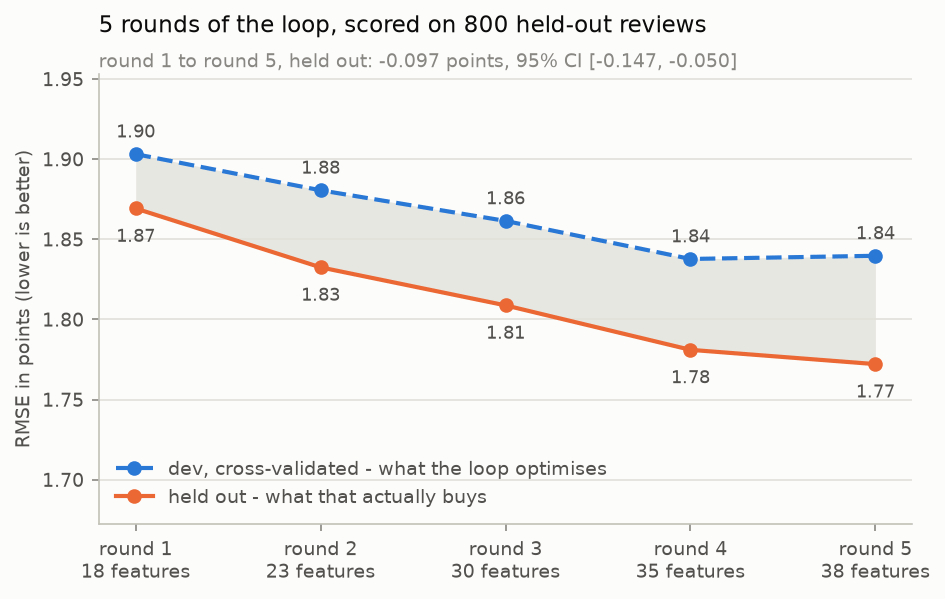
La línea de datos retenidos cae más que la línea de desarrollo. La ronda 1 escribió sus preguntas sin retroalimentación previa, y las cuatro rondas siguientes valen 0.10 puntos en las filas retenidas, IC 95% [-0.147, -0.050].
La ronda 5 propuso cuatro adiciones, dos reescrituras y ocho eliminaciones, y dio el primer número de desarrollo que no mejoró. Solo hay tanto como preguntar sobre una nota de 245 caracteres, y para la ronda 5 las propuestas se habían inclinado desde añadir preguntas hasta eliminarlas.
kinds = {f["name"]: f["kind"] for f in accepted}
print("feature importance share: % of total CatBoost importance across all questions")
print(f"{'feature':<38}{'asked as':<10}{'importance share':>16}")
for name, importance_share in sorted(feature_importances.items(), key=lambda p: -p[1])[
    :12
]:
    kind = "score" if kinds[name] == "intensity" else "noul"
    print(
        f"{name[:36]:<38}{kind:<10}{importance_share:>8.1f}%  "
        f"{'#' * round(importance_share)}"
    )
counts = f"{sum(1 for k in kinds.values() if k == 'intensity')} score"
counts += f", {sum(1 for k in kinds.values() if k == 'presence')} noul"
print(f"\nthe {len(accepted)} questions the loop kept: {counts}")
top = max(feature_importances, key=feature_importances.get)
print(
    f'the question behind the top row:\n  {top}: "{owner_of(top, accepted)["question"]}"'
)
feature importance share: % of total CatBoost importance across all questions
feature asked as importance share
note_overall_tone_positivity score 17.4% #################
savory_food_wine_seriousness score 8.7% #########
positive_superlative_language score 8.4% ########
single_vineyard_or_prestige_signal noul 7.2% #######
descriptive_detail_density score 5.7% ######
elegance_finesse_language score 5.0% #####
complexity score 5.0% #####
aging_potential score 5.0% #####
balance_harmony score 2.9% ###
drinkability_easiness score 2.9% ###
critic_enthusiasm_confidence score 2.7% ###
flavor_distinctiveness score 2.6% ###
the 38 questions the loop kept: 29 score, 9 noul
the question behind the top row:
note_overall_tone_positivity: "Setting aside specific descriptors, how positive is the overall emotional tone and word choice of the note taken as a whole (warm, admiring language throughout vs. flat, neutral, or lukewarm phrasing)?"importance share es la importancia de las características de CatBoost, normalizada de modo que las 38 preguntas sumen
100%. No es una proporción de filas, de preguntas ni de precisión de la predicción. Una pregunta de puntuación
posee dos columnas, una media y una dispersión, por lo que sus dos importancias de columna se suman
de nuevo antes de imprimir el porcentaje. note_overall_tone_positivity representa
el 17,4% del total. La cuarta fila es un noul: si la nota nombra un viñedo único o
alguna otra señal de prestigio es un hecho sí/no, por lo que se planteó como uno.
Próximos pasos
Esta ejecución mantiene el bucle pequeño. Extensiones directas:
- Evaluar a un candidato antes de pagar para que responda. Tratar la propia pregunta propuesta como el estado y preguntar a nouls sobre ella: si puede responderse a partir del texto fuente, si significa una sola cosa bajo sus criterios, si se aplica a la mayoría de las filas y si variará entre filas. Enviar solo las preguntas que superen los cuatro filtros con suficiente confianza.
- Podar las características correlacionadas. Medir la correlación entre las columnas codificadas en las filas de desarrollo, agrupar los casi duplicados y conservar la pregunta más clara o importante de cada grupo.
- Añadir líneas base simples. Comparar TF-IDF, recuentos de caracteres y otras características estructurales por separado, y luego añadirlas a las columnas descubiertas para medir qué aporta cada una.
- Mezclar familias de proponentes. Generar lotes de candidatos con Anthropic, OpenAI, Google Gemini y modelos de código abierto, y luego fusionarlos y eliminar duplicados antes de que cualquiera de ellos llegue a TypeSafe. Diferentes familias deberían ampliar la búsqueda más que las llamadas repetidas a un único proponente.
- Comparar modelos y métodos predictivos. Probar regresión lineal o elastic-net, un regresor de vectores de soporte, bosques aleatorios y recalibración cuando la salida posterior es probabilística. Comprobar si las características descubiertas ayudan fuera de CatBoost.
- Añadir una línea base de incrustaciones. Una incrustación convierte una nota en unos pocos cientos de números sin ninguna pregunta adjunta:
sentence-transformers/all-MiniLM-L6-v2se ejecuta localmente, latext-embedding-3-smallde OpenAI es una llamada alojada. Añadir una a las columnas descubiertas y medir si aporta algo que ellas no cubran. - Ajustar la validación al despliegue. Utilizar divisiones cronológicas al predecir el futuro, divisiones agrupadas cuando las filas relacionadas deben permanecer juntas, y conservar un conjunto de prueba final intacto tanto por el descubrimiento de características como por la selección del modelo.
- Detenerse en una meseta. Finalizar el bucle cuando el RMSE validado cruzadamente deje de mejorar durante un número fijo de rondas, o cuando alcance un presupuesto de preguntas o solicitudes.
- Ejecutar una búsqueda más larga en el modo Goal de un agente. Proporcionarle una métrica explícita, un presupuesto y una regla de parada, y permitir que proponga, evalúe y refine durante más rondas.
- Comprobar la estabilidad. Repetir el descubrimiento entre semillas o fragmentos de datos y conservar las preguntas que siguen siendo útiles, en lugar de aquellas cuya importancia depende de una única división.
Ábrelo en el playground
Este enlace de compartir contiene una nota de cata más todas las preguntas que el bucle terminó por generar.
playground_link = make_playground_link(
    NOTES[0], feature_questions(accepted), models=[TYPESAFE_MODEL]
)
display(
    Markdown(
        f"🔗 [Open the note + questions in the TypeSafe playground]({playground_link})"
    )
)