 JevCode
Descoberta de recursos do Autoresearch
Executa um loop de autoresearch que propõe perguntas TypeSafe, converte texto livre em características numéricas e utiliza os erros do modelo para aprimorar um regressor CatBoost supervisionado.
Traduzido automaticamente do en, sem revisão. Apenas como referência rápida.

As perguntas do TypeSafe transformam texto livre em recursos numéricos para um modelo CatBoost supervisionado; use um loop de autoresearch para descobri-las.
O CatBoost precisa de uma tabela de números, e uma nota de degustação não é uma. Este livro de receitas constrói a tabela a partir de perguntas sobre a nota, e nenhuma delas é escrita à mão. Um LLM propõe as perguntas, o TypeSafe responde a elas para cada linha, e o CatBoost treina com as respostas. A parte de autoresearch é o que vem a seguir: o CatBoost relata quais perguntas usou e quais linhas ainda erra, a próxima chamada de proposta lê esse relatório, e o loop roda novamente.
No final, você terá um loop que você pode apontar para seu próprio texto rotulado, uma curva de erro de retenção por rodada e uma tabela de quais perguntas o modelo final usou mais.
tasting note
    |
    v
38 TypeSafe answers
    |-- 29 score questions x 2 columns = 58
    |     expected rubric level + answer uncertainty
    `--  9 noul questions  x 1 column  =  9
          probability true
    |
    v
67 numeric columns --> CatBoost --> predicted critic score
                                     held-out RMSE: 1.77 points
Uma resposta de score se divide em duas colunas: o nível médio que a resposta aponta e o quanto ela se espalha em torno dessa média. Uma resposta noul é uma única probabilidade, portanto corresponde a uma única coluna.
Os dados são 2.000 avaliações de vinhos: uma nota de degustação é inserida, a pontuação do crítico em uma escala de 80 a 100 é o resultado. O RMSE mede o erro de previsão em pontos da pontuação do crítico, onde erros maiores têm mais peso, e quanto menor, melhor. Cada número na tabela abaixo provém das 800 avaliações que nem o modelo nem o loop jamais viram.
| como a nota se torna uma pontuação | RMSE |
|---|---|
| prever a pontuação média das linhas de treinamento | 3.09 |
| o mesmo CatBoost, lendo a nota como contagem de palavras | 2.47 |
| pedir ao TypeSafe a própria pontuação, reescalonada e deslocada | 2.15 |
| 18 perguntas de uma única chamada de proposta, sem loop | 1.87 |
| 38 perguntas após cinco rodadas do loop | 1.77 |
As duas últimas linhas são o loop. Uma chamada de proposta, sem nada para se basear ainda, chega a 1,87. Mais quatro rodadas de leitura de suas piores previsões chegam a 1,77. A maior parte do ganho está nessa primeira chamada, e quanto as quatro rodadas seguintes adicionam é medido mais abaixo.
Dica — Quer levar este caderno adiante ou aplicá-lo a outro problema? Consulte Próximos passos.
from __future__ import annotations
import json
import os
import random
import textwrap
import urllib.request
from concurrent.futures import ThreadPoolExecutor
from pathlib import Path
from time import perf_counter
from typing import NamedTuple
import matplotlib
import matplotlib.pyplot as plt
import numpy as np
from catboost import CatBoostRegressor
from cooksafe import JsonCache, make_playground_link
from IPython.display import Markdown, display
from typesafe_sdk import Noul, NoulCriteria, Score, TypeSafeClient
matplotlib.use("Agg") # headless render
TYPESAFE_MODEL = "jev-1.12"
FOLDS, REPEATS = 5, 3 # repeats steady the error at this sample size
CATBOOST = dict(
iterations=400,
depth=4,
learning_rate=0.05,
loss_function="RMSE",
verbose=0,
random_seed=0,
thread_count=1,
allow_writing_files=False,
)
client = TypeSafeClient(
# keyless kernels replay the cache
api_key=os.environ.get("TYPESAFE_API_KEY", "cache-only"),
base_url=os.environ.get("TYPESAFE_ENDPOINT"),
timeout=120.0,
)
json_cache = JsonCache(Path("json_cache.json"))
# ----------------------------------------------------------------- the specification
INTENSITY_LEVELS = [
"Not present in this note at all",
"Barely present - mentioned once, in passing",
"Present at a moderate level",
"Present strongly - the note dwells on it",
"Dominant - the note is largely about this",
]
PRESENCE_CRITERIA = NoulCriteria(
true="The note states this or clearly implies it",
false="The note gives no indication of this",
)
# Asking for the score outright: ten quality bands, rescaled onto the 80-100 critic scale.
SCORE_LEVELS = [
"Faulty or unpleasant - the note is mostly criticism",
"Barely acceptable - drinkable, with nothing to recommend it",
"Simple and sound - correct, plain, forgettable",
"Pleasant everyday wine - some appeal, little depth",
"Good - clear varietal character, well made",
"Very good - balanced, with something to say",
"Excellent - complex and structured",
"Outstanding - depth and length, built to age",
"Superb - among the best of its type",
"Profound - the note treats it as exceptional",
]
# Structured output requires every property in `required`, so unused fields come back empty.
PROPOSAL_SCHEMA = {
"type": "object",
"properties": {
"actions": {
"type": "array",
"items": {
"type": "object",
"properties": {
"op": {"type": "string", "enum": ["add", "revise", "drop"]},
"target": {"type": "string"},
"name": {"type": "string"},
"kind": {"type": "string", "enum": ["intensity", "presence"]},
"question": {"type": "string"},
},
"required": ["op", "target", "name", "kind", "question"],
"additionalProperties": False,
},
}
},
"required": ["actions"],
"additionalProperties": False,
}
PROPOSALS = 18 # actions the proposer may return per round
# The one string that knows this is about wine. Point it at your own label and text.
PROPOSER_TASK = f"""You are designing numeric features for a gradient-boosting model that
predicts the score a wine critic gave (an integer from 80 to 100) from the tasting note alone.
The model sees nothing but the features you design.
Return up to {PROPOSALS} actions. Each action is one of:
- {{"op": "add", "target": "", "name": ..., "kind": ..., "question": ...}}
A new feature.
- {{"op": "revise", "target": <name of an existing feature>, "name": ..., "kind": ...,
"question": ...}}
Replace that feature's question with better wording. Use this when a feature measures the
right thing badly: too narrow, too vague, or worded so nearly every note answers the same.
- {{"op": "drop", "target": <name of an existing feature>, "name": "", "kind": "intensity",
"question": ""}}
Remove a feature that is not earning its place.
`kind` is "intensity" for something with a degree, or "presence" for a yes/no fact.
`question` is what gets asked about one tasting note.
An "intensity" question is graded against this fixed five-level rubric, so word it so that the
levels make sense:
{chr(10).join(f" {i}. {level}" for i, level in enumerate(INTENSITY_LEVELS))}
A "presence" question is answered as the probability that it is true of the note.
Good features can be judged from the note's own words, vary from note to note, and carry
information about quality that the other features do not. Reviewers describe structure, fruit,
oak, length, complexity, and drinkability, and they also signal quality through word choice."""
class Split(NamedTuple):
"""The rows, their labels, and which half the loop is allowed to read."""
notes: list[str]
scores: np.ndarray
dev: np.ndarray
test: np.ndarray
# ----------------------------------------------------------------- the data
WINEMAG_CSV = (
"https://huggingface.co/datasets/GroNLP/ik-nlp-22_winemag/resolve/"
"90eb39f35fc64e556fc17f06d4137a4a69ec3297/train.csv"
)
@json_cache
def load_slice(n_dev: int, n_test: int, seed: int) -> dict:
"""Fetch the pinned CSV and take a seeded sample of note + score, one row per note."""
import csv
import io
request = urllib.request.Request(
WINEMAG_CSV, headers={"User-Agent": "typesafe-cookbook/1.0"}
)
with urllib.request.urlopen(request, timeout=300) as response:
text = response.read().decode()
rows, seen = [], set()
for row in csv.DictReader(io.StringIO(text)): # a few notes repeat verbatim
if not row["description"] or not row["points"] or row["description"] in seen:
continue
seen.add(row["description"])
rows.append((row["description"], float(row["points"])))
random.Random(seed).shuffle(rows)
picked = rows[: n_dev + n_test]
return {"notes": [r[0] for r in picked], "points": [r[1] for r in picked]}
def example_rows(split: Split, out_of_fold: np.ndarray | None, n: int) -> list[int]:
"""Select representative dev rows for a proposer round."""
dev = split.dev
if out_of_fold is None:
ranked = dev[np.argsort(split.scores[dev], kind="stable")]
return [int(ranked[round(q * (len(ranked) - 1))]) for q in np.linspace(0, 1, n)]
error = np.abs(split.scores[dev] - out_of_fold)
order = np.argsort(-error, kind="stable")
worst = [int(dev[i]) for i in order[: n // 2]]
best = [int(dev[i]) for i in order[len(order) - (n - n // 2) :]]
return worst + best
def example_block(
rows: list[int],
split: Split,
out_of_fold: np.ndarray | None,
previous: np.ndarray | None = None,
) -> str:
"""Format selected rows for the proposer."""
if out_of_fold is None:
head = "Example notes, with the score each one was given:"
body = [f"- scored {split.scores[r]:.0f}: {split.notes[r]}" for r in rows]
return head + "\n" + "\n".join(body)
head = (
"Dev notes, worst-predicted first. The first half is where your current questions "
"miss by the most and the second half is where they are already right, so what "
"separates the halves is what the questions have not captured."
)
if previous is not None:
head += (
" Each line also carries what the previous round predicted, so you can see which "
"notes your last batch of questions moved."
)
body = []
for r in rows:
line = f"- scored {split.scores[r]:.0f}, predicted {out_of_fold[r]:.1f}"
if previous is not None:
line += f" (last round {previous[r]:.1f})"
body.append(f"{line}: {split.notes[r]}")
return head + "\n" + "\n".join(body)
def load_split(n_dev: int, n_test: int, seed: int = 0) -> Split:
# keyword, because the cache key is the function name plus how each argument was spelled
data = load_slice(n_dev, n_test, seed=seed)
return Split(
notes=data["notes"],
scores=np.array(data["points"]),
dev=np.arange(n_dev),
test=np.arange(n_dev, n_dev + n_test),
)
# ----------------------------------------------------------------- step 1: propose
def proposal_prompt(examples: str, feedback: str, accepted: list[dict]) -> str:
parts = [PROPOSER_TASK, "\n" + examples]
if accepted:
parts.append(
"\nThe features you have now. `add` must not duplicate one of these; `revise` and "
"`drop` refer to one by name:\n"
+ "\n".join(
f"- {f['name']} ({f['kind']}): {f['question']}" for f in accepted
)
)
if feedback:
parts.append("\nHow the model did with those features:\n" + feedback)
return "\n".join(parts)
@json_cache
def propose(model: str, round_index: int, prompt: str) -> dict:
"""One proposal call. Every number in `prompt` is rounded so a replay hits the cache."""
if model.startswith("claude"):
import anthropic
response = anthropic.Anthropic(
api_key=os.environ.get("ANTHROPIC_API_KEY", "cache-only")
).messages.create(
model=model,
max_tokens=16000,
output_config={
"effort": "medium",
"format": {"type": "json_schema", "schema": PROPOSAL_SCHEMA},
},
messages=[{"role": "user", "content": prompt}],
)
body = next(block.text for block in response.content if block.type == "text")
usage = [response.usage.input_tokens or 0, response.usage.output_tokens or 0]
else:
from openai import OpenAI
response = OpenAI(
api_key=os.environ.get("OPENAI_API_KEY", "cache-only")
).chat.completions.create(
model=model,
reasoning_effort="high",
max_completion_tokens=16000,
response_format={"type": "json_object"},
messages=[
{
"role": "user",
"content": prompt
+ "\n\nReply with JSON matching this schema:\n"
+ json.dumps(PROPOSAL_SCHEMA),
}
],
)
body = response.choices[0].message.content
usage = [response.usage.prompt_tokens, response.usage.completion_tokens]
return {"actions": json.loads(body)["actions"][:PROPOSALS], "usage": usage}
def slug(name: str, taken: set[str]) -> str:
"""Names become question ids and column labels, so keep them plain and unique."""
base = (
"".join(c if c.isalnum() else "_" for c in name.lower()).strip("_") or "feature"
)
candidate, n = base, 2
while candidate in taken:
candidate, n = f"{base}_{n}", n + 1
return candidate
def to_candidates(actions: list[dict], accepted: list[dict], round_index: int) -> tuple:
"""Split a round's actions into screenable candidates and a list of names to drop."""
live = {f["name"] for f in accepted}
drops = [a["target"] for a in actions if a["op"] == "drop" and a["target"] in live]
replacing = {
a["target"] for a in actions if a["op"] == "revise" and a["target"] in live
}
# a revision may keep the name it replaces, since that feature is on its way out
taken, candidates = live - replacing, []
for action in actions:
if action["op"] == "drop":
continue
if action["op"] == "revise" and action["target"] not in live:
continue # a revision of something that is not there
name = slug(action["name"], taken)
taken.add(name)
candidates.append(
{
"id": f"{name}@{round_index}", # unique, so earlier rounds keep their columns
"name": name,
"kind": action["kind"],
"question": action["question"],
"replaces": action["target"] if action["op"] == "revise" else "",
}
)
return candidates, drops
# ----------------------------------------------------------------- step 2: answer
def feature_questions(features: list[dict]) -> dict:
questions = {}
for feature in features:
if feature["kind"] == "intensity":
questions[feature["name"]] = Score(
instructions=feature["question"], criteria=INTENSITY_LEVELS
)
else:
questions[feature["name"]] = Noul(
instructions=feature["question"], criteria=PRESENCE_CRITERIA
)
return questions
@json_cache
def answer(model: str, note: str, features_json: str) -> dict:
"""One request per note; every question of the round rides it. Keeps every probability."""
features = json.loads(features_json)
started = perf_counter()
response = client.system_one(
state=note, questions=feature_questions(features), model=model
)
raw = {}
for feature in features:
got = response.answers[feature["name"]]
if feature["kind"] == "intensity":
raw[feature["name"]] = [
got.probabilities.get(i, 0.0) for i in range(len(INTENSITY_LEVELS))
]
else:
raw[feature["name"]] = [got.noul]
return {
"raw": raw,
"seconds": round(perf_counter() - started, 2),
"input_tokens": response.usage.input_tokens or 0,
"output_tokens": response.usage.output_tokens or 0,
}
def featurize(notes: list[str], features: list[dict]) -> dict:
"""Answer one question set for many notes: one request each, eight in flight."""
payload = json.dumps(features, sort_keys=True)
with ThreadPoolExecutor(max_workers=8) as pool:
results = list(
pool.map(lambda note: answer(TYPESAFE_MODEL, note, payload), notes)
)
return {
f["name"]: np.array([r["raw"][f["name"]] for r in results], dtype=float)
for f in features
}
def encode(feature: dict, probabilities: np.ndarray, mode: str) -> list[tuple]:
"""Turn one question's probabilities into named columns."""
name = feature["name"]
if feature["kind"] == "presence":
return [(name, probabilities[:, 0])] # one number is all there is
levels = np.arange(probabilities.shape[1])
mean = probabilities @ levels
if mode == "mean":
return [(name, mean)]
if mode == "mean_spread":
variance = probabilities @ (levels**2) - mean**2
return [(name, mean), (f"{name}_sd", np.sqrt(np.clip(variance, 0, None)))]
return [(f"{name}_p{i}", probabilities[:, i]) for i in levels]
def design(features: list[dict], answers_for: dict, mode: str) -> tuple:
"""Stack every feature's columns into one matrix, plus a label per column."""
columns, labels = [], []
for feature in features:
for label, column in encode(feature, answers_for[feature["id"]], mode):
columns.append(column)
labels.append(label)
return np.column_stack(columns), labels
def plain(features: list[dict]) -> list[dict]:
"""What goes on the wire and into the cache key: no id, no bookkeeping."""
return [
{"name": f["name"], "kind": f["kind"], "question": f["question"]}
for f in features
]
# ----------------------------------------------------------------- step 3: fit
def rmse(y: np.ndarray, p: np.ndarray) -> float:
return float(np.sqrt(np.mean((y - p) ** 2)))
def spearman(a: np.ndarray, b: np.ndarray) -> float:
"""Rank correlation: does the model order the wines the way the critic did?"""
ranks = (
np.argsort(np.argsort(a)).astype(float),
np.argsort(np.argsort(b)).astype(float),
)
return float(np.corrcoef(*ranks)[0, 1])
def folds(y: np.ndarray, k: int, seed: int) -> list[np.ndarray]:
"""Label-stratified k-fold: sort by the label with a seeded tiebreak, then deal off the top."""
rng = np.random.default_rng(seed)
order = np.lexsort((rng.random(len(y)), y))
return [np.sort(order[i::k]) for i in range(k)]
def cross_validate(X: np.ndarray, y: np.ndarray) -> tuple[np.ndarray, float]:
out_of_fold = np.zeros((REPEATS, len(y)))
for repeat in range(REPEATS):
for fold in folds(y, FOLDS, seed=repeat):
train = np.setdiff1d(np.arange(len(y)), fold)
model = CatBoostRegressor(**CATBOOST).fit(X[train], y[train])
out_of_fold[repeat, fold] = model.predict(X[fold])
scores = [rmse(y, out_of_fold[repeat]) for repeat in range(REPEATS)]
return out_of_fold.mean(axis=0), float(np.mean(scores))
def importances(X: np.ndarray, y: np.ndarray) -> np.ndarray:
return CatBoostRegressor(**CATBOOST).fit(X, y).get_feature_importance()
def paired_gain(y: np.ndarray, before: np.ndarray, after: np.ndarray) -> tuple:
"""Bootstrap the paired held-out RMSE change."""
squared = ((y - before) ** 2, (y - after) ** 2)
rng = np.random.default_rng(0)
drawn = []
for _ in range(2000):
rows = rng.integers(0, len(y), len(y))
drawn.append(
np.sqrt(squared[1][rows].mean()) - np.sqrt(squared[0][rows].mean())
)
drawn = np.array(drawn)
return (
rmse(y, after) - rmse(y, before),
float(np.percentile(drawn, 2.5)),
float(np.percentile(drawn, 97.5)),
)
def fit_predict(X: np.ndarray, split: Split) -> np.ndarray:
model = CatBoostRegressor(**CATBOOST).fit(X[split.dev], split.scores[split.dev])
return model.predict(X[split.test])
def fit_predict_text(split: Split) -> np.ndarray:
"""The reference arm: the same model, handed the note instead of the columns."""
from catboost import Pool
raw = np.array([[note] for note in split.notes], dtype=object)
model = CatBoostRegressor(**CATBOOST).fit(
Pool(raw[split.dev], split.scores[split.dev], text_features=[0])
)
return model.predict(Pool(raw[split.test], text_features=[0]))
def evaluate(
features: list[dict], answers_for: dict, split: Split, mode: str
) -> tuple[np.ndarray, float]:
"""Cross-validated error on the dev rows for one candidate question set."""
X, _ = design(features, answers_for, mode)
return cross_validate(X[split.dev], split.scores[split.dev])
def swap_in(accepted: list[dict], feature: dict) -> list[dict] | None:
"""The accepted set with `feature` in place of the one it revises, or None if it is gone."""
at = next(
(i for i, f in enumerate(accepted) if f["name"] == feature["replaces"]), None
)
if at is None:
return None
trial = list(accepted)
trial[at] = {k: feature[k] for k in ("id", "name", "kind", "question")}
return trial
def try_change(
trial: list[dict],
accepted: list[dict],
cv: float,
answers_for: dict,
split: Split,
mode: str,
tolerance: float,
) -> tuple[list[dict], float, str, bool]:
"""Refit with the change and keep it only if the dev error improves. No API calls."""
_, cv_trial = evaluate(trial, answers_for, split, mode)
if cv_trial <= cv + tolerance:
return trial, cv_trial, f"CV {cv:.3f} -> {cv_trial:.3f}", True
return accepted, cv, f"would cost {cv_trial - cv:+.3f}", False
def owner_of(label: str, features: list[dict]) -> dict:
"""Which feature a column label belongs to - encodings suffix the name."""
exact = next((f for f in features if f["name"] == label), None)
if exact:
return exact
return next(f for f in features if label.startswith(f["name"] + "_"))
def importance_per_feature(
features: list[dict], labels: list[str], column_importances: np.ndarray
) -> dict:
"""Sum each question's CatBoost column importances.
Intensity questions can produce multiple model columns. Combining their normalized
importances gives one percentage share per question.
"""
total = {f["name"]: 0.0 for f in features}
for label, column_importance in zip(labels, column_importances):
total[owner_of(label, features)["name"]] += float(column_importance)
return total
def feedback_for(
history: list[float],
accepted: list[dict],
answers_for: dict,
split: Split,
mode: str,
out_of_fold: np.ndarray,
previous: np.ndarray | None,
) -> str:
"""The scoreboard the next proposal call reads. The notes themselves arrive separately,
through `example_block`. Numbers are rounded before they enter the prompt."""
X, labels = design(accepted, answers_for, mode)
dev, scores = split.dev, split.scores
by_name = importance_per_feature(accepted, labels, importances(X[dev], scores[dev]))
lines = ["Cross-validated RMSE in points so far, lower is better:"]
lines += [f" round {i + 1}: {v:.2f}" for i, v in enumerate(history)]
if previous is not None:
now, before = np.abs(scores[dev] - out_of_fold), np.abs(scores[dev] - previous)
better, worse = int((now < before - 0.1).sum()), int((now > before + 0.1).sum())
lines.append(
f"\nAgainst the previous round, {better} of the {len(dev)} dev notes are now "
f"predicted better by more than 0.1 points and {worse} are predicted worse."
)
lines.append(
"\nYour features, with importance as a percentage of the total and the spread of the "
"column across the dev rows. Low importance or low spread means the question is not "
"doing much; revise or drop it."
)
for feature in sorted(accepted, key=lambda f: -by_name.get(f["name"], 0.0)):
column = encode(feature, answers_for[feature["id"]], mode)[0][1]
lines.append(
f" {feature['name']} ({feature['kind']}): "
f"{by_name.get(feature['name'], 0.0):.1f}% importance, "
f"spread {column[dev].std():.2f}"
)
return "\n".join(lines)
# ----------------------------------------------------------------- the loop itself
class Discovery(NamedTuple):
"""Artifacts returned by the discovery loop."""
accepted: list[dict] # the question set it ended with
answers_for: dict # feature id -> (rows x levels) probabilities
snapshots: list[list[dict]] # the set as it stood at the end of each round
history: list[float] # dev CV error after each round
batches: list[tuple] # what each round sent, for the request table
journal: list[tuple] # every action and what became of it
def run_loop(
split: Split,
proposer: str,
rounds: int,
examples: int,
mode: str,
min_spread: float,
tolerance: float,
) -> Discovery:
"""Run the propose, answer, fit, and feedback loop."""
shown = example_rows(split, None, examples) # round 1 has nothing predicted yet
out_of_fold = previous = None
got_from = Discovery([], {}, [], [], [], [])
accepted, answers_for = got_from.accepted, got_from.answers_for
snapshots, history = got_from.snapshots, got_from.history
batches, journal = got_from.batches, got_from.journal
feedback = ""
for round_index in range(1, rounds + 1):
block = example_block(shown, split, out_of_fold, previous)
actions = propose(
proposer, round_index, proposal_prompt(block, feedback, accepted)
)["actions"]
keep, drops = to_candidates(actions, accepted, round_index)
if keep: # one request per row, carrying every question this round proposed
batches.append((round_index, plain(keep)))
answers = featurize(split.notes, plain(keep))
for feature in keep:
answers_for[feature["id"]] = answers[feature["name"]]
for (
feature
) in keep: # an add goes in; importance says later whether it earned it
if feature["replaces"]:
continue
column = encode(feature, answers_for[feature["id"]], mode)[0][1]
flat = float(column[split.dev].std()) < min_spread
journal.append(
(round_index, "flat" if flat else "add", feature["name"], "")
)
if not flat:
accepted.append(
{k: feature[k] for k in ("id", "name", "kind", "question")}
)
_, cv = evaluate(accepted, answers_for, split, mode)
trial_args = (answers_for, split, mode, tolerance)
for feature in [f for f in keep if f["replaces"]]: # every revision is tried
trial = swap_in(accepted, feature)
if trial is None: # it revises something an earlier round already dropped
journal.append(
(round_index, "stale", feature["name"], "target is gone")
)
continue
accepted[:], cv, note, took = try_change(trial, accepted, cv, *trial_args)
what = "revise" if took else "reject"
journal.append(
(
round_index,
what,
feature["name"],
f"was {feature['replaces']}, {note}",
)
)
for name in drops: # and so is every drop
trial = [f for f in accepted if f["name"] != name]
if not trial:
continue
accepted[:], cv, note, took = try_change(trial, accepted, cv, *trial_args)
journal.append((round_index, "drop" if took else "keep", name, note))
previous, (out_of_fold, cv) = (
out_of_fold,
evaluate(accepted, answers_for, split, mode),
)
history.append(cv)
snapshots.append(list(accepted))
feedback = feedback_for(
history, accepted, answers_for, split, mode, out_of_fold, previous
)
# next round reads the rows these questions get most wrong, and as many they get right
shown = example_rows(split, out_of_fold, examples)
report(round_index, keep, drops, journal, accepted, cv)
return got_from
def report(
round_index: int,
keep: list[dict],
drops: list[str],
journal: list[tuple],
accepted: list[dict],
cv: float,
) -> None:
"""One block per round: the counts, the names it added, then everything with a number."""
revised = sum(1 for f in keep if f["replaces"])
print(
f"round {round_index}: {len(keep) - revised} add, {revised} revise, "
f"{len(drops)} drop"
)
this_round = [j for j in journal if j[0] == round_index]
added = [name for _, what, name, _ in this_round if what == "add"]
if added:
print(
textwrap.fill(
", ".join(added),
88,
initial_indent=" added ",
subsequent_indent=" " * 10,
)
)
for _, what, name, note in this_round: # everything carrying a number of its own
if what != "add":
print(f" {what:<7}{name:<34}{note}")
print(f" -> {len(accepted)} features, dev CV RMSE {cv:.3f}\n")
# ----------------------------------------------------------------- asking for the score
@json_cache
def ask_score(model: str, note: str) -> dict:
"""One `Score` over ten quality bands, read as a level and rescaled to 80-100."""
response = client.system_one(
state=note,
questions={
"quality": Score(
instructions=(
"Judging only by what this tasting note says, how good is the wine?"
),
criteria=SCORE_LEVELS,
)
},
model=model,
)
got = response.answers["quality"]
top = len(SCORE_LEVELS) - 1
expected = sum(k * v for k, v in got.probabilities.items())
return {
# level 0 is the bottom of the critic's scale, level 9 the top
"expected": 80.0 + 20.0 * expected / top,
"picked": 80.0 + 20.0 * got.score / top,
"input_tokens": response.usage.input_tokens or 0,
"output_tokens": response.usage.output_tokens or 0,
}
# ----------------------------------------------------------------- charts
SURFACE, INK, INK2, MUTED = "#fcfcfb", "#0b0b0b", "#52514e", "#898781"
GRID, AXIS, BLUE, ORANGE = "#e1e0d9", "#c3c2b7", "#2a78d6", "#eb6834"
def style(ax) -> None:
ax.set_facecolor(SURFACE)
for side in ("top", "right"):
ax.spines[side].set_visible(False)
for side in ("left", "bottom"):
ax.spines[side].set_color(AXIS)
ax.tick_params(colors=MUTED, labelcolor=INK2, labelsize=9)
ax.set_axisbelow(True)
def polarity(feature: dict, answers_for: dict, split: Split) -> float:
"""Rank correlation between a question's answer and the critic score, on the dev rows.
Positive means a higher answer goes with a better review, negative the opposite. It is
what orders the rows of the feature map, so the map reads as a gradient that flips.
"""
column = encode(feature, answers_for[feature["id"]], "mean")[0][1]
return spearman(column[split.dev], split.scores[split.dev])
def reviews_heatmap(
plt,
questions: list[dict],
answers_for: dict,
split: Split,
rows: tuple,
):
"""Compare held-out reviews across the discovered questions, best-signal first.
Rows arrive sorted from the questions that rise with the score to the ones that fall with
it, so a row above the divider shades left to right and a row below it shades right to
left.
"""
def value_of(feature: dict, row: int) -> float:
return float(encode(feature, answers_for[feature["id"]], "mean")[0][1][row])
signs = [polarity(question, answers_for, split) for question in questions]
flip = next((i for i, s in enumerate(signs) if s < 0), len(questions))
raw = np.array(
[[value_of(question, row) for row in rows] for question in questions]
)
normalized = np.array(
[
values / (4 if question["kind"] == "intensity" else 1)
for question, values in zip(questions, raw)
]
)
cmap = matplotlib.colors.LinearSegmentedColormap.from_list(
"typesafe_heat", [SURFACE, "#f7c7ad", ORANGE]
)
fig, ax = plt.subplots(
figsize=(9.5, 1.8 + 0.58 * len(questions)), facecolor=SURFACE
)
image = ax.imshow(normalized, aspect="auto", cmap=cmap, vmin=0, vmax=1)
row_labels = []
for question, sign in zip(questions, signs):
kind = "score" if question["kind"] == "intensity" else "noul"
prefix = f"{sign:+.2f} ({kind}) "
lines = textwrap.wrap(
" ".join(question["question"].split()),
width=52,
max_lines=2,
placeholder="...",
break_long_words=False,
break_on_hyphens=False,
)
row_labels.append(prefix + (f"\n{' ' * len(prefix)}").join(lines))
column_labels = [
f"#{i}\n{split.scores[row]:.0f} points\n{' '.join(split.notes[row].split())[:15]}..."
for i, row in enumerate(rows, 1)
]
ax.set_yticks(np.arange(len(questions)), row_labels)
ax.set_xticks(np.arange(len(rows)), column_labels)
ax.tick_params(
axis="x", top=True, labeltop=True, bottom=False, labelbottom=False, pad=8
)
ax.tick_params(axis="y", labelsize=8.5)
for side in ax.spines.values():
side.set_visible(False)
ax.set_xticks(np.arange(-0.5, len(rows), 1), minor=True)
ax.set_yticks(np.arange(-0.5, len(questions), 1), minor=True)
ax.grid(which="minor", color=SURFACE, linewidth=2)
ax.tick_params(which="minor", bottom=False, left=False)
for i, question in enumerate(questions):
for j, value in enumerate(raw[i]):
label = (
f"{value:.1f}" if question["kind"] == "intensity" else f"{value:.2f}"
)
color = SURFACE if normalized[i, j] > 0.58 else INK2
ax.text(j, i, label, ha="center", va="center", color=color, fontsize=8)
# the line where the questions stop rising with the score and start falling with it
if 0 < flip < len(questions):
ax.axhline(flip - 0.5, color=INK, linewidth=1.2)
ax.annotate(
"a higher answer means a worse review, below this line",
(len(rows) - 0.5, flip - 0.5),
xytext=(-4, 5),
textcoords="offset points",
va="bottom",
ha="right",
color=INK2,
fontsize=8.5,
)
colorbar = fig.colorbar(image, ax=ax, fraction=0.025, pad=0.025)
colorbar.set_ticks([0, 0.5, 1])
colorbar.set_label("normalized answer", color=INK2, fontsize=8.5)
colorbar.ax.tick_params(labelsize=8, colors=INK2)
fig.suptitle(
"Every question, on five held-out reviews from worst to best",
x=0.01,
y=0.995,
ha="left",
color=INK,
fontsize=11,
)
fig.text(
0.01,
0.972,
"sorted by how the answer moves with the score, so each row above the line shades "
"left to right and each row below it shades the other way",
color=MUTED,
fontsize=9,
)
fig.text(
0.01,
0.005,
"Row labels lead with the rank correlation between that question's answer and the "
"critic score. Cell text is each question's native scale: score 0-4, noul 0-1.",
color=MUTED,
fontsize=8.5,
)
return fig
def rounds_chart(
plt, curve: list[tuple], history: list[float], n_test: int, gain: tuple
):
"""Dev error and held-out error per round. The trend is the point, not the gap."""
rounds = list(range(1, len(curve) + 1))
values = [v for _, v in curve]
fig, ax = plt.subplots(figsize=(7, 3.9), facecolor=SURFACE)
style(ax)
ax.grid(axis="y", color=GRID, linewidth=0.8)
# each dev fold trains on four fifths of the rows, so the dev line sits the higher of the two
ax.fill_between(rounds, history, values, color=GRID, alpha=0.75, linewidth=0)
ax.plot(
rounds,
history,
marker="o",
color=BLUE,
linewidth=2,
linestyle="--",
label="dev, cross-validated - what the loop optimises",
)
ax.plot(
rounds,
values,
marker="o",
color=ORANGE,
linewidth=2,
label="held out - what that actually buys",
)
# label each point on the outside of the pair, so neither line crowds its own numbers
for x, dev_value, test_value in zip(rounds, history, values):
for value, other in ((dev_value, test_value), (test_value, dev_value)):
ax.annotate(
f"{value:.2f}",
(x, value),
textcoords="offset points",
xytext=(0, 8 if value >= other else -16),
ha="center",
color=INK2,
fontsize=8.5,
)
ax.set_xticks(
rounds, [f"round {x}\n{n} features" for x, (n, _) in zip(rounds, curve)]
)
ax.set_ylabel("RMSE in points (lower is better)", color=INK2, fontsize=9)
# tight around the two lines: the whole finding lives inside 0.15 of a point
low, high = min(values + history), max(values + history)
ax.set_ylim(low - 0.10, high + 0.05)
difference, low_ci, high_ci = gain
ax.set_title(
f"{len(rounds)} rounds of the loop, scored on {n_test} held-out reviews",
loc="left",
color=INK,
fontsize=11,
pad=20,
)
# the number the chart is really about: is the held-out move bigger than the noise?
ax.text(
0,
1.015,
f"round 1 to round {len(rounds)}, held out: {difference:+.3f} points, "
f"95% CI [{low_ci:+.3f}, {high_ci:+.3f}]",
transform=ax.transAxes,
color=MUTED,
fontsize=9,
)
ax.legend(frameon=False, labelcolor=INK2, fontsize=9, loc="lower left")
return figConfiguração
pip install anthropic openai catboost numpy matplotlib ipython "typesafe-sdk>=0.5.7" cooksafe --extra-index-url https://pypi.typesafe.ai/então defina TYPESAFE_API_KEY e ANTHROPIC_API_KEY. Cada chamada de API é armazenada em cache em
json_cache.json, que vem junto com o cookbook, então um novo render reproduz esses números
sem fazer nenhuma chamada. Apague-o para executar novamente ao vivo. Os números vieram do TypeSafe
jev-1.12 e claude-sonnet-5 em 2026-08-03. propose() tem um segundo branch para
gpt-5.6-luna, que não foi executado.
A primeira célula de código é a implementação completa: chamadas de API, codificações, métricas, estilo do gráfico. Ela está aqui para que este arquivo seja executado de forma independente, e o site de documentação o oculta. Pule-o na primeira leitura — a receita começa abaixo dele.
N_DEV, N_TEST = 1200, 800  # the loop reads dev labels only; test is scored once
ROUNDS = 5  # a round answers questions for all 2,000 rows: 2,000 requests
PROPOSER = "claude-sonnet-5"  # or "gpt-5.6-luna"; the cache holds the Anthropic run
EXAMPLES = 60  # dev notes the proposer reads per round, half of them its worst misses
MIN_SPREAD = 0.05  # a column this flat cannot separate anything, so it is not kept
CHANGE_TOLERANCE = 0.0  # a revision or drop has to improve dev error, not just not hurt
ENCODING = "mean_spread"  # a score answer becomes two columns: its mean and spread

split = load_split(N_DEV, N_TEST, seed=0)
NOTES, SCORES, DEV, TEST = split.notes, split.scores, split.dev, split.test

print(
    f"{len(DEV)} dev rows, {len(TEST)} held out; scores run "
    f"{SCORES.min():.0f}-{SCORES.max():.0f}, mean {SCORES.mean():.2f}, sd {SCORES.std():.2f}"
)
print(f"\none of the notes:\n{NOTES[0]}")
1200 dev rows, 800 held out; scores run 80-98, mean 88.73, sd 3.17
one of the notes:
A Champagne that is very much wine. The structure and the richness are just right for a food wine, showing ripe acidity, flavors of plums and apricots, and balancing these primary fruits with a dense, complex structure that takes in yeast, maturity and a tight apple skin finish.O loop lê as mesmas 1.200 das 2.000 linhas (as linhas de desenvolvimento) repetidamente, e mantém uma pergunta quando isso ajuda a prever esses 1.200 escores. A pontuação nas mesmas linhas mediria principalmente o quão bem o loop se ajustou a elas, então as outras 800 são mantidas à parte e pontuadas uma vez, no final.
Dois tipos de pergunta
Uma pergunta proposta é de um de dois tipos, e o tipo determina qual número será retornado.
intensitytorna-se umScore, para qualquer coisa que venha em graus. Seus cinco níveis são impressos abaixo, e a coluna é o nível médio, então uma nota que fica entre “moderado” e “fortemente” sai entre os dois.presencetorna-se umNoul, para um fato sim/não como se uma falha é nomeada. A coluna é essa uma probabilidade.
O método
questions <- {}
repeat for each round:
    notes  <- round 1 ? 60 dev notes across the score range
                      : the 30 worst-predicted dev notes + the 30 best,
                        each with its score, this prediction and the last
    actions <- LLM(brief, questions, notes, importance and error so far)
    answers[q] <- TypeSafe(note, all new questions of this round) for every row
    for each added q:      keep it unless its column is flat
    for each revised q:    refit; keep the change only if dev error drops
    for each dropped q:    refit; drop it only if dev error drops
    out_of_fold <- k-fold CatBoost on the columns   # judges, and picks next round's notes
Nenhuma pergunta é filtrada antes de ser respondida. Todas as perguntas de uma rodada são enviadas no mesmo pedido, portanto, uma pergunta adicional não gera custo extra de requisição. Uma pergunta que se aplica a uma linha em dez parecerá inútil nas 60 notas lidas pelo proponente, mas ainda será a coluna mais útil do conjunto.
k-fold significa dividir as linhas de dev em k partes e prever cada parte com um modelo treinado nas outras partes. Essas previsões fazem três trabalhos: julgam cada revisão e descarte, escolhem as notas que a próxima rodada lê, e dizem ao proponente quais de suas perguntas ajudaram, em quanto se moveram desde a rodada anterior.
print("every intensity question is graded on these five levels:\n")
for i, level in enumerate(INTENSITY_LEVELS):
    print(f"  {i}. {level}")
print("\nevery presence question is judged true or false against these:\n")
print(f"  true:  {PRESENCE_CRITERIA['true']}")
print(f"  false: {PRESENCE_CRITERIA['false']}")
print("\nthe brief the proposer works from:\n")
print("\n".join(PROPOSER_TASK.splitlines()[:6]) + "\n  ...")
every intensity question is graded on these five levels:
0. Not present in this note at all
1. Barely present - mentioned once, in passing
2. Present at a moderate level
3. Present strongly - the note dwells on it
4. Dominant - the note is largely about this
every presence question is judged true or false against these:
true: The note states this or clearly implies it
false: The note gives no indication of this
the brief the proposer works from:
You are designing numeric features for a gradient-boosting model that
predicts the score a wine critic gave (an integer from 80 to 100) from the tasting note alone.
The model sees nothing but the features you design.
Return up to 18 actions. Each action is one of:
...O loop de autoresearch
run_loop executa todas as cinco rodadas e imprime um bloco por rodada. Uma pergunta adicionada entra diretamente: suas respostas já foram buscadas, e sua importância mostrará mais tarde se valeu a pena perguntar. Uma revisão ou remoção tira uma coluna que o modelo já está usando, então cada uma é testada primeiro: refit com a mudança, e mantenha-a apenas se o erro de dev diminuir. Um refit não custa chamadas de API, então tentar uma mudança e rejeitá-la é gratuito.
run = run_loop(
    split, PROPOSER, ROUNDS, EXAMPLES, ENCODING, MIN_SPREAD, CHANGE_TOLERANCE
)
accepted, answers_for = run.accepted, run.answers_for
snapshots, history = run.snapshots, run.history
round 1: 18 add, 0 revise, 0 drop
added complexity, fruit_intensity, tannin_structure, acidity_intensity,
oak_intensity, finish_length, balance_harmony, aging_potential,
positive_superlative_language, negative_critical_language,
drinkability_easiness, body_richness, sweetness_level, texture_descriptors,
earthy_savory_notes, flaw_or_defect_mentioned,
single_vineyard_or_prestige_signal, varietal_blend_detail
-> 18 features, dev CV RMSE 1.903
round 2: 5 add, 3 revise, 3 drop
added power_concentration_language, flavor_distinctiveness, generic_fruit_language,
candied_artificial_flavor, rustic_authentic_character
reject oak_dominance was oak_intensity, would cost +0.005
revise negative_critical_language was negative_critical_language, CV 1.897 -> 1.894
revise single_vineyard_or_prestige_signalwas single_vineyard_or_prestige_signal, CV 1.894 -> 1.881
keep finish_length would cost +0.009
keep texture_descriptors would cost +0.001
keep varietal_blend_detail would cost +0.023
-> 23 features, dev CV RMSE 1.881
round 3: 7 add, 2 revise, 1 drop
added elegance_finesse_language, minerality_precision_language,
hedged_qualified_praise, underripe_green_character,
reviewer_overall_verdict_strength, unusual_or_funky_descriptor_valence,
botrytis_or_special_winemaking_signal
revise negative_critical_language was negative_critical_language, CV 1.868 -> 1.864
revise finish_quality was finish_length, CV 1.864 -> 1.861
keep candied_artificial_flavor would cost +0.014
-> 30 features, dev CV RMSE 1.861
round 4: 5 add, 2 revise, 3 drop
added excess_or_imbalance_signal, descriptive_detail_density,
critic_enthusiasm_confidence, savory_food_wine_seriousness,
note_overall_tone_positivity
revise rustic_authentic_character was rustic_authentic_character, CV 1.843 -> 1.838
reject hedged_qualified_praise was hedged_qualified_praise, would cost +0.014
keep botrytis_or_special_winemaking_signalwould cost +0.011
keep candied_artificial_flavor would cost +0.009
keep unusual_or_funky_descriptor_valencewould cost +0.010
-> 35 features, dev CV RMSE 1.838
round 5: 4 add, 2 revise, 8 drop
added structural_seriousness, youthful_tension_signal, surface_prettiness_vs_depth,
price_value_signal
reject unconventional_character_as_virtuewas rustic_authentic_character, would cost +0.010
revise flavor_distinctiveness was flavor_distinctiveness, CV 1.849 -> 1.843
keep candied_artificial_flavor would cost +0.002
keep botrytis_or_special_winemaking_signalwould cost +0.003
keep hedged_qualified_praise would cost +0.006
keep excess_or_imbalance_signal would cost +0.005
drop underripe_green_character CV 1.843 -> 1.840
keep unusual_or_funky_descriptor_valencewould cost +0.002
keep texture_descriptors would cost +0.001
keep generic_fruit_language would cost +0.000
-> 38 features, dev CV RMSE 1.840Apontando para seus próprios dados
PROPOSER_TASK é a única string que menciona vinho, e featurize() aceita qualquer lista de strings. Editar esse resumo altera o prompt da proposta, e o prompt faz parte da chave de cache, então a próxima execução chama a API novamente para cada rodada.
A contagem de solicitações aumenta com as linhas, não com as perguntas: uma solicitação por linha por rodada, então 100.000 linhas equivalem a 100.000 solicitações por rodada. Uma revisão conta como uma nova pergunta, então ela custa outra passagem por todas as linhas. Aumente o pool de trabalhadores lentamente. Oito já é suficiente para atingir um limite de taxa em uma chave compartilhada.
O que as perguntas veem
Cinco avaliações mantidas à parte, uma em cada quarto da faixa de pontuação, contra quinze das 38 perguntas: as oito perguntas de pontuação mais importantes, além dos sete nouls.
Essas quinze linhas são então ordenadas pela direção em que a resposta se move com a pontuação do crítico. As perguntas cuja resposta aumenta com a pontuação vêm primeiro, as perguntas cuja resposta diminui com ela vêm após o separador. Portanto, indo da esquerda para a direita, da pior avaliação para a melhor, as respostas acima do separador devem subir e as respostas abaixo dele devem cair.
X, labels = design(accepted, answers_for, ENCODING)
column_importances = importances(X[DEV], SCORES[DEV])
# an encoding gives a feature more than one column, so add a feature's columns back up
feature_importances = importance_per_feature(accepted, labels, column_importances)
ranked = sorted(accepted, key=lambda f: -feature_importances[f["name"]])
score_questions = [f for f in ranked if f["kind"] == "intensity"][:8]
noul_questions = [f for f in ranked if f["kind"] == "presence"][:7]
# ordered by which way the answer moves with the score, so the map flips halfway down
heatmap_questions = sorted(
    score_questions + noul_questions,
    key=lambda f: -polarity(f, answers_for, split),
)
ordered_test = TEST[np.argsort(SCORES[TEST], kind="stable")]
positions = np.linspace(0, len(ordered_test) - 1, 5).round().astype(int)
review_rows = tuple(ordered_test[positions])

print("the five held-out heatmap columns:\n")
for i, row in enumerate(review_rows, 1):
    excerpt = " ".join(NOTES[row].split())
    print(f"  {i}. {SCORES[row]:.0f} points: {excerpt[:100]}...")

fig = reviews_heatmap(plt, heatmap_questions, answers_for, split, review_rows)
display(fig)
plt.close(fig)
the five held-out heatmap columns:
1. 80 points: Raw cherry and plum aromas are resiny and suggest wet cement. This is shearing and so jacked up with...
2. 86 points: A slight spritz brightens the mouthfeel of this lemony wine. Aromas are a bit musky, but flavors of ...
3. 89 points: This is a European-style Syrah, cofermented with 2% Viognier. It's soft and round, medium in body, a...
4. 91 points: From the producer's dry-farmed estate vineyard, and supported by small amounts of Merlot and Caberne...
5. 97 points: A thoroughly elegant, serious and yet immensely enjoyable wine that stays lively many days after ope...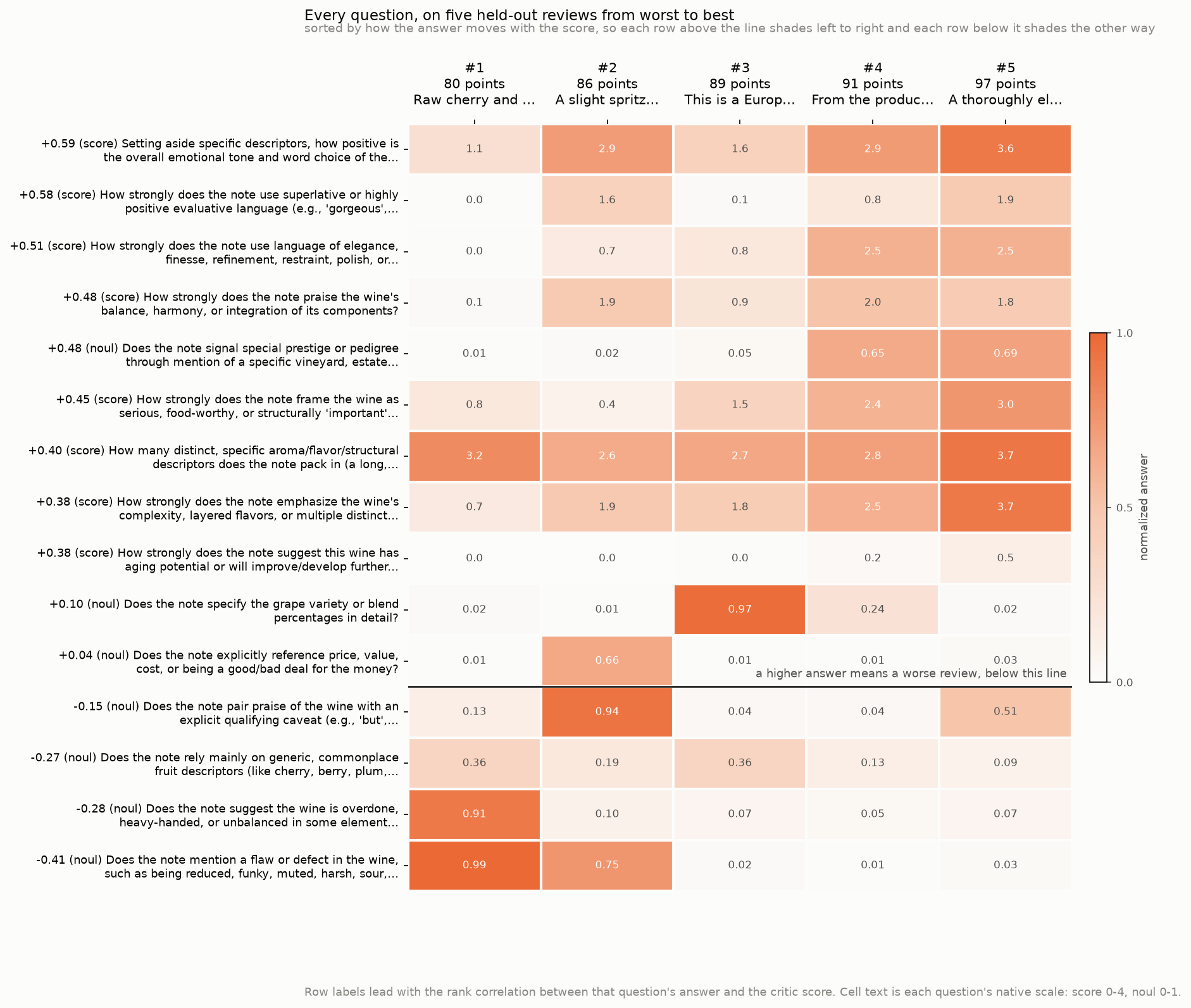
A tabela do topo da página, computada. Todos os cinco braços são pontuados uma vez nas mesmas 800 linhas reservadas, e os três primeiros pulam a descoberta de recursos. Um prevê a média das pontuações de dev e não lê nada da nota. Um passa a nota para o mesmo CatBoost por meio do seu manuseio text_features, que a converte em contagens de palavras. Um pede a TypeSafe a pontuação em si.
Aquele terceiro é um único Score por linha sobre dez faixas de qualidade, de “defeituoso ou
desagradável” até “profundo”. Dez porque dez níveis é o máximo que uma pergunta Score
aceita -
onze retorna como erro de servidor. O nível 0 corresponde a 80 pontos e o nível 9 a 100.
Espalhar as faixas pela escala dessa maneira não é suficiente por si só, porque nada na
pergunta indica onde as pontuações desta publicação realmente se situam nela. Portanto, cada resposta é
então deslocada por um único offset, medido nas pontuações do dev. Esse offset é impresso no
rótulo da linha, e é a única coisa que esse atalho aprende a partir das pontuações.
Spearman é correlação de postos, onde 1,0 colocaria os vinhos reservados exatamente na ordem do crítico. A linha de contagem de palavras é o próprio tratamento de texto do CatBoost, não um pipeline de regressão de texto ajustado. Tudo isso é um único conjunto de dados e uma única execução do loop.
predicted = fit_predict(X, split)
text_predicted = fit_predict_text(split)

# ask TypeSafe for the score itself, one request per row
with ThreadPoolExecutor(max_workers=8) as pool:
    direct = list(pool.map(lambda note: ask_score(TYPESAFE_MODEL, note), NOTES))
asked = np.array([d["expected"] for d in direct])
shift = float(SCORES[DEV].mean() - asked[DEV].mean())  # one number, from the dev labels

# what one proposal call gets you, before any feedback: the set round 1 ended with
first_round, _ = design(snapshots[0], answers_for, ENCODING)

print(f"{'arm':<46}{'RMSE':>7}{'spearman':>10}")
for label, p in (
    ("predict the mean of the dev rows", np.full(len(TEST), SCORES[DEV].mean())),
    ("the note as word counts, same CatBoost", text_predicted),
    (f"ask for the score itself, shifted {shift:+.2f}", asked[TEST] + shift),
    (
        f"{len(snapshots[0])} questions from round 1, no loop",
        fit_predict(first_round, split),
    ),
    (f"{len(accepted)} questions after all {ROUNDS} rounds", predicted),
):
    print(f"{label:<46}{rmse(SCORES[TEST], p):>7.3f}{spearman(SCORES[TEST], p):>10.3f}")
arm RMSE spearman
predict the mean of the dev rows 3.088 -0.014
the note as word counts, same CatBoost 2.466 0.605
ask for the score itself, shifted -1.71 2.145 0.761
18 questions from round 1, no loop 1.869 0.778
38 questions after all 5 rounds 1.772 0.799As rodadas de autoresearch ajudaram?
Ambas as linhas traçam o erro do conjunto de perguntas no final de cada rodada, começando pela primeira proposta. A linha tracejada é o erro de validação cruzada no dev, o número sobre o qual cada decisão de aceitar ou rejeitar é tomada. A linha sólida pontua o mesmo conjunto de perguntas nas linhas reservadas, que o loop nunca lê. Cada ponto representa o conjunto conforme estava quando a rodada foi encerrada, então uma rodada que apenas revisou ou removeu uma pergunta ainda move ambas as linhas. O mapa de recursos diz o que as perguntas medem; o erro é o que indica se as rodadas após a primeira proposta melhoraram as previsões.
O eixo é apertado: tudo nele ocorre dentro de um quinto de ponto, e cada atalho da tabela acima fica bem fora do topo dele. A linha de dev fica acima da linha mantida em espera durante todo o percurso, e isso é um efeito do tamanho do treinamento. Cada dobra de dev treina com quatro quintos das linhas de dev, enquanto o número mantido em espera vem de um modelo que recebeu todos os 1.200. As duas linhas se movem juntas, de modo que o número de dev pelo qual o loop orienta acompanha o número mantido em espera que ele nunca vê. O intervalo sob o título vem de remostragem das linhas mantidas em espera, então ele indica se a mudança da rodada 1 para a rodada 5 é maior que o ruído em 800 linhas.
curve, per_round = [], []
for features in snapshots:
    X_round, _ = design(features, answers_for, ENCODING)
    per_round.append(fit_predict(X_round, split))
    curve.append((len(features), rmse(SCORES[TEST], per_round[-1])))

# the same held-out rows resampled 2,000 times, both arms scored on each resample
gain = paired_gain(SCORES[TEST], per_round[0], per_round[-1])
print(
    f"round 1 -> round {ROUNDS} on the held-out rows: {gain[0]:+.3f} points, "
    f"95% CI [{gain[1]:+.3f}, {gain[2]:+.3f}]"
)

fig = rounds_chart(plt, curve, history, len(TEST), gain)
display(fig)
plt.close(fig)
round 1 -> round 5 on the held-out rows: -0.097 points, 95% CI [-0.147, -0.050]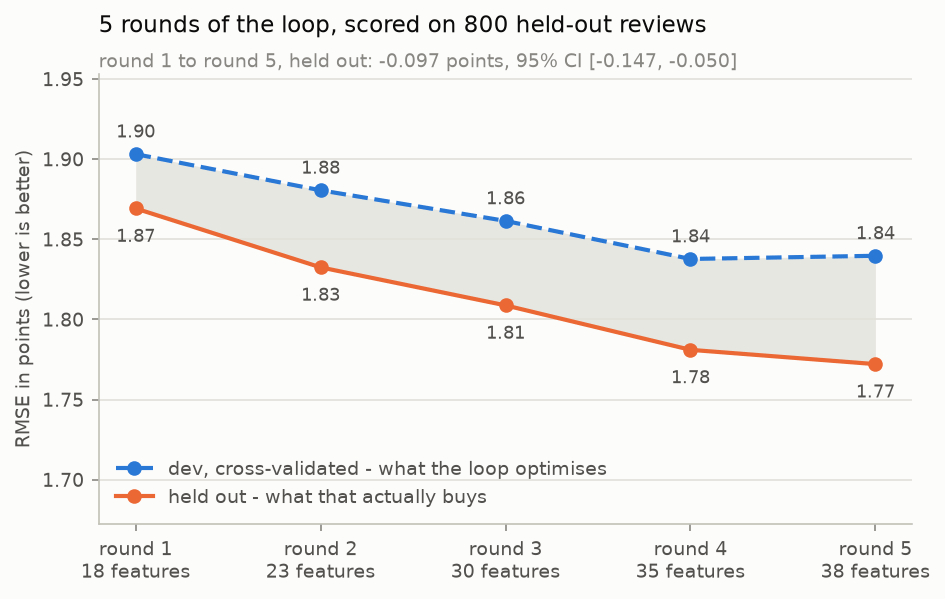
A linha reservada cai mais do que a linha de desenvolvimento. A Rodada 1 escreveu suas perguntas sem feedback para trabalhar, e as quatro rodadas seguintes valem 0,10 pontos nas linhas reservadas, IC 95% [-0,147, -0,050].
A rodada 5 propôs quatro adições, duas reescritas e oito remoções, e apresentou o primeiro número de desenvolvimento que não melhorou. Há apenas tanto a se perguntar sobre uma nota de 245 caracteres, e, na rodada 5, as propostas passaram de adicionar perguntas para removê-las.
kinds = {f["name"]: f["kind"] for f in accepted}
print("feature importance share: % of total CatBoost importance across all questions")
print(f"{'feature':<38}{'asked as':<10}{'importance share':>16}")
for name, importance_share in sorted(feature_importances.items(), key=lambda p: -p[1])[
    :12
]:
    kind = "score" if kinds[name] == "intensity" else "noul"
    print(
        f"{name[:36]:<38}{kind:<10}{importance_share:>8.1f}%  "
        f"{'#' * round(importance_share)}"
    )
counts = f"{sum(1 for k in kinds.values() if k == 'intensity')} score"
counts += f", {sum(1 for k in kinds.values() if k == 'presence')} noul"
print(f"\nthe {len(accepted)} questions the loop kept: {counts}")
top = max(feature_importances, key=feature_importances.get)
print(
    f'the question behind the top row:\n  {top}: "{owner_of(top, accepted)["question"]}"'
)
feature importance share: % of total CatBoost importance across all questions
feature asked as importance share
note_overall_tone_positivity score 17.4% #################
savory_food_wine_seriousness score 8.7% #########
positive_superlative_language score 8.4% ########
single_vineyard_or_prestige_signal noul 7.2% #######
descriptive_detail_density score 5.7% ######
elegance_finesse_language score 5.0% #####
complexity score 5.0% #####
aging_potential score 5.0% #####
balance_harmony score 2.9% ###
drinkability_easiness score 2.9% ###
critic_enthusiasm_confidence score 2.7% ###
flavor_distinctiveness score 2.6% ###
the 38 questions the loop kept: 29 score, 9 noul
the question behind the top row:
note_overall_tone_positivity: "Setting aside specific descriptors, how positive is the overall emotional tone and word choice of the note taken as a whole (warm, admiring language throughout vs. flat, neutral, or lukewarm phrasing)?"importance share é a importância de recursos do CatBoost, normalizada de modo que as 38 perguntas somem 100%. Não se trata de uma parcela de linhas, de perguntas ou de precisão de previsão. Uma pergunta de pontuação possui duas colunas, uma média e uma dispersão, portanto as importâncias de suas duas colunas são somadas antes da impressão da porcentagem. note_overall_tone_positivity responde por 17,4% do total. A quarta linha é um noul: se a nota nomeia um único vinhedo ou algum outro sinal de prestígio é um fato sim/não, portanto foi feita como uma única pergunta.
Próximos passos
Esta execução mantém o loop pequeno. Extensões diretas:
- Rastreie um candidato antes de pagar para responder. Trate a própria proposta de pergunta como o estado e pergunte aos nouls sobre ela: pode ser respondida a partir do texto-fonte, significa uma única coisa sob seus critérios, aplica-se à maioria das linhas, variará entre as linhas. Envie apenas as perguntas que passarem por todas as quatro com confiança suficiente.
- Poda recursos correlacionados. Meça a correlação entre colunas codificadas nas linhas de dev, agrupe os quase-duplicatas e mantenha a pergunta mais clara ou mais importante de cada cluster.
- Adicione baselines simples. Compare TF-IDF, contagens de caracteres e outros recursos estruturais por conta própria, depois anexe-os às colunas descobertas para medir o que cada um contribui.
- Misture famílias de proponentes. Gere lotes de candidatos com Anthropic, OpenAI, Google Gemini, e modelos de código aberto, depois mescle e remova duplicatas antes que qualquer um deles alcance TypeSafe. Diferentes famílias devem ampliar a busca mais do que chamadas repetidas a um proponente.
- Compare modelos e métodos preditivos. Tente regressão linear ou elastic-net, um regressor de vetores de suporte, florestas aleatórias e recalibração onde a saída downstream é probabilística. Verifique se os recursos descobertos ajudam fora do CatBoost.
- Adicione uma baseline de embedding. Um embedding transforma uma nota em algumas centenas de números sem
nenhuma pergunta anexada:
sentence-transformers/all-MiniLM-L6-v2roda localmente, OpenAI’stext-embedding-3-smallé uma chamada hospedada. Anexe um às colunas descobertas e meça se ele carrega algo que elas não carregam. - Combine validação com implantação. Use divisões cronológicas ao prever o futuro, divisões agrupadas quando linhas relacionadas devem permanecer juntas, e mantenha um conjunto de teste final intocado tanto pela descoberta de recursos quanto pela seleção de modelos.
- Pare em um platô. Encerre o loop quando o RMSE validado cruzadamente parar de melhorar por um número fixo de rodadas, ou quando atingir um orçamento de perguntas ou solicitações.
- Execute uma busca mais longa no modo Goal de um agente. Dê a ele uma métrica explícita, orçamento e regra de parada, depois deixe-o propor, avaliar e refinar mais rodadas.
- Verifique a estabilidade. Repita a descoberta através de sementes ou fatias de dados e mantenha as perguntas que permanecem úteis, em vez daquelas cuja importância repousa em uma única divisão.
Abra no playground
Este link de compartilhamento contém uma nota de degustação e todas as perguntas que o loop acabou gerando.
playground_link = make_playground_link(
    NOTES[0], feature_questions(accepted), models=[TYPESAFE_MODEL]
)
display(
    Markdown(
        f"🔗 [Open the note + questions in the TypeSafe playground]({playground_link})"
    )
)